
In commercial kitchens and industrial food manufacturing, efficiency is the primary driver of profitability. High-volume food prep often creates bottlenecks, tying up labor hours and risking inconsistencies in product quality. For operations processing large batches of ingredients daily, relying on standard equipment or manual labor is no longer viable.
A commercial bowl cutter (often referred to as a meat chopping machine or bowl chopper) is an essential piece of industrial food processing equipment designed to solve this exact problem. By combining a rotating bowl with a high-speed multi-blade shaft, these machines deliver unmatched speed and precision.
This guide explores how commercial bowl cutters streamline high-volume food prep, detailing their versatility across different ingredient types, time-saving benefits, and the specific blade configurations that optimize kitchen workflows.
The Core Mechanics of a Commercial Bowl Cutter
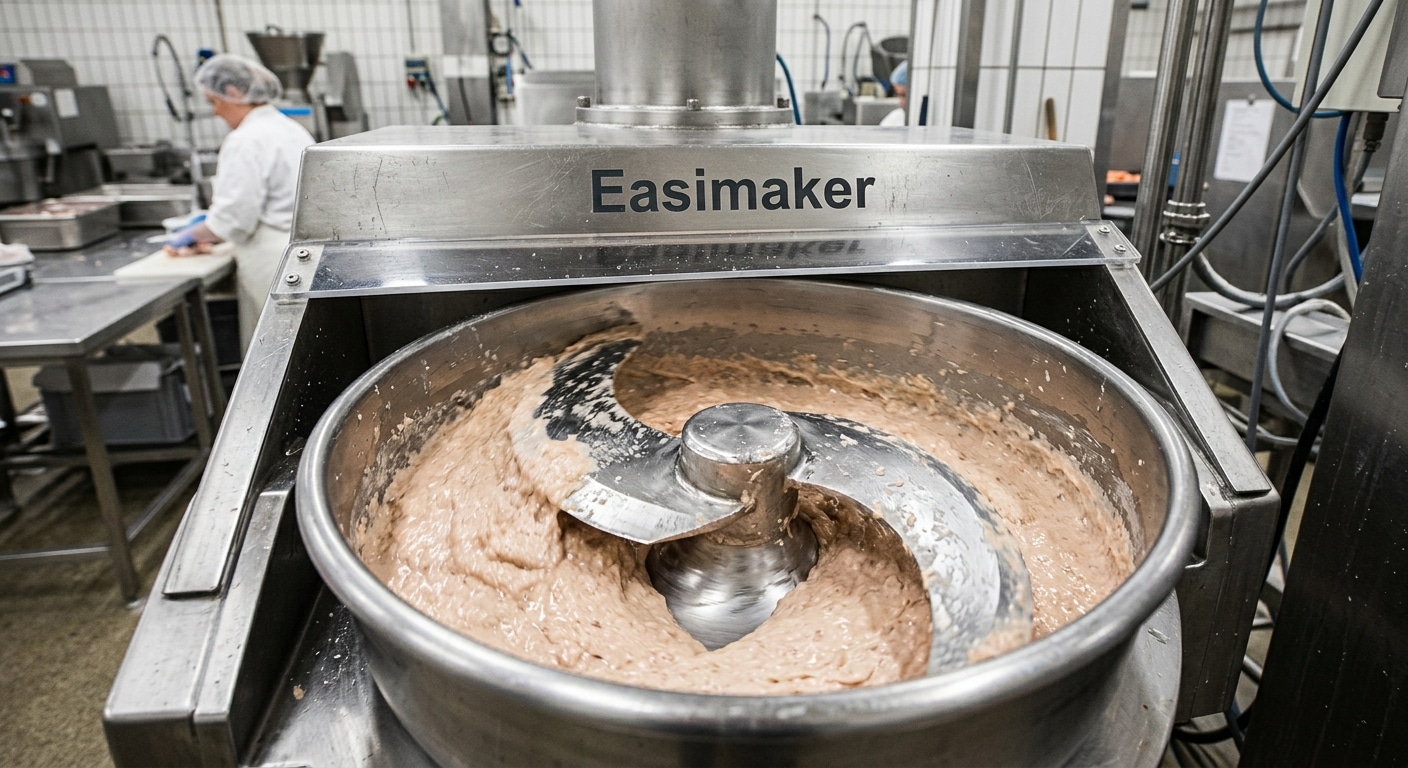
Unlike standard food processors that rely on gravity to pull ingredients toward a single blade, a commercial bowl cutter operates on a dual-motion principle. The heavy-duty stainless steel bowl rotates at a controlled speed, feeding the product continuously into a set of vertically rotating blades. This mechanism ensures that every part of the batch is processed evenly without bruising or crushing the ingredients.
This design allows operators to achieve anything from a coarse chop to a perfectly smooth emulsion in a matter of minutes, simply by adjusting the run time and shaft speed.
Versatility in High-Volume Food Prep
One of the primary reasons restaurant owners and food manufacturers invest in an industrial food processor of this caliber is its extreme versatility. A single machine can replace multiple single-purpose prep tools.
Rapid Meat Processing
As a highly efficient meat chopping machine, the bowl cutter excels at processing proteins. Whether you are preparing coarse ground beef for burgers, mincing pork for dumplings, or creating ultra-fine meat pastes for sausages and hot dogs, the machine handles it effortlessly. The swift cutting action prevents the meat’s temperature from rising too quickly, preserving fat structure and preventing premature rendering.
Bulk Vegetable Chopping
Preparing mirepoix, salsas, or bulk chopped salads manually is highly labor-intensive. A commercial bowl cutter can process dozens of pounds of onions, carrots, and celery in seconds. Because the blades slice cleanly rather than mashing the vegetables, the ingredients retain their cellular integrity, resulting in less water loss and a fresher appearance.
High-Quality Emulsions
Creating stable emulsions—such as mayonnaise, hummus, pâté, or specialized sauces—requires high shear force. The rapid rotation of the blade shaft (often exceeding 3,000 RPM in high-end models) breaks down fat globules and blends them seamlessly with liquids, resulting in a smooth, stable, and uniform texture that is difficult to achieve with standard mixers.
Time-Saving Benefits for Commercial Kitchens
Integrating a bowl cutter into your prep workflow yields immediate and measurable efficiency gains:
- Drastic Reduction in Prep Time: Tasks that take hours by hand or with smaller processors can be completed in under three minutes. For example, processing 40 liters of meat paste can be achieved in a single, short cycle.
- Labor Optimization: By automating the most time-consuming chopping and blending tasks, skilled culinary staff can be reallocated to cooking, plating, and quality control.
- Unmatched Consistency: Programmable time and speed settings ensure that every batch meets exact particle size and texture specifications, which is critical for portion control and cooking yields.
Optimizing Workflow: Blade Configurations Explained
The efficiency of a bowl cutter efficiency heavily relies on selecting the correct blade configuration. Most industrial units allow operators to swap or adjust blades based on the application.
| Blade Type | Best Used For | Key Benefit |
|---|---|---|
| Straight Blades | Coarse chopping, vegetables, salads | Clean, precise cuts with minimal bruising or moisture loss. |
| Curved / Sickle Blades | Meat pastes, emulsions, fine purees | Maximum shear force; pulls ingredients inward for a smoother blend. |
| Serrated Blades | Fibrous meats, tough root vegetables | Grips and slices through tough connective tissues efficiently. |
Furthermore, modern machines feature variable speed drives. Running the bowl slowly while the blades spin rapidly is ideal for fine emulsions, whereas a faster bowl speed with slower blades works best for coarse, uniform chopping.
Technical Specifications & Material Standards
When procuring a commercial bowl cutter, B2B buyers must evaluate several technical factors to ensure the equipment meets industrial demands:
- Construction Materials: The entire machine, especially the bowl and blades, should be constructed from 304 or 316-grade food-safe stainless steel to resist corrosion and comply with international hygiene standards.
- Motor Power & Cooling: High-volume processing generates heat. Look for heavy-duty, fan-cooled motors capable of continuous operation. Some advanced models feature double-jacketed bowls for water or gas cooling to keep meat temperatures low during processing.
- Safety Features: Essential safety mechanisms include magnetic interlocks on the noise-dampening cover, emergency stop buttons, and automatic shut-off if the lid is lifted during operation.
- Sanitation: IP65 water-resistant ratings allow for safe, low-pressure washdowns, significantly reducing end-of-shift cleaning times.
Procurement Guide: Choosing the Right Size
Selecting the correct capacity is vital for maximizing ROI. Bowl cutters are typically sized by bowl volume (in liters). As a general rule of thumb, the working capacity is roughly 60% to 70% of the total bowl volume.
- 20L to 40L Models: Ideal for mid-sized restaurants, catering companies, and artisanal butcher shops.
- 50L to 80L Models: Suited for large-scale commercial kitchens, institutional cafeterias, and mid-sized food processors.
- 100L+ Models: Designed for heavy industrial food manufacturing, wholesale sausage production, and large continuous-batch operations.
Frequently Asked Questions (FAQs)
Can a commercial bowl cutter process frozen meat?
Standard bowl cutters are designed for fresh or slightly tempered meat (around -2°C to 0°C). Processing fully frozen blocks can damage the blades and motor. For deep-frozen products, a frozen meat flaker or grinder should be used prior to bowl chopping.
How often do the blades need to be sharpened?
This depends on usage volume and the toughness of the ingredients. In a high-volume setting, blades should be inspected weekly and typically require professional sharpening or replacement every 3 to 6 months to maintain optimal cutting efficiency.
Is a bowl cutter difficult to clean?
No. Industrial models are designed with sanitation in mind. Features like removable blade shafts, tiltable bowls (on larger models), and smooth stainless-steel surfaces make them easy to wash down and sanitize.
What is the typical lead time for ordering an industrial bowl cutter?
Lead times vary based on capacity and customization requirements. Standard sizes may be available for immediate dispatch, while highly customized units (e.g., specific voltage requirements or vacuum features) may take 4 to 8 weeks for manufacturing and delivery.
Conclusion
A commercial bowl cutter is a transformative investment for any high-volume food preparation facility. By delivering rapid processing, exceptional versatility, and consistent results, these machines eliminate prep bottlenecks and significantly lower labor costs. Whether you are producing fine meat emulsions or processing bulk vegetables, selecting the right machine size and blade configuration will ensure your kitchen operates at peak efficiency.
Ready to upgrade your food processing workflow? Request a quote / Get a sample today to discuss your specific capacity requirements and find the perfect equipment solution for your operation.