How to Clean and Sanitize a Commercial Bowl Cutter

Table of Contents

To clean a commercial bowl cutter, first stop and isolate the machine, remove product residue with suitable tools, wash removable food-contact parts with detergent, rinse, sanitize at the correct concentration and contact time, air-dry, then inspect and reassemble. Never clean around bowl-cutter knives while the machine can be energised.

The correct cleaning sequence
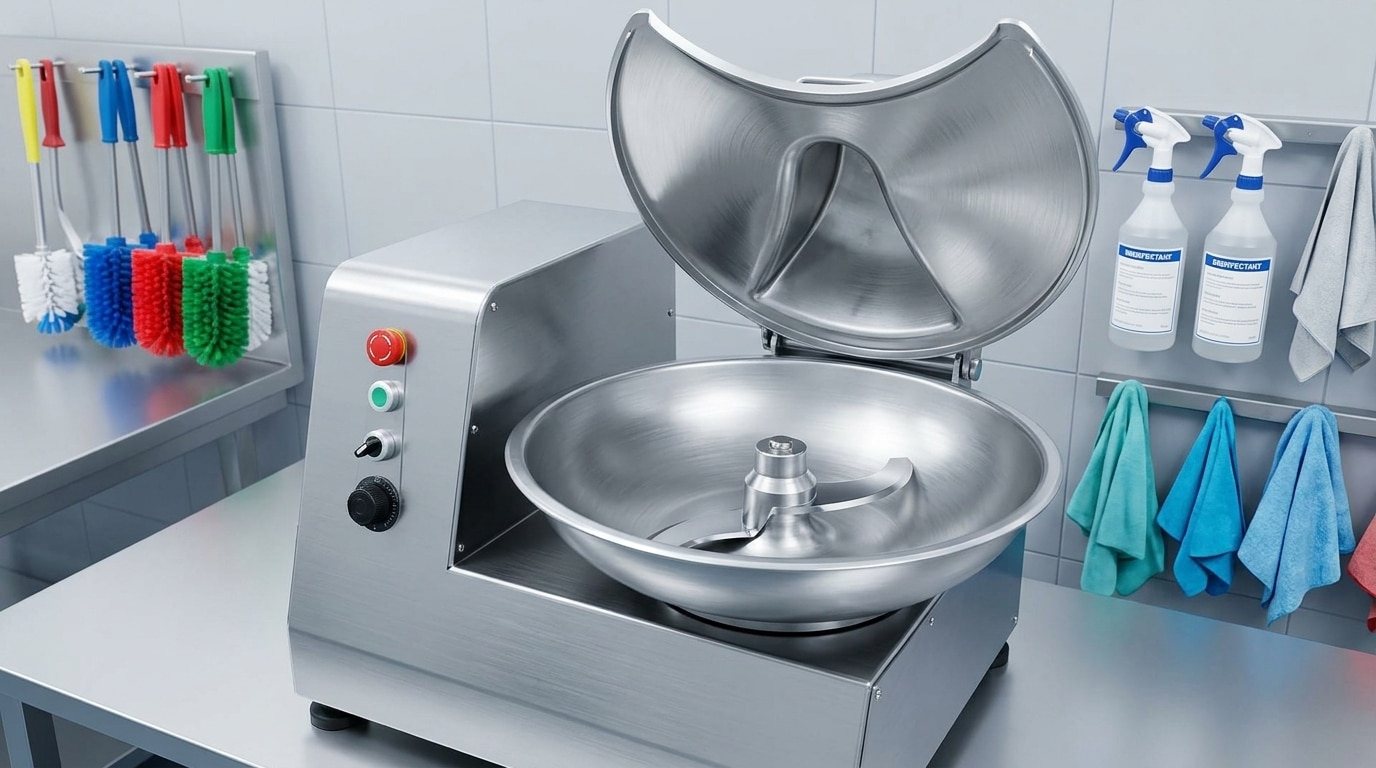
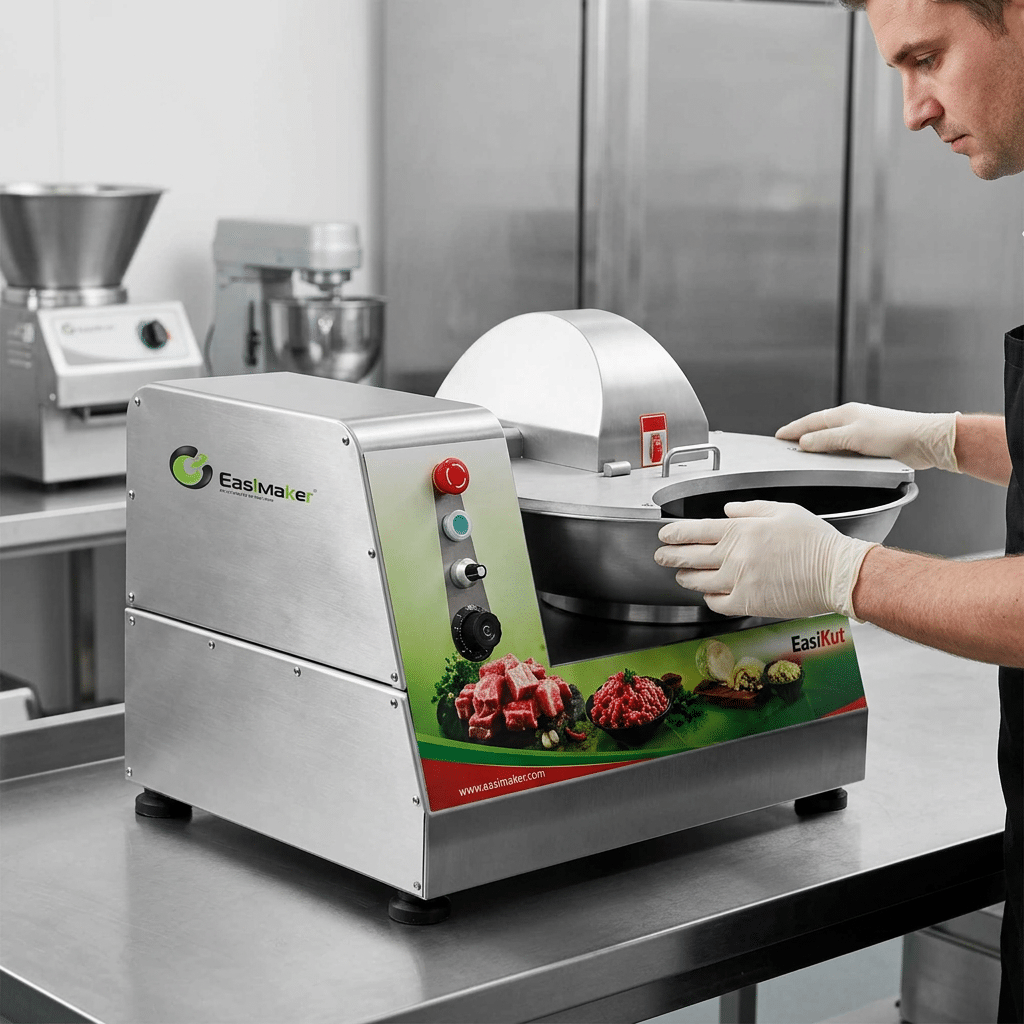
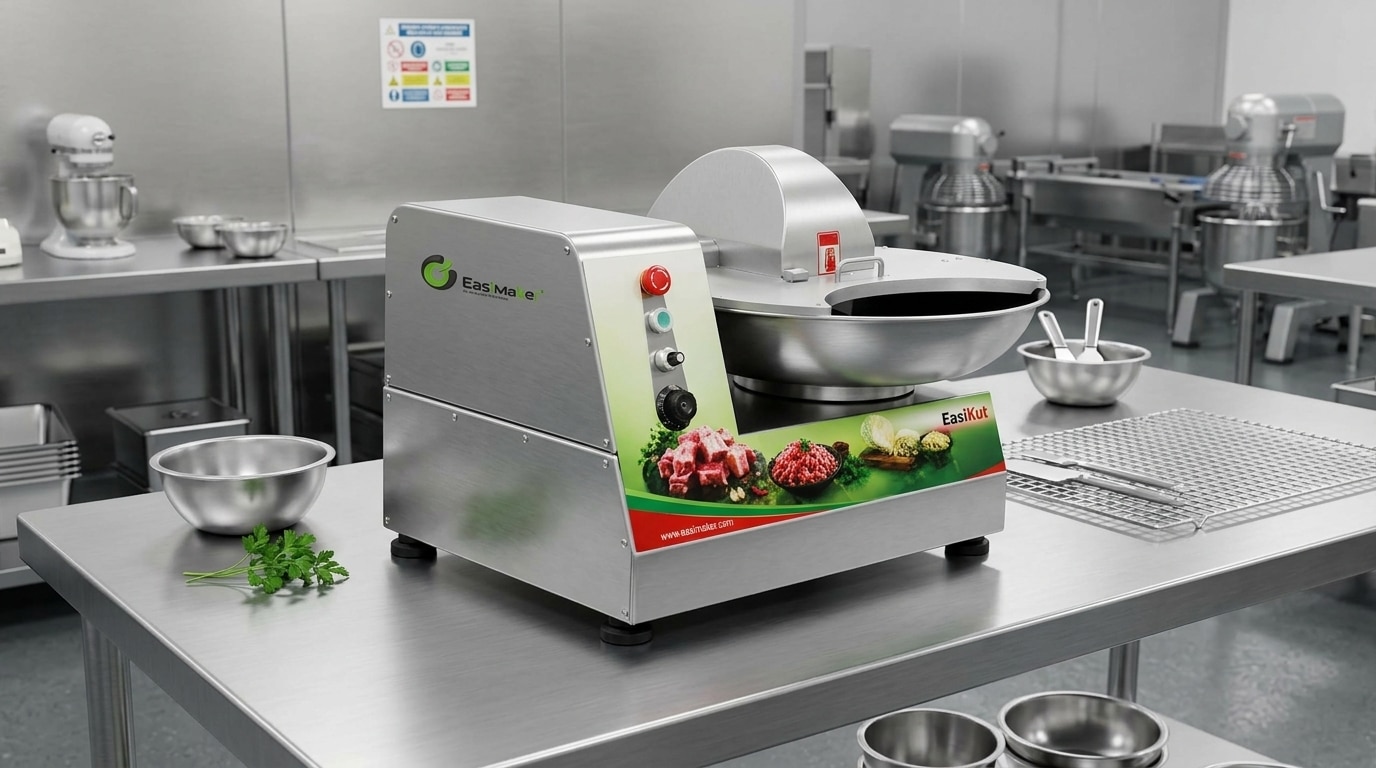
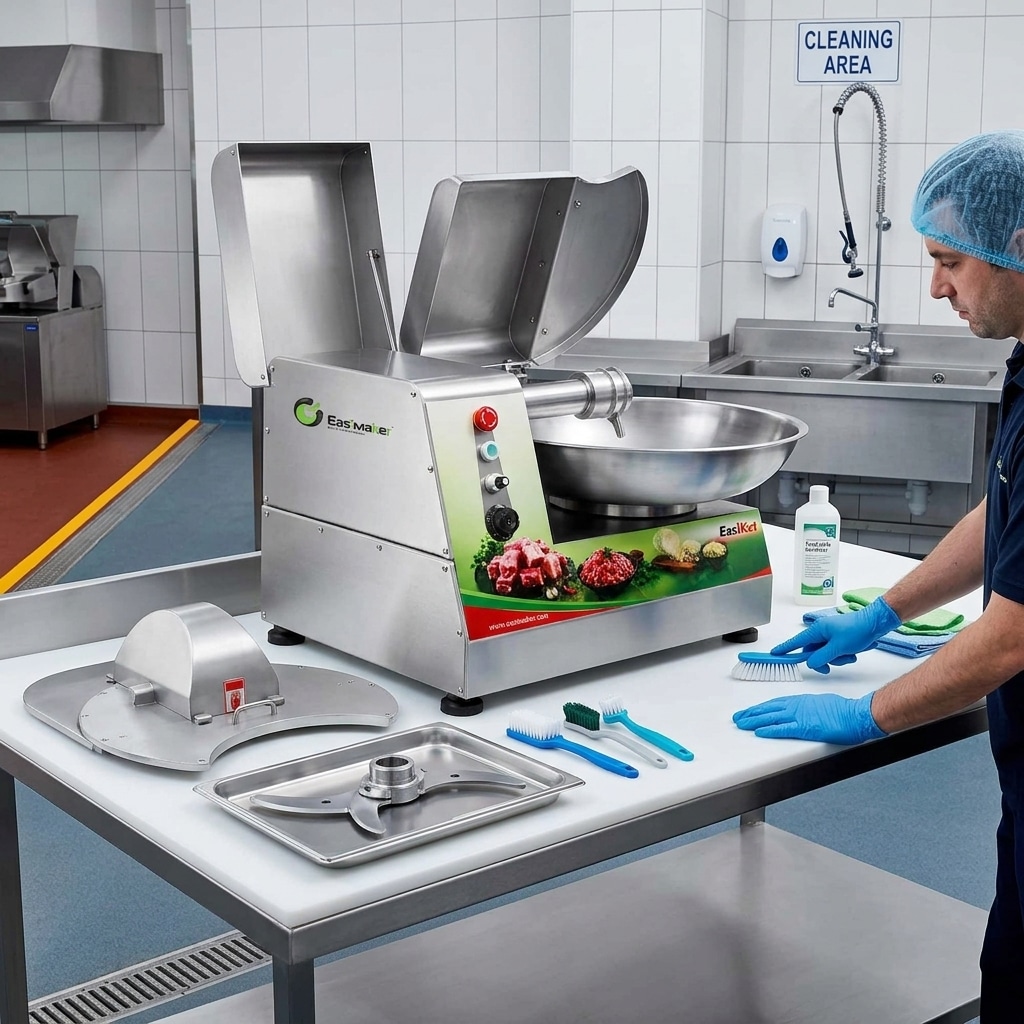
Commercial bowl cutter prepared for a safe cleaning procedure

To clean a commercial bowl cutter safely, stop the machine, disconnect and secure its power supply, remove product residue, wash accessible food-contact components with an approved detergent, rinse, sanitize, air-dry, inspect, and reassemble. The exact removable parts, chemical compatibility, and disassembly method depend on the machine model. Always follow the equipment manual and your local food-hygiene requirements where they set a stricter procedure.

A bowl cutter combines a rotating bowl, sharp knife assembly, covers, seals, and drive components. This makes cleaning more than a quick wipe-down. Product residue can remain beneath the lid, around the bowl rim, at knife hubs, and inside small crevices. At the same time, the knife area presents a serious cut hazard. A reliable procedure protects both food safety and the people cleaning the machine.

For operations evaluating how this equipment fits into a production line, see how commercial bowl cutters support high-volume food preparation. Cleaning time, safe access, and staff training should be considered alongside processing requirements when planning the workflow.

Cleaning and sanitizing are different steps

Cleaning removes visible food soil, fat, protein deposits, and other residue. Sanitizing is a separate step intended to reduce microorganisms on a surface that has already been properly cleaned. Sanitizer does not work reliably through grease, dried product, or detergent residue.

The correct order is therefore:

  1. Remove loose product and gross soil.
  2. Wash with water and a food-equipment detergent suitable for the material.
  3. Rinse away detergent and loosened soil.
  4. Apply a food-contact sanitizer at the manufacturer-specified dilution and contact time.
  5. Allow surfaces to drain and air-dry unless the sanitizer label specifically instructs otherwise.

Do not assume that a stronger chemical mix is better. Excess concentration can leave residues, damage surfaces or seals, and create an avoidable handling risk. Use the sanitizer supplier’s instructions, verify concentration with the appropriate test method when required by your hygiene programme, and never mix chemicals unless the chemical manufacturer explicitly permits it.

Prepare the bowl cutter safely before cleaning
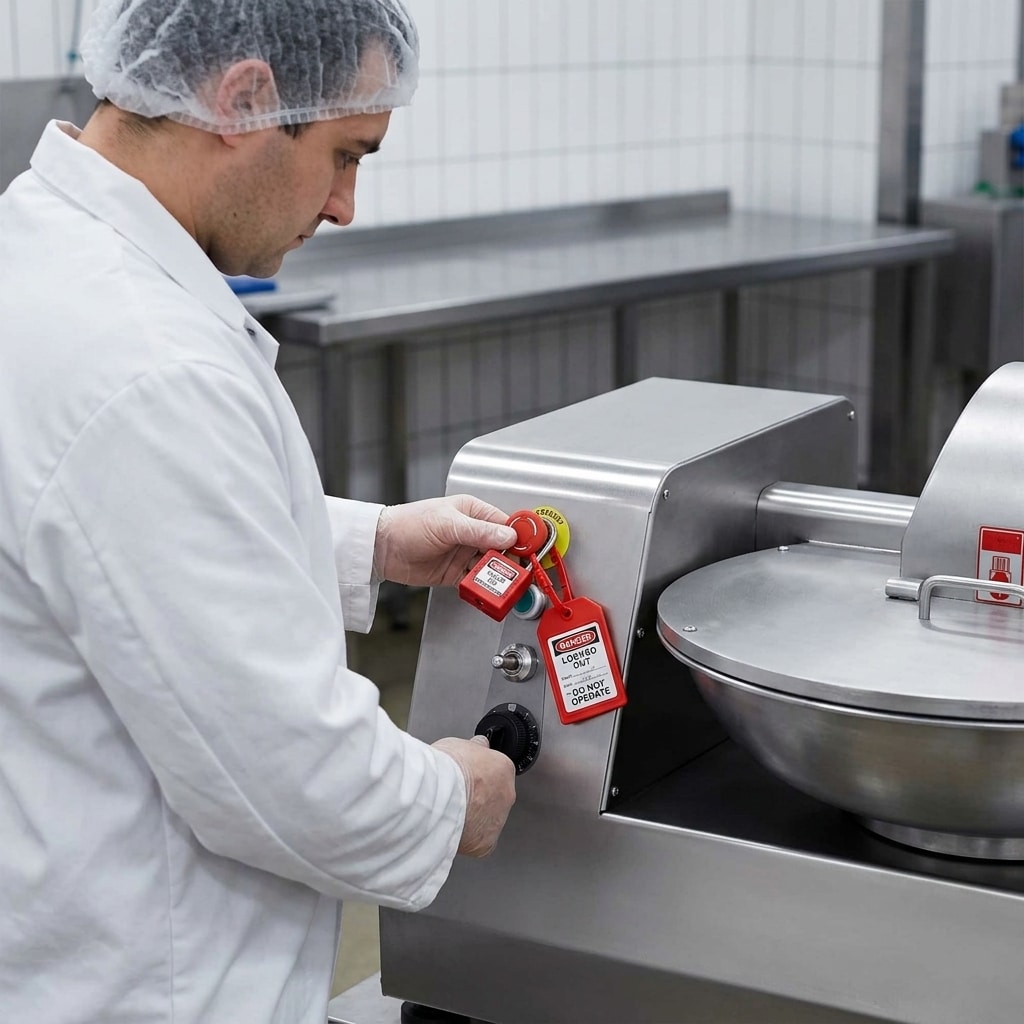
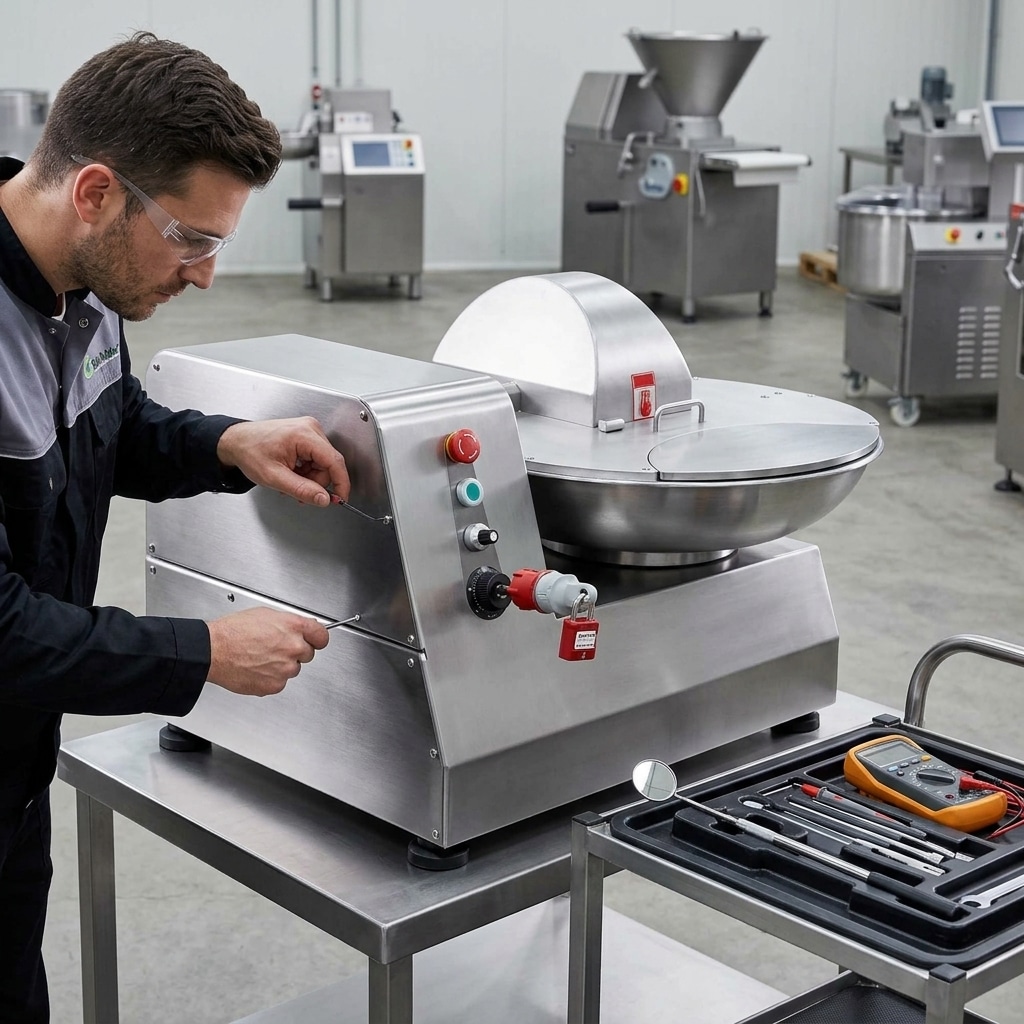
Commercial bowl cutter isolated before cleaning

Do not start cleaning immediately after processing. First make the machine safe. A bowl cutter must not be capable of starting while hands, brushes, or cloths are near the knives or bowl.

  • Finish the current batch and switch the machine off using its normal stop control.
  • Isolate the electrical supply according to your site’s lockout or isolation procedure. Where applicable, use a lock and warning tag.
  • Wait until the bowl and knife assembly have come to a complete stop.
  • Confirm that guards and covers are stable before opening them.
  • Wear suitable personal protective equipment for the task, such as cut-resistant gloves where safe work procedures require them, eye protection, and chemical-resistant gloves when handling detergents or sanitizer.
  • Prepare clearly labelled wash, rinse, and sanitizer tools. Use clean, food-safe brushes and cloths reserved for this equipment or area.

Never reach toward the knife assembly to remove material while the machine is plugged in, isolated only by a control switch, or coasting to a stop. Do not bypass guards or safety interlocks to make cleaning faster. If access is restricted or a component cannot be safely removed, consult the machine manual or an authorised service provider rather than forcing the part.

Step-by-step: how to clean a commercial bowl cutter
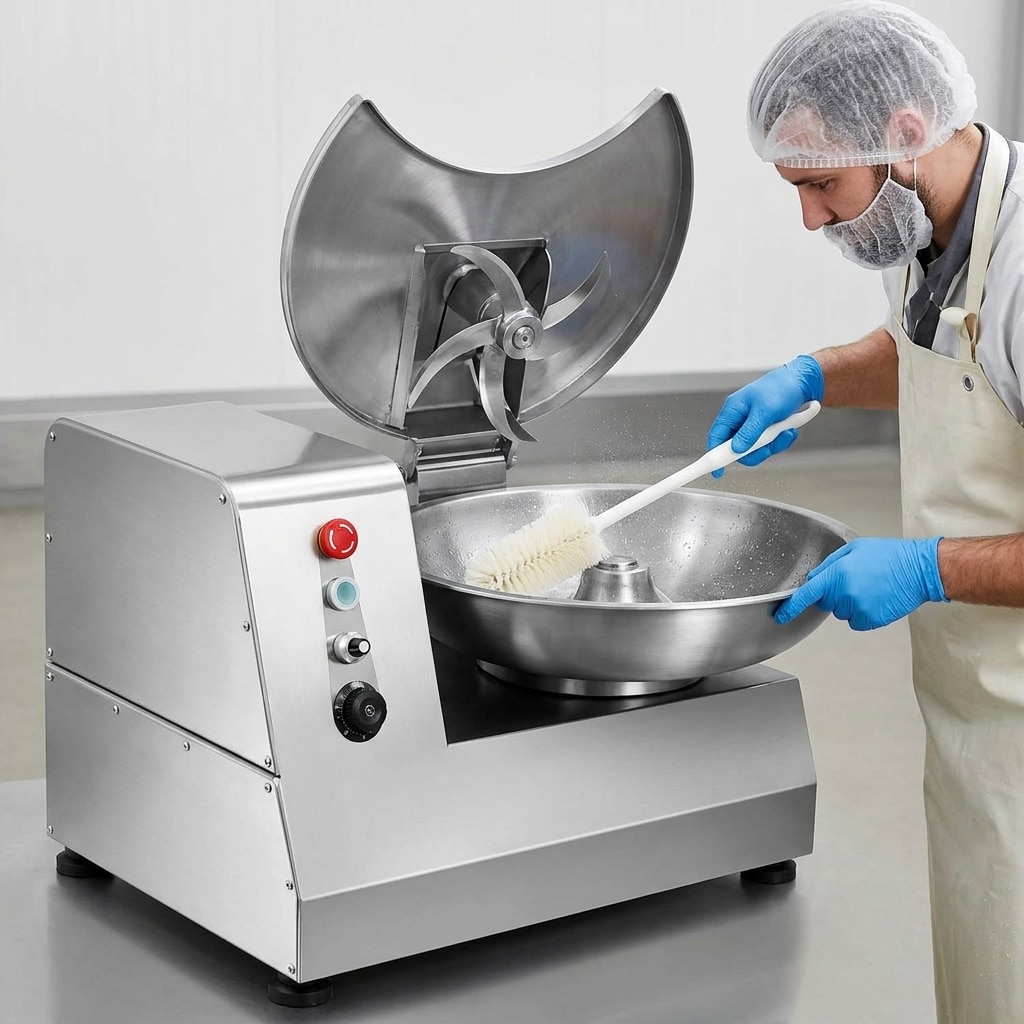
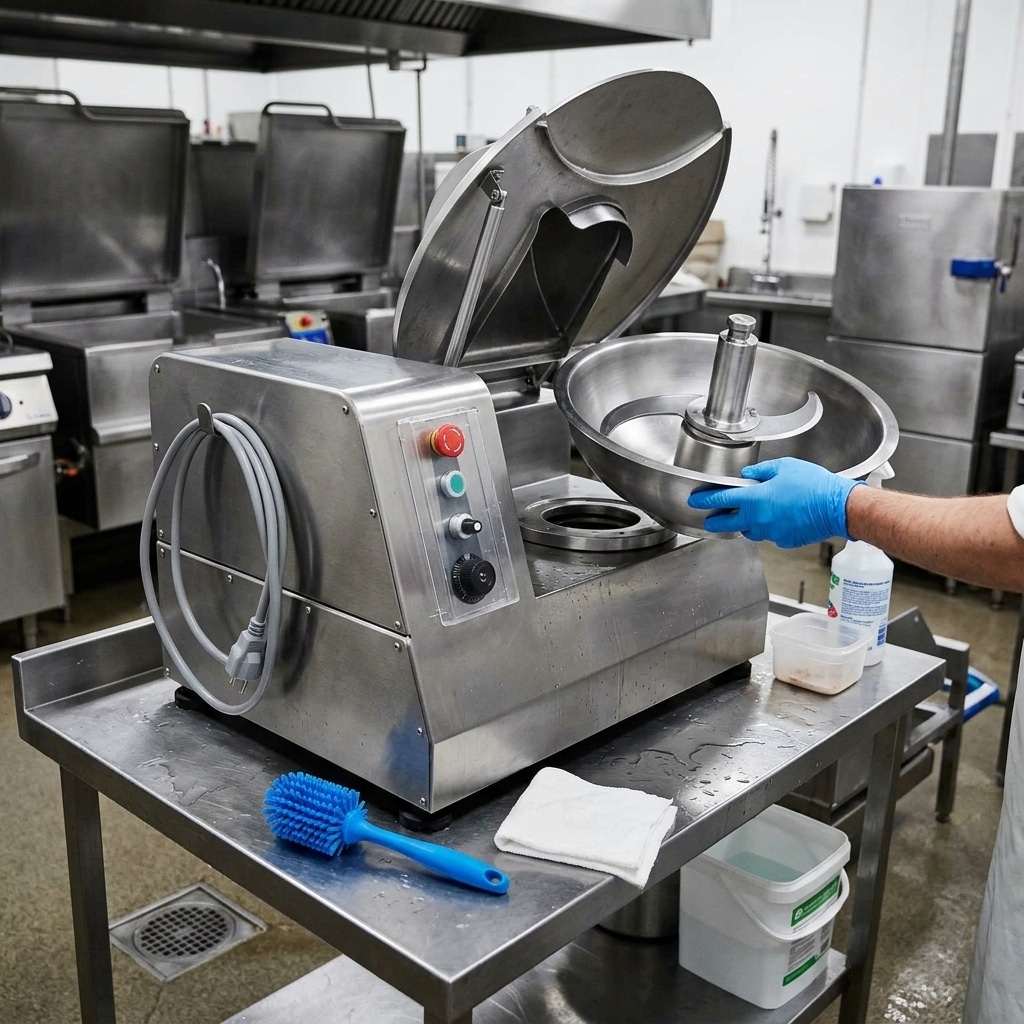
Washing the bowl interior of an isolated commercial bowl cutter with a food-safe brush

1. Remove product residue

Use a non-damaging scraper, brush, or other tool approved for the machine to remove remaining product from the bowl, lid, discharge or transfer areas, and accessible surfaces. Work away from knife edges. Do not use hands to clear compacted material around the knives. Place waste in the correct container promptly so it cannot contaminate the clean-down area.

2. Disassemble only the parts intended for routine removal

Refer to the manufacturer’s instructions for removable covers, scraper assemblies, bowl accessories, knife covers, or other food-contact components. Keep fasteners and small components in a clean, designated tray. Do not dismantle sealed bearings, electrical housings, knife hubs, or drive assemblies unless the manual identifies this as an operator task.

3. Pre-rinse carefully

Use water at a temperature appropriate for the detergent and soil being removed. Avoid high-pressure spray near bearings, electrical controls, vents, safety switches, and seals. High-pressure water can drive soil and moisture into areas that are difficult to dry and may affect electrical or mechanical components.

4. Wash with detergent

Apply a food-equipment detergent at the supplier’s specified dilution. Brush the bowl interior and exterior, underside of the cover, splash zones, scraper surfaces, handle areas, and accessible knife-related components using tools that can reach seams without damaging surfaces. Change brushes or wash solution if they become heavily soiled. Give particular attention to fat or protein deposits, which can form a film that looks clean but is not fully removed.

5. Rinse and inspect before sanitizing

Rinse all washed areas with clean water to remove detergent and dislodged residue. Then inspect under good lighting. Surfaces should be visibly free of food particles, greasy film, and chemical foam. Repeat washing where necessary. Sanitizing a surface that is still dirty is not an acceptable substitute for re-cleaning it.

How to sanitize food-contact surfaces

After washing and rinsing, apply a sanitizer that is approved and suitable for food-contact surfaces in your location. Follow the sanitizer label for dilution, water conditions, application method, required contact time, and whether a final potable-water rinse is required. These instructions vary by chemistry and local rules, so they should not be replaced with a generic time or concentration.

Apply sanitizer to all cleaned food-contact surfaces, including the bowl, lid underside, removable scraper parts, accessible knife-adjacent surfaces, and any product transfer components. Use the method approved in your sanitation programme, such as a clean low-pressure spray bottle, a dedicated cloth, immersion for suitable removable parts, or another controlled method. Avoid creating aerosol or overspray around electrical equipment.

Keep the surface wet for the stated contact time. If it dries too early, reapply sanitizer as necessary. After the required contact time, allow components to drain and air-dry on a clean rack or clean surface. Do not dry food-contact parts with a reused towel, as it may reintroduce contamination. Reassemble only when parts are dry enough to avoid trapping moisture in enclosed areas.

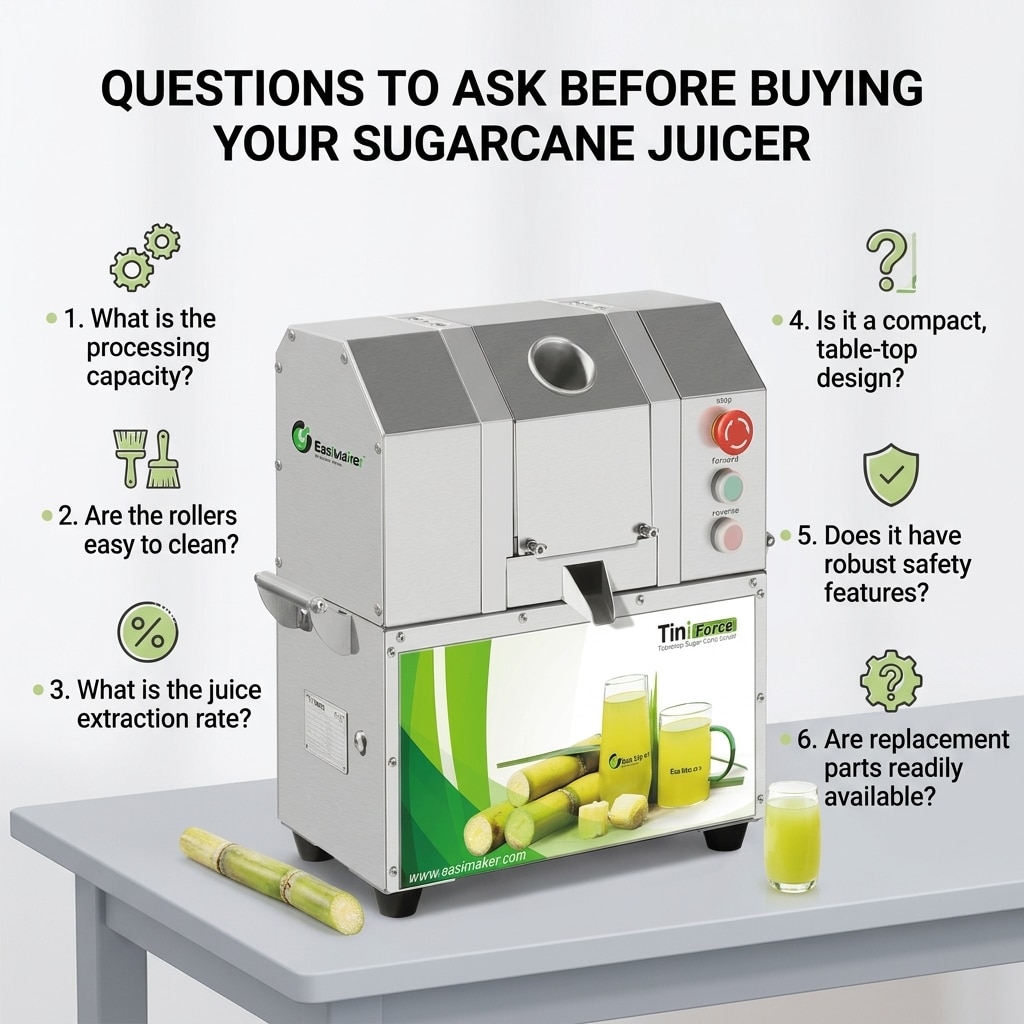
The same clean-rinse-sanitize-air-dry principle applies across many food machines. For a related example of organising an end-of-service hygiene routine, read this guide to cleaning a commercial sugarcane juicer.

Areas that need extra attention
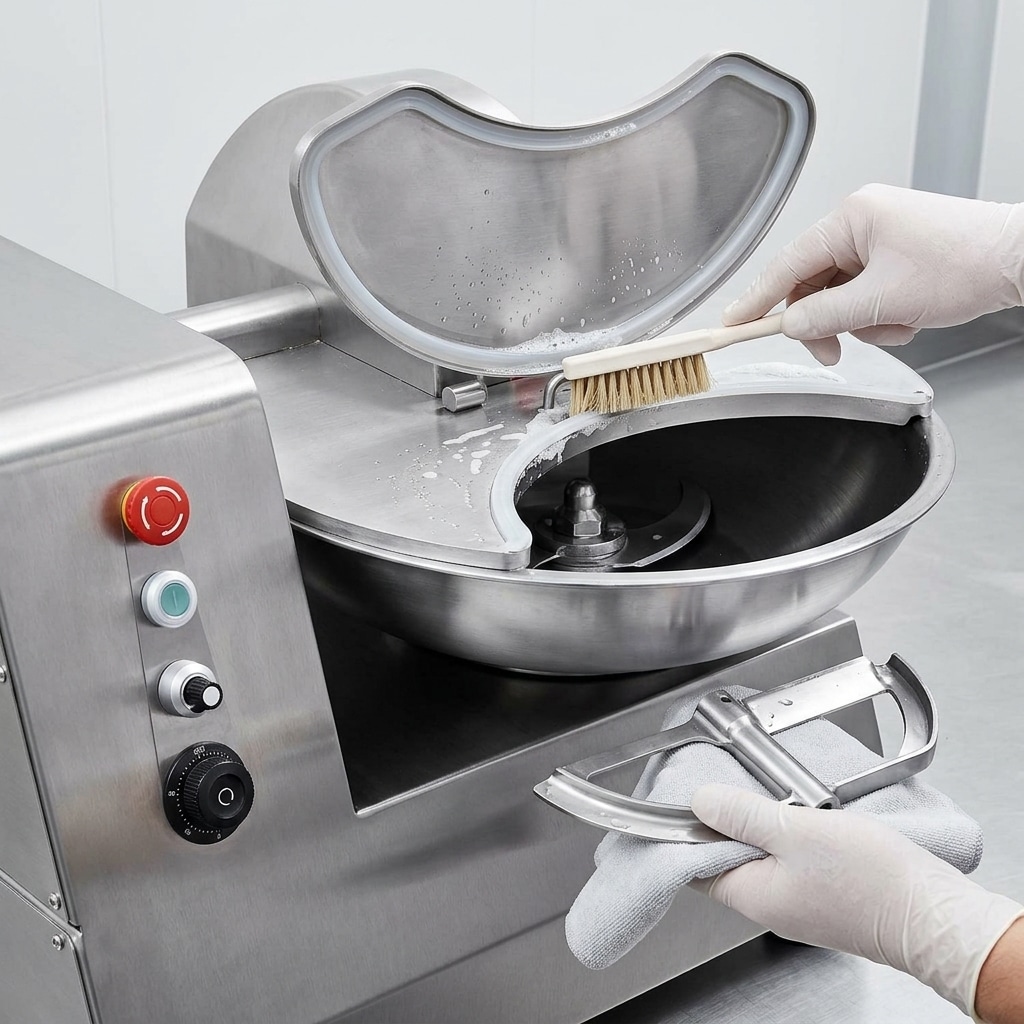
Cleaning the bowl rim, lid seal, and scraper of a commercial bowl cutter

Most cleaning failures occur in small, shaded, or awkward-to-reach areas rather than on the open bowl surface. Build these points into the cleaning checklist:

  • Bowl rim and cover seal area: Product can collect where the cover closes against the bowl. Clean both mating surfaces and inspect seals for splits, compression damage, or embedded residue.
  • Knife hub and mounting zone: Clean only as far as the operator-safe design and manual permit. Use a suitable brush rather than fingers or a loose cloth that could catch on an edge.
  • Underside of the lid and splash guard: These surfaces may receive fine particles during cutting and mixing.
  • Scraper and scraper contact edge: Remove and wash the scraper if the design allows. Check for worn, cracked, or hardened material that may prevent effective cleaning.
  • Controls, handles, and exterior touch points: These are not always food-contact surfaces, but they need routine cleaning and disinfection under the site’s environmental hygiene procedure.
  • Drainage and surrounding bench or floor: Clean the area around the machine after equipment cleaning so splash, waste, and standing water do not undermine the result.

If seals, plastic components, brushes, or knife guards show damage, replace them with compatible parts before the next production run. Damaged surfaces are harder to clean effectively and may affect safe operation.

Reassembly, inspection, and records

Once the cleaned parts have air-dried, reassemble the bowl cutter in the sequence specified by the manufacturer. Check that covers, scrapers, knife guards, fasteners, and safety devices are seated correctly. Do not restart the machine with removed components, loose fasteners, or an improperly fitted guard.

Before returning the unit to production, complete a simple pre-use check:

  • All food-contact surfaces are visually clean and dry.
  • The bowl, cover, knives, and attachments are correctly positioned.
  • Guards and interlocks have not been altered or bypassed.
  • There is no water pooled near electrical controls, cable entries, or the base of the machine.
  • There are no unusual signs of wear, corrosion, cracks, or loose parts.

A documented sanitation log helps supervisors confirm that the procedure was completed and identify recurring issues. Record the date, time, equipment identification, cleaner’s initials, chemicals used if your programme requires it, and any corrective action. A recurring residue problem may indicate that the cleaning tools, chemical selection, disassembly method, or production schedule needs review.

Safe cleaning should sit within the wider preventive-maintenance plan. The operational discipline described in commercial food machine safety and maintenance protocols is also useful when building staff checks, cleaning records, and escalation procedures for cutting equipment.

Common cleaning mistakes to avoid

  • Sanitizing before washing: This leaves soil in place and reduces sanitizer effectiveness.
  • Cleaning while the machine is still energised: The normal stop button alone is not an adequate safeguard for knife-area cleaning.
  • Using a pressure washer indiscriminately: Water can be forced into bearings, electrical components, seals, and inaccessible spaces.
  • Using abrasive pads or unapproved chemicals: These can scratch stainless steel, cloud plastics, attack seals, or shorten component life.
  • Using one cloth for dirty and clean stages: This can spread soil back onto already cleaned surfaces.
  • Skipping inspection: A quick visual check is necessary to identify remaining film, trapped food, damaged seals, and loose parts.
  • Reassembling wet parts too soon: Trapped moisture can create an avoidable hygiene issue in enclosed joints or under covers.

Train new operators on the machine-specific procedure before assigning cleaning duties. A printed checklist positioned near the wash area can reduce missed steps, particularly during busy shifts or handovers.

How often to clean a commercial bowl cutter

At a minimum, carry out a full clean and sanitation after the production period or at the end of each day of use. Additional cleaning is normally needed between product types, after allergen changeovers, after extended pauses, and whenever residue builds up. Your required frequency may be higher depending on the ingredients, product temperature, local regulations, customer standards, and documented food-safety plan.

Use three practical levels of care:

  • During production: Keep external touch points and the surrounding area orderly; remove spills safely; do not attempt to clear knives or internal areas while the machine is live.
  • Between batches or changeovers: Perform the cleaning and sanitation level required by the product and allergen-control plan.
  • End of shift: Complete the full isolate, disassemble as permitted, wash, rinse, sanitize, air-dry, inspect, and reassemble process.

A well-planned cleaning routine supports reliable daily operation because it makes residue, component wear, and seal damage easier to spot before they become a larger service issue.
What Can a Commercial Bowl Cutter Process?

Table of Contents

A commercial bowl cutter can chop, mince, mix, and emulsify many food ingredients, especially meat, fat, seasonings, vegetables, herbs, and selected prepared-food mixtures. Results depend on ingredient preparation, knife condition, batch size, processing time, and temperature control.

What a Commercial Bowl Cutter Can Process

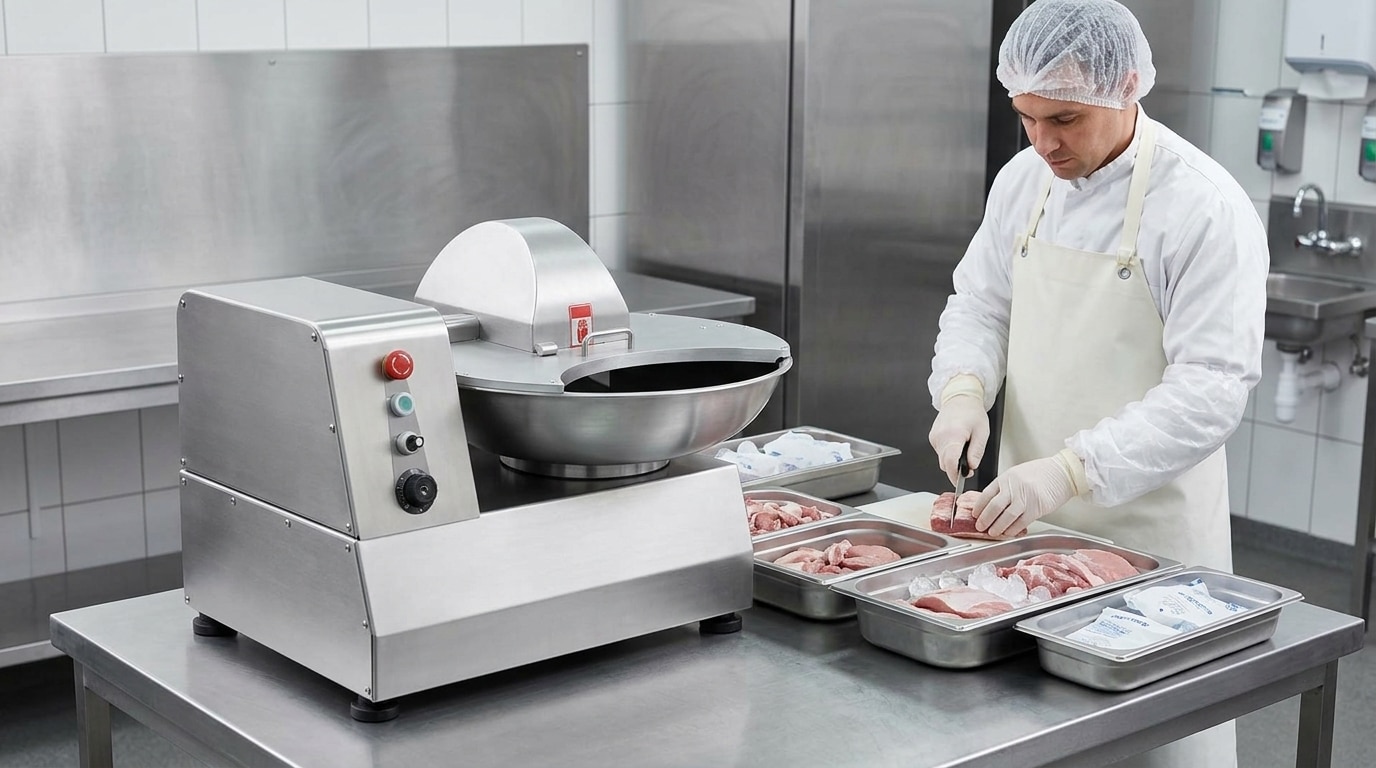
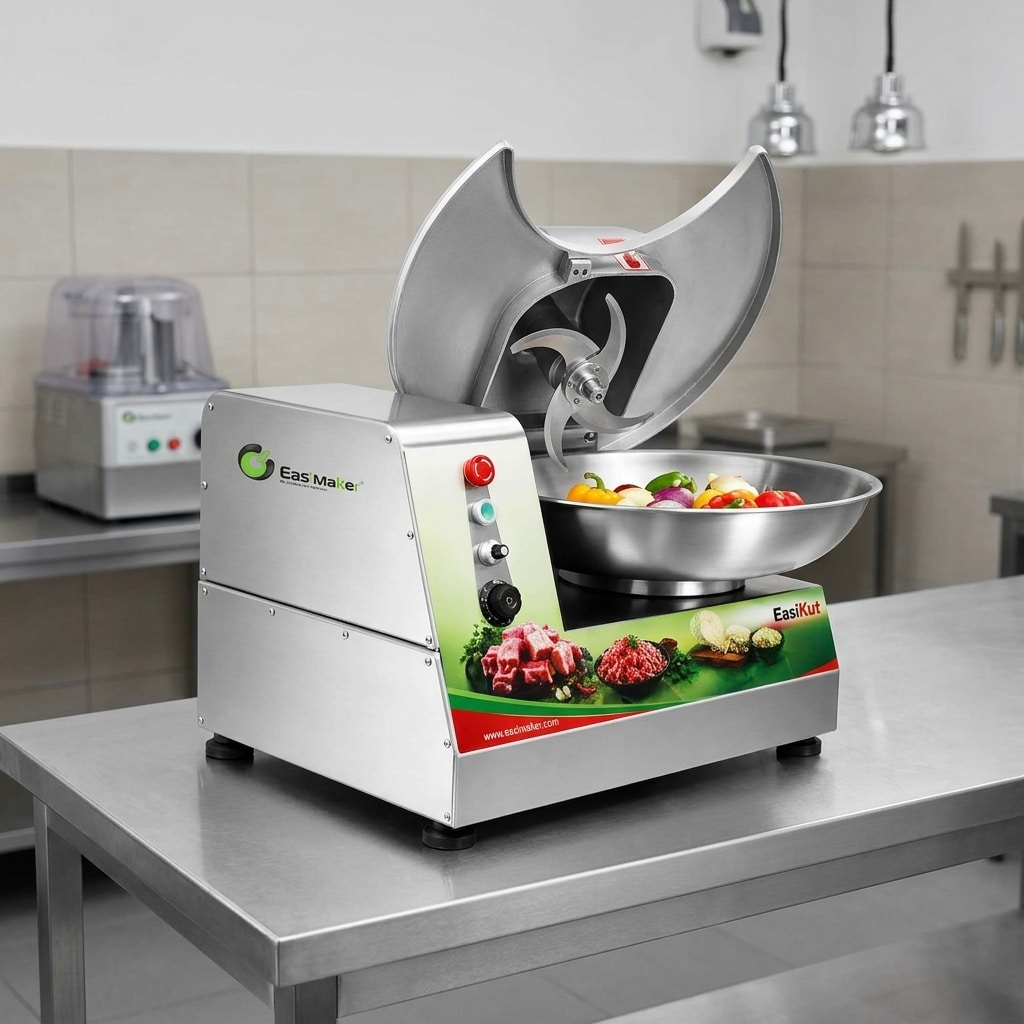
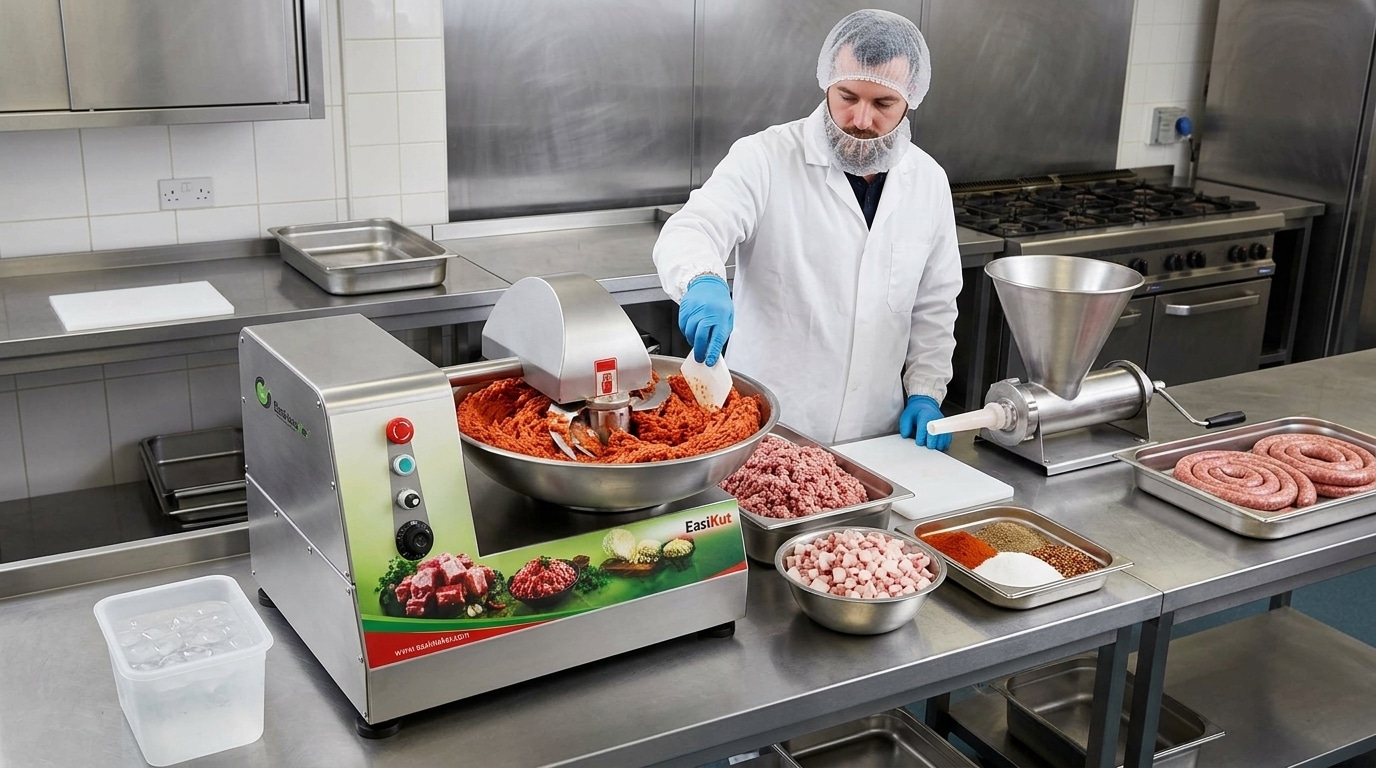
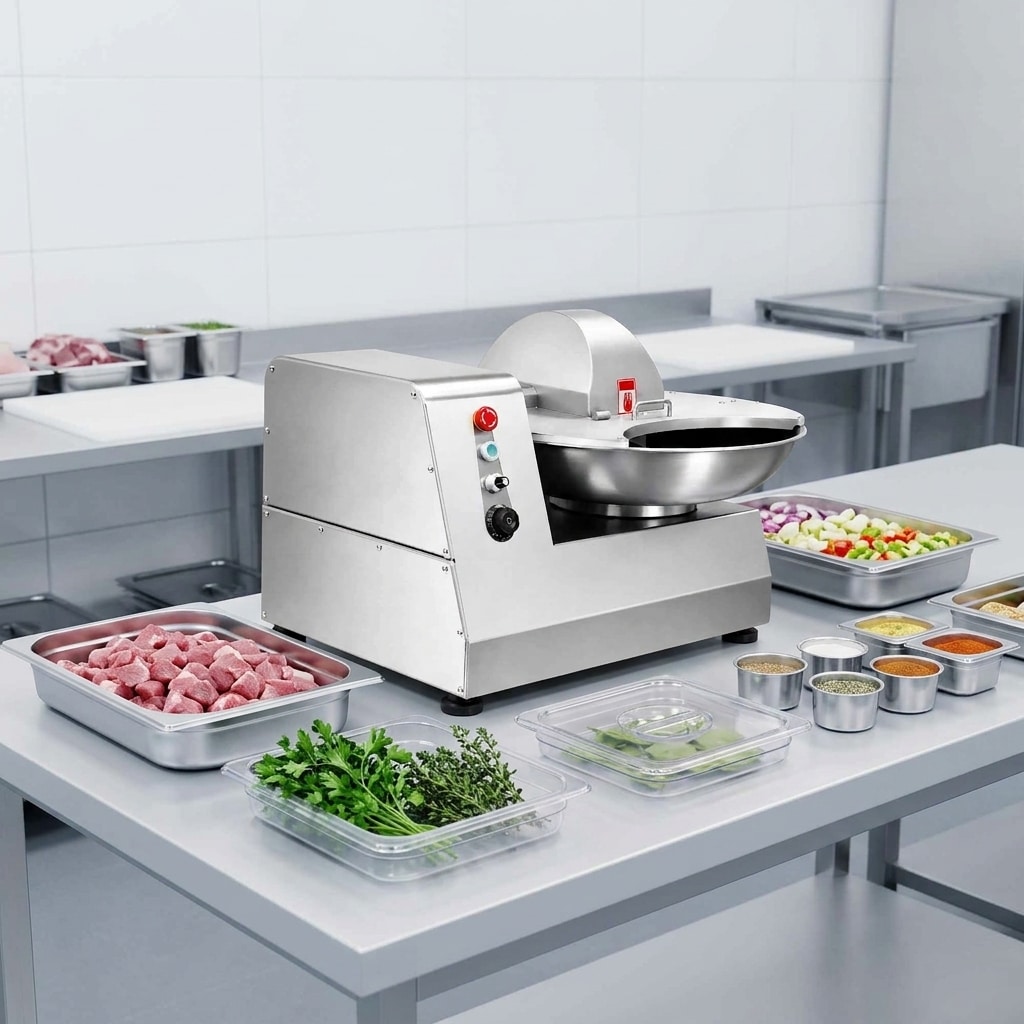
Commercial bowl cutter with suitable meat, vegetables, herbs, and seasonings ready for processing

A commercial bowl cutter can process chilled meat, poultry, fish, fat, vegetables, herbs, aromatics, seasonings, and many mixed food preparations. It is commonly used to chop, mince, blend, and, where the recipe and process allow, create a fine meat or food emulsion. Typical applications include sausage meat, burger mixes, meat fillings, pâté-style mixtures, chopped vegetables, herb blends, and selected prepared-food ingredients.

The machine is not a universal grinder or a bone-processing machine. Good results depend on using ingredients that are appropriate for knife cutting, preparing them to a manageable size, controlling the batch, and stopping at the intended texture. Hard foreign objects, bones, frozen solid blocks, and unsuitable packaging must be kept out of the bowl.

For a buyer asking what can a commercial bowl cutter process, the practical answer is: ingredients that need controlled cutting and mixing in one batch. The final product may be coarse, medium, finely chopped, or smooth, depending on the recipe, knife action, ingredient order, and processing time.

How a Commercial Bowl Cutter Works

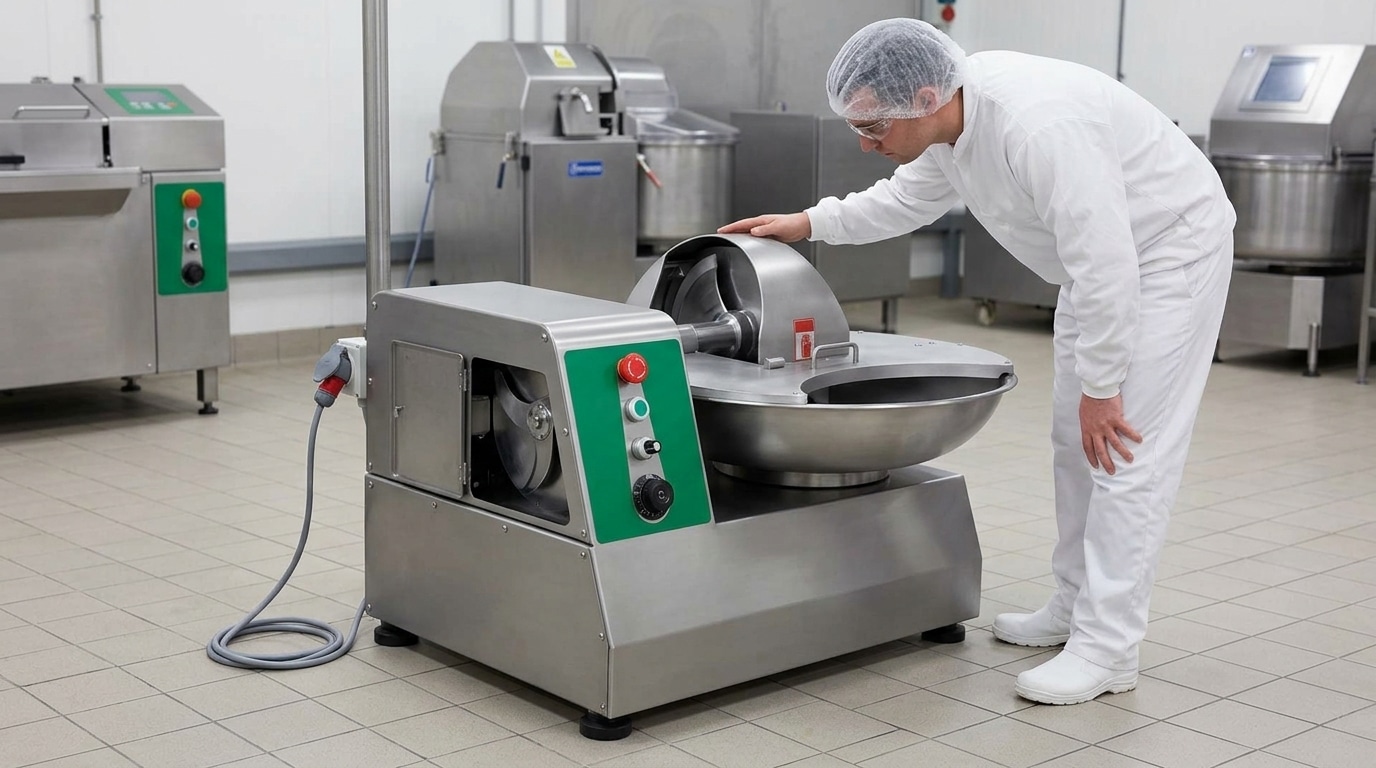
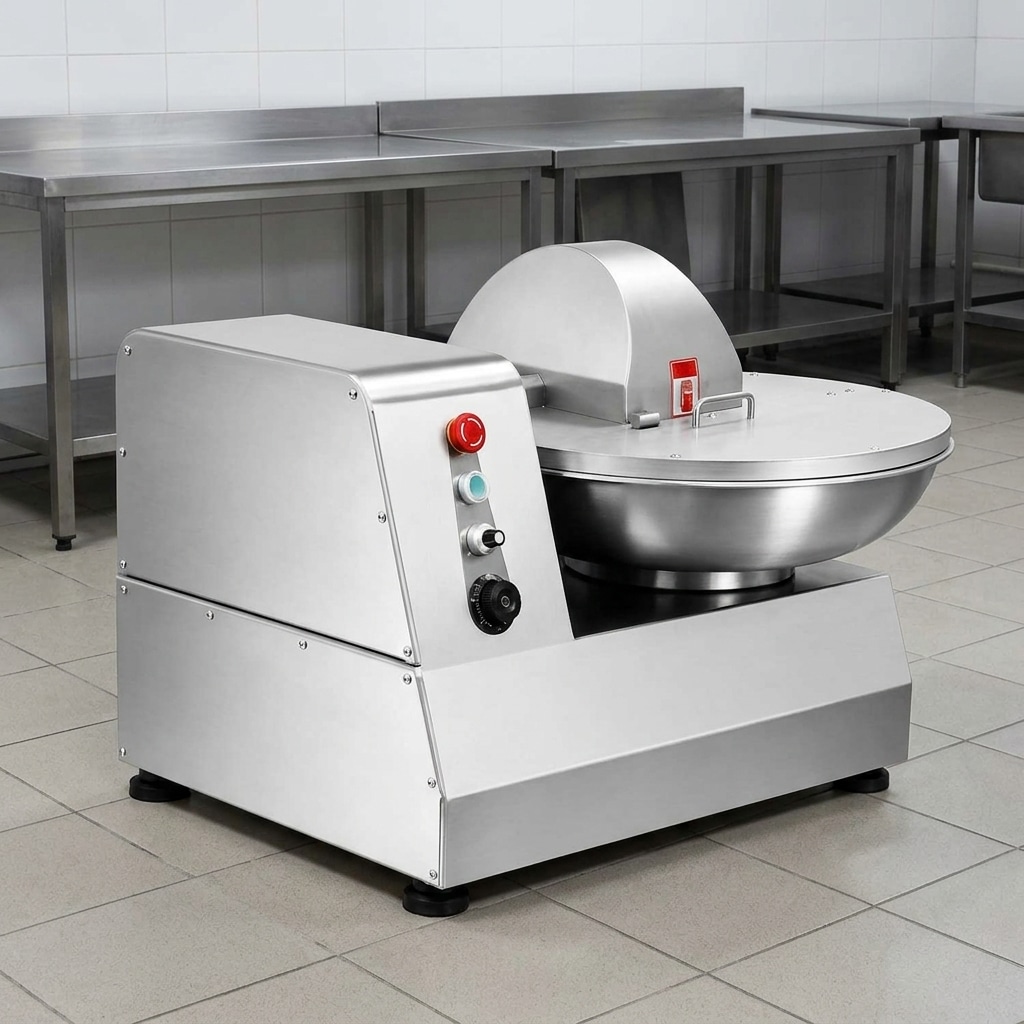
Commercial bowl cutter in a clean food production setting

A bowl cutter, also called a bowl chopper in some markets, uses rotating knives and a moving bowl to repeatedly cut ingredients. As material travels through the knife zone, it is reduced and redistributed through the batch. This action allows operators to combine cutting and mixing instead of moving ingredients between separate machines for every stage.

The result is controlled by several connected variables:

  • Raw-material condition: chilled, trimmed, and portioned ingredients generally process more predictably than warm, irregular, or oversized pieces.
  • Knife condition: sharp, correctly maintained knives cut more cleanly than dull knives.
  • Batch size: an underloaded or overloaded bowl can reduce mixing consistency.
  • Processing time: longer processing usually creates a finer texture, but it can also change the product unnecessarily.
  • Ingredient sequence: the point at which water, ice, fat, seasonings, binders, or vegetables are added affects the result.
  • Temperature: temperature monitoring is important for meat and other sensitive food products.

A bowl cutter is therefore best viewed as a process machine, not simply a chopping machine. Operators should define the intended texture before processing and use a repeatable loading and timing procedure.

Meat, Poultry, and Fish

Chilled trimmed meat prepared for commercial bowl cutter processing

Meat is one of the main commercial bowl cutter applications. Beef, pork, poultry, lamb, and many fish products can be chopped or mixed when they are prepared correctly for the machine and the required product specification. A bowl cutter can support a range of textures, from visibly chopped meat for fillings to a finer matrix for formed or emulsified products.

Before loading, remove bones, hard cartilage, packaging, clips, and other foreign material. Trim ingredients to suit the bowl cutter and avoid feeding pieces that are too large for safe, even circulation. Chilled raw materials are commonly used because processing friction can increase product temperature. The appropriate starting temperature and maximum process temperature should be set by the operator’s food-safety system and recipe requirements.

For coarse products, use short, controlled processing intervals and inspect the particle size rather than relying only on a timer. For finer products, add ingredients in stages and avoid processing beyond the required texture. This helps maintain repeatability between batches. For further operating guidance, see how to make consistent meat texture with a bowl cutter.

Fish and seafood require similar attention to raw-material condition, bones or shell fragments, temperature, and sanitation. Where the recipe contains delicate fish flesh, trial batches are useful to establish the knife time and ingredient sequence that give the desired texture without overworking the mixture.

Sausage Meat and Emulsified Mixtures

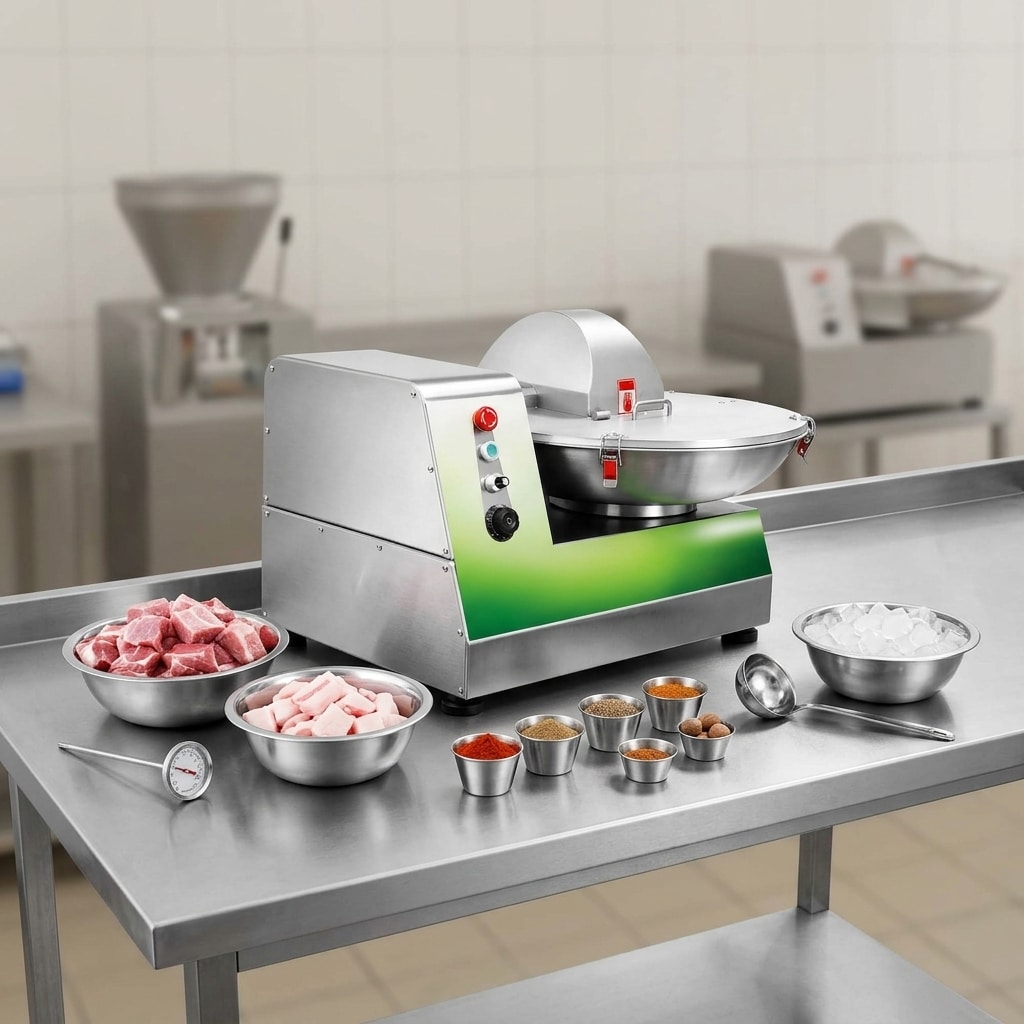
Measured ingredients for sausage meat preparation with a commercial bowl cutter

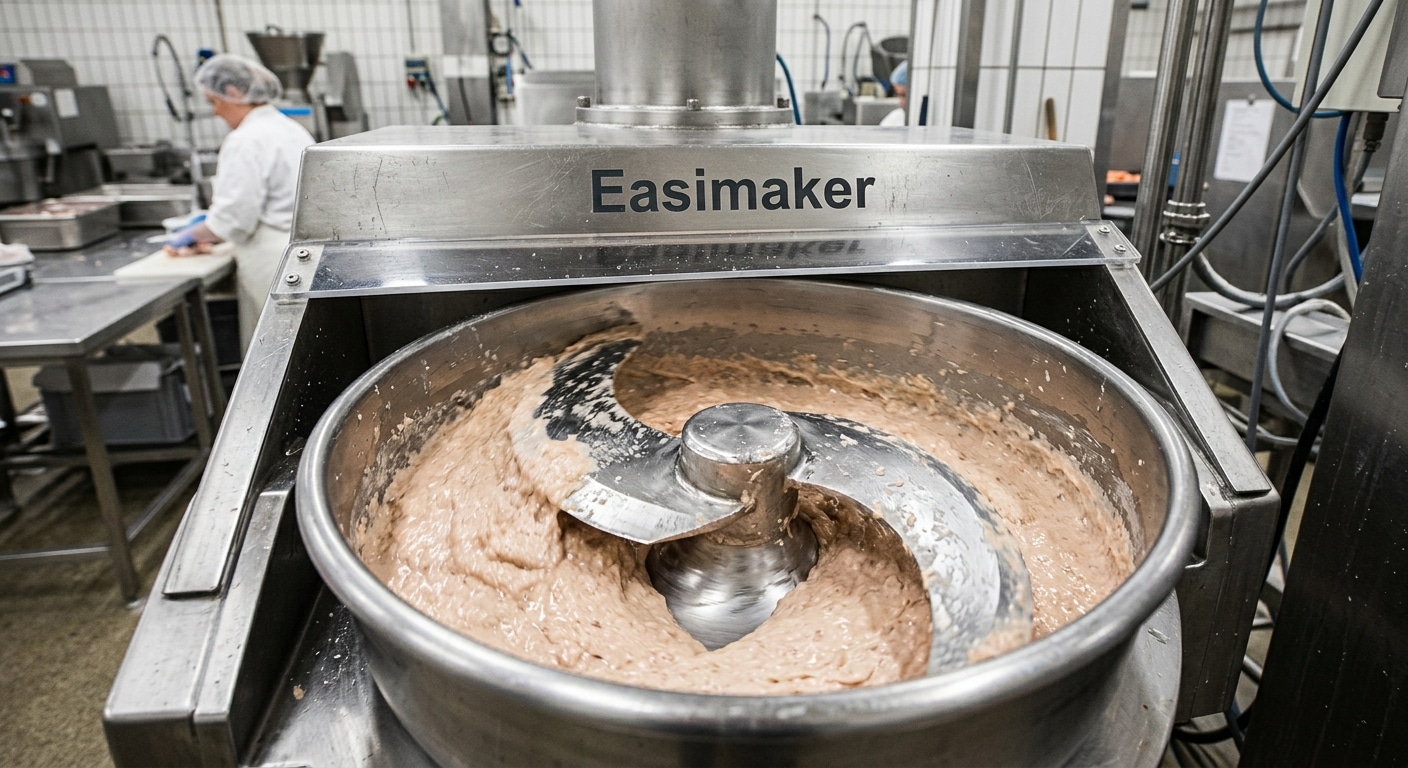
A commercial bowl cutter is widely used for sausage meat preparation because it can cut meat and fat while distributing seasonings and other recipe ingredients through the batch. Depending on the formulation, it may be used for fresh sausage mixtures, cooked sausage systems, meat fillings, and other finely processed products.

For this work, ingredient order matters. Many operations begin with chilled lean meat and salt or a recipe-specific seasoning stage, then add liquid, ice, fat, spices, and other components according to the formulation. There is no single sequence for every product, so operators should follow a validated recipe and applicable local food requirements.

Texture is not the only control point. Operators should monitor the mixture during processing for temperature, distribution of ingredients, and visual consistency. A smooth-looking mixture is not automatically the correct mixture; the target should always be the specification for that product. Documented batch procedures are especially useful when several operators use the same machine.

Read the practical guide to using a bowl cutter for sausage meat preparation for a closer look at chilled ingredients, loading sequence, texture checks, and cleaning steps.

Vegetables, Herbs, and Aromatics

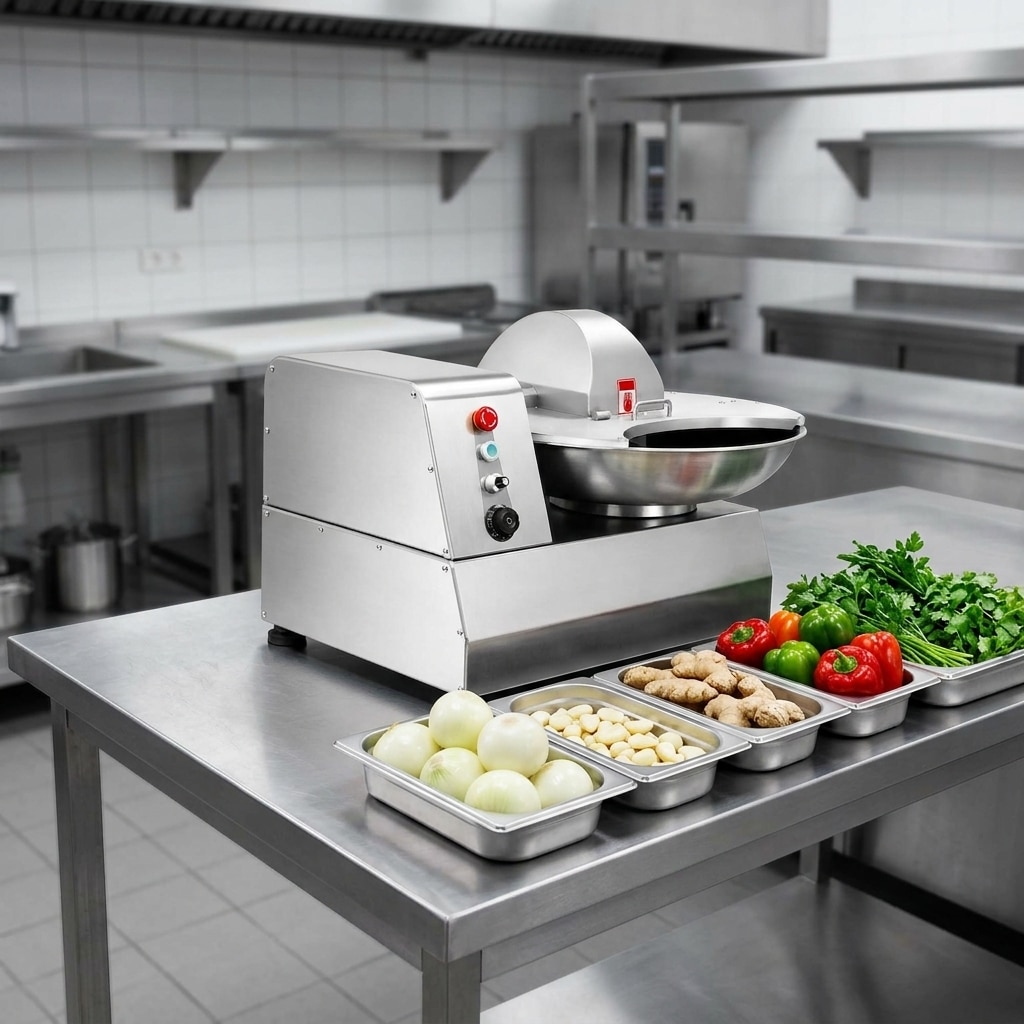
Vegetables, herbs, and aromatics prepared for bowl cutter processing

Commercial bowl cutters can also process many vegetables, herbs, and aromatics. Common examples include onions, garlic, ginger, leafy herbs, peppers, mushrooms, and cooked or soft vegetables used in fillings, sauces, prepared foods, and seasoning bases. The machine can create anything from a rough chop to a fine paste-like texture, depending on the ingredient and processing method.

Wash and inspect produce before processing, then remove unsuitable parts such as stems, stones, ties, labels, and damaged material. Cut large vegetables into manageable pieces before loading. Very dry or light ingredients may not circulate in the bowl in the same way as a moist product, while watery vegetables can release liquid quickly when finely cut. Both factors affect the batch result.

Operators should separate allergen-containing recipes and strongly flavoured ingredients from other production where required by their site controls. Garlic, onion, chilli, herbs, and spice blends can leave residues and aromas on food-contact surfaces, making prompt cleaning important before a different product is run.

For vegetable-heavy recipes, it is sensible to make a small trial batch first. This helps determine whether the desired result needs a coarse chop, a short fine-cut stage, or another preparation method before the bowl cutter is used.

Fats, Seasonings, and Other Additions

A bowl cutter processes more than the main protein or vegetable ingredient. It can distribute fats, salt, dry spices, fresh herbs, approved recipe liquids, ice, and certain binders or functional ingredients through a mixture. This makes it useful where even distribution is important to product appearance, texture, and batch consistency.

These additions should be loaded in a planned sequence rather than all at once. Fine powders can clump if added poorly, while liquids may pool or splash if they are introduced too quickly. Fat should be in a condition appropriate for the product and process. The correct approach depends on the recipe, raw materials, knife action, and target texture.

Measure additions accurately and keep a batch record when repeatability matters. This is particularly important for products that contain allergens, curing ingredients, or recipe components subject to local labelling and food-control requirements. A bowl cutter can help distribute ingredients, but it does not replace recipe validation, weighing procedures, or operator checks.

When changing products, inspect the bowl, knives, cover area, discharge points, and adjacent surfaces for residue. Small deposits of spices, powders, or fat can affect the next batch if cleaning is incomplete.

Prepared Food Mixtures

Beyond meat applications, a commercial bowl cutter may be used for selected prepared-food mixtures where controlled chopping and blending are needed. Examples can include stuffing mixtures, dumpling or pie fillings, vegetable blends, dips, spreads, cooked ingredient mixtures, and sauce bases. Suitability depends on the product’s texture, moisture level, ingredient size, and required final consistency.

Some recipes contain a combination of meat, vegetables, cooked starches, cheese, sauces, or seasonings. In these cases, operators should consider which ingredients should be cut first and which should be folded in near the end. An ingredient that is intended to remain visible in the finished product should not be subjected to the same knife time as an ingredient intended to form a smooth base.

For operations handling multiple product lines, a bowl cutter can support efficient batch preparation when the workflow includes clear separation of raw and ready-to-eat materials, controlled recipe changeovers, and thorough sanitation. Learn more about how commercial bowl cutters support high-volume food preparation when planning a broader production workflow.

What Should Not Go Into a Bowl Cutter

A commercial bowl cutter is designed for food ingredients that can safely circulate and be cut by the machine’s knife system. It should not be used as a substitute for a bone saw, a frozen-meat saw, or equipment intended for hard materials.

Do not load the following unless the machine manufacturer specifically confirms suitability for the product and application:

  • bones, shell fragments, hard pits, stones, or other hard foreign material;
  • solid frozen blocks that cannot circulate safely through the cutting zone;
  • metal clips, plastic packaging, ties, labels, or utensils;
  • excessively large pieces that have not been pre-cut;
  • non-food materials or cleaning tools;
  • ingredients that conflict with the site’s allergen, raw-to-ready-to-eat, or sanitation controls.

For bone-in or frozen meat cuts, use equipment designed for that task. A suitable cutting process protects the product, helps avoid premature knife damage, and supports safer operation. If a production line includes both cutting and bowl processing, review the intended role of each machine before purchase or installation.

Selection and Process-Control Factors

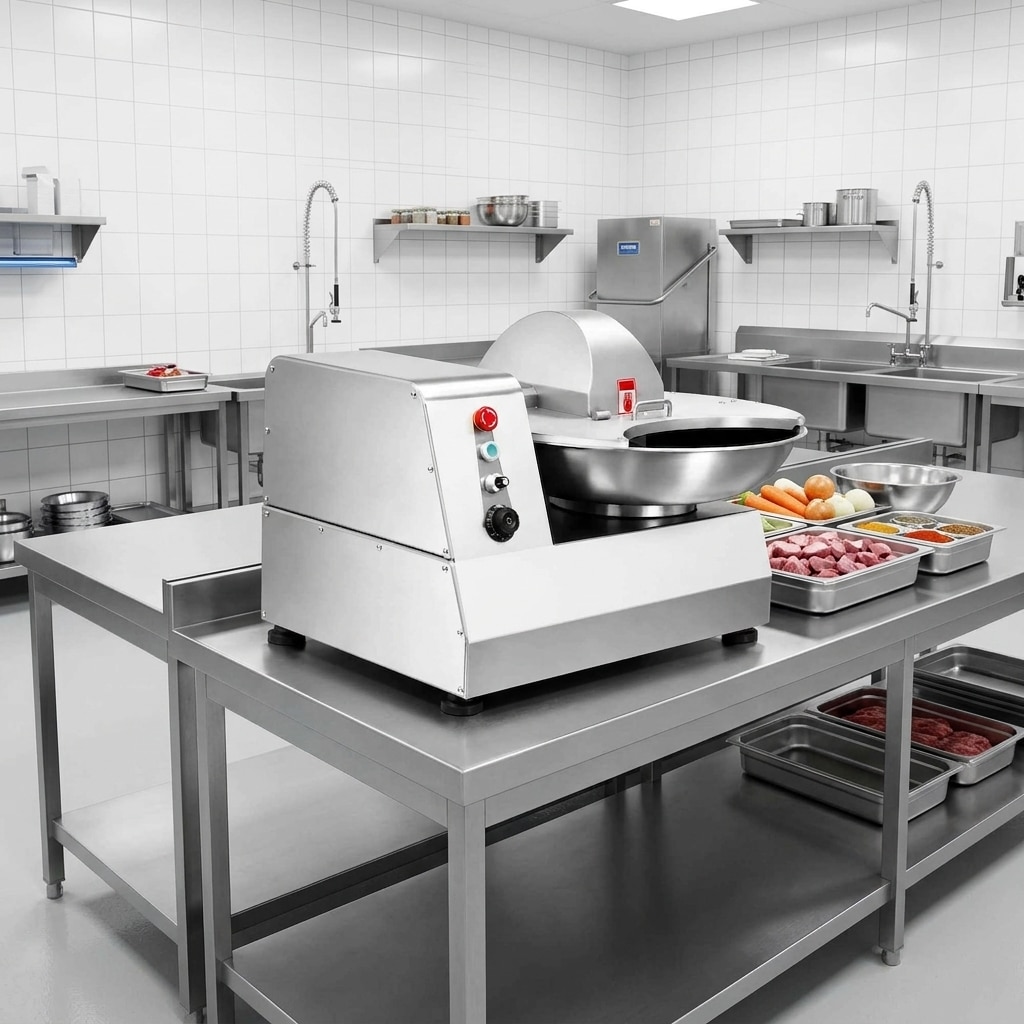
Commercial bowl cutter installed in an organised food processing kitchen

When selecting a commercial bowl cutter, start with the products you intend to make rather than choosing by machine size alone. A processor making coarse burger mix, a deli producing fine sausage meat, and a prepared-food kitchen making vegetable fillings may require different bowl size, knife configuration, process controls, and workflow arrangements.

Key questions for buyers include:

  • What ingredients will be processed, and are they raw, cooked, chilled, or partly frozen?
  • What texture is required: coarse chop, defined particle size, fine mince, or a smooth emulsion?
  • What batch size fits the production schedule without routinely underloading or overloading the bowl?
  • How will product temperature be monitored and managed?
  • What electrical supply, floor space, access clearance, and cleaning area are available?
  • What operator training, cleaning procedure, spare-parts access, and service support are needed?

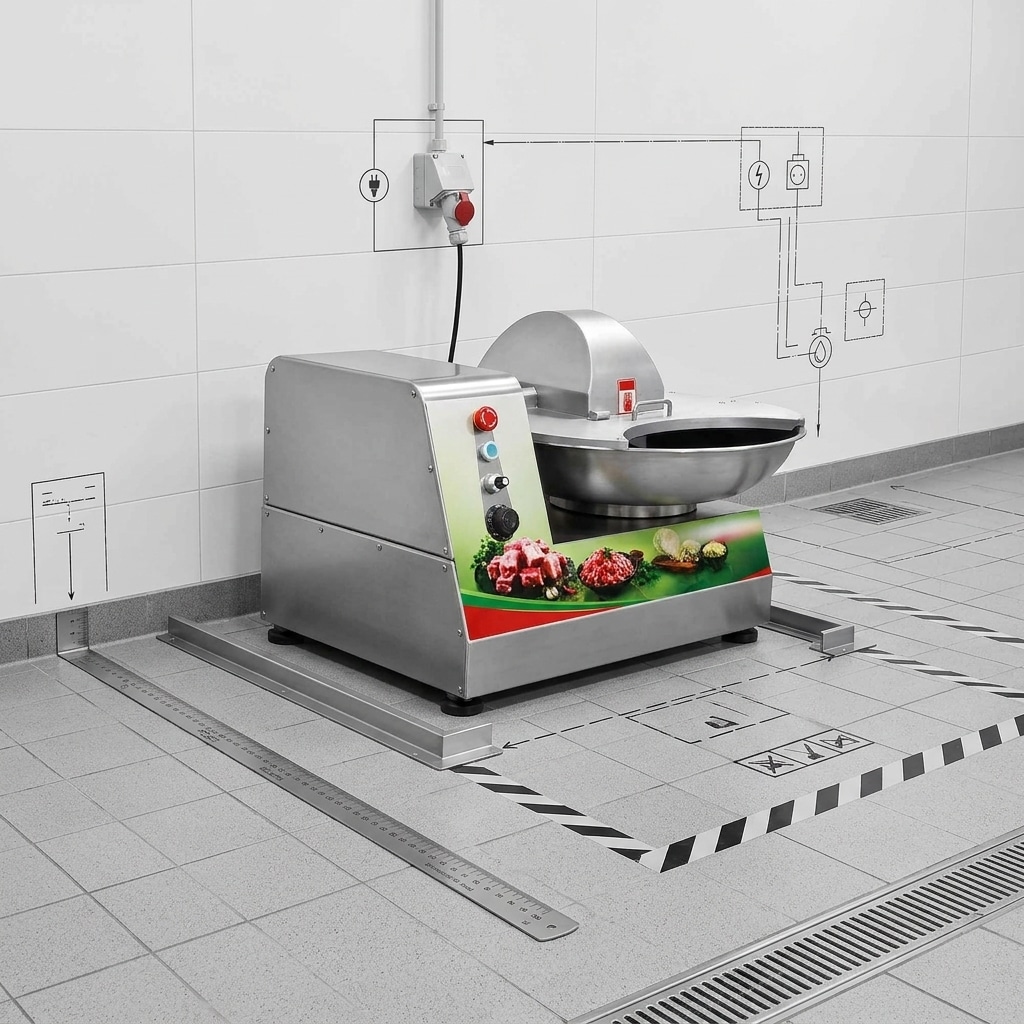
Installation also affects process reliability. A stable position, correct electrical connection, safe access around the machine, and a defined cleaning routine should be established before production begins. Review this guide on setting up a bowl cutter in a commercial kitchen to plan the work area and operating controls.

Before committing to a production method, test representative ingredients and recipes. A trial should assess texture, temperature movement, ingredient distribution, cleaning time, and how the machine fits the wider workflow. This is more useful than assuming that one setting or knife time will work for every product.

Cleaning and Maintenance After Processing

The range of foods a bowl cutter processes makes cleaning especially important. Meat proteins, fat, vegetable fibres, herbs, spice powders, and allergens can remain on the bowl, knives, cover, discharge area, and nearby surfaces. Cleaning should take place according to the site’s food-safety procedure and the machine instructions after each relevant production run or changeover.

Before cleaning, stop the machine, isolate it from its energy source, and follow the manufacturer’s safe-access instructions. Do not reach into the knife area while the machine is connected to power. Use appropriate tools and personal protective equipment required by the site, particularly around sharp blades.

Knife care also affects both product quality and operating consistency. Dull or damaged blades can change cutting performance and may encourage operators to extend processing times unnecessarily. Check knife condition routinely and investigate unusual vibration, noise, poor cutting, or inconsistent texture before continuing production.

Use the step-by-step resource on how to clean and sanitize a commercial bowl cutter to support a structured cleaning routine. For blade-related operating factors, see how to prevent bowl cutter blades from dulling early.

Conclusion

A commercial bowl cutter can process a broad range of suitable food ingredients, including chilled meat, poultry, fish, fat, vegetables, herbs, seasonings, and selected prepared-food mixtures. Its value is the ability to combine controlled cutting and mixing within a batch, but the correct result depends on recipe design, raw-material preparation, temperature management, knife condition, and disciplined cleaning.

For the best fit, define the ingredients, required texture, batch pattern, site utilities, sanitation plan, and operator workflow before selecting equipment. This approach helps ensure that the bowl cutter supports the products you actually intend to make and the daily routine needed to make them consistently.

Commercial Bowl Cutter Troubleshooting and Operator Checks

Table of Contents

Commercial bowl cutter problems are often linked to setup, ingredients, blade condition, electrical supply, cleaning, or operator technique. This guide explains the checks operators can complete safely before requesting technical service.

Direct Troubleshooting Answer

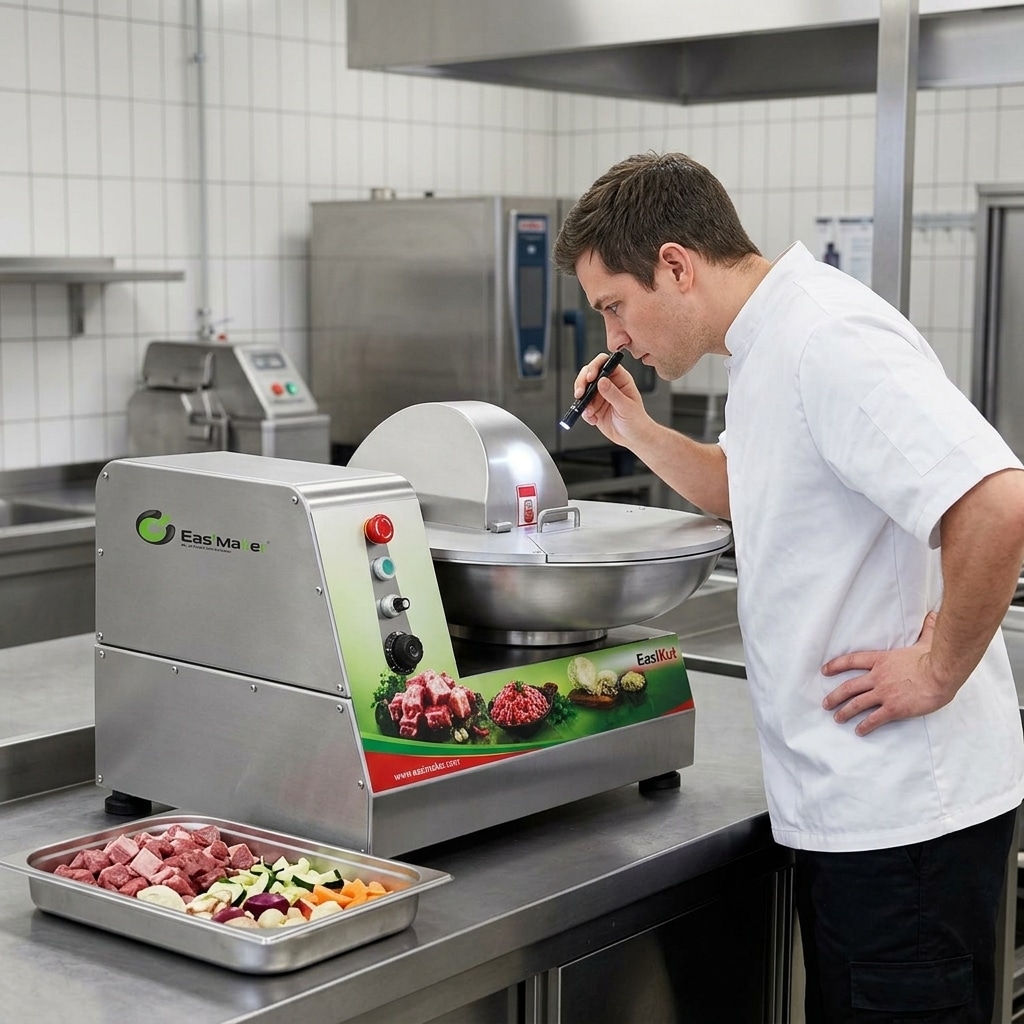
Operator checking an EasiKut BC25 commercial bowl cutter before food processing

For commercial bowl cutter troubleshooting, start by stopping the machine and isolating the power. Check the basic conditions first: the bowl and cover are correctly positioned, safety interlocks are engaged, the machine is receiving the correct electrical supply, the blades are installed securely, and the ingredients are within the equipment’s intended working range.

If the machine runs but produces uneven texture, inspect the batch size, ingredient temperature, cutting time, blade sharpness, and loading order. If the machine is noisy or vibrates, stop operation and check for an unbalanced load, loose blade assembly, foreign material, poor footing, or damaged components. Do not bypass a safety switch or continue operating when there is burning odour, smoke, exposed wiring, abnormal movement, or repeated circuit trips.

Operators can complete visual, cleaning, loading, and setup checks. Electrical repairs, motor work, damaged guards, safety switch faults, and bearing or drive problems should be handled by qualified service personnel or the manufacturer.

Understand the Equipment

EasiKut BC25 commercial food bowl cutter in a processing workspace

A commercial bowl cutter is a food processing machine that uses rotating knives and a rotating or driven bowl to chop, mince, mix, or emulsify selected ingredients. It is commonly used for meat mixtures, sausage preparation, fillings, seasonings, vegetables, and other prepared-food applications. The exact result depends on the machine design, blade arrangement, ingredient condition, batch size, processing time, and operator settings.

A bowl cutter is different from a general food processor because it is designed around controlled cutting and mixing in a production workflow. Before diagnosing a problem, confirm that the machine is suitable for the product being processed. The guide what a commercial bowl cutter can process can help operators compare suitable applications with ingredients that may require another machine.

For kitchens deciding between equipment types, review bowl cutter versus food processor. Choosing the wrong equipment for the material can appear to be a machine fault when the real issue is an unsuitable process.

Before-Startup Operator Checks

Operator completing pre-start checks on a commercial bowl cutter

A consistent pre-start inspection prevents many avoidable stoppages. The operator should complete the checks at the beginning of each shift and whenever the machine has been moved, cleaned, or reassembled.

Check the work area

  • Place the machine on a stable, level surface with enough clearance for loading, unloading, cleaning, and service access.
  • Keep the floor dry and remove loose tools, packaging, and other objects from around the machine.
  • Confirm that the power cable, plug, isolator, and socket are undamaged and suitable for the machine’s required supply.

Check the bowl, cover, and safety systems

  • Make sure the bowl is seated correctly and can rotate or operate without obstruction.
  • Confirm that the cover, guard, and access panels are closed and secured.
  • Test the normal start and stop controls according to the manufacturer’s instructions.
  • Never tape down, remove, or bypass an interlock or guard to keep production moving.

Check the blade assembly

  • Inspect the knives for damage, cracks, excessive wear, or food residue.
  • Confirm that the blade assembly and retaining hardware are fitted correctly and securely.
  • Use the specified tools and isolation procedure when removing or installing blades.

Check the ingredients

  • Remove bones, hard foreign material, packaging, and unsuitable pieces before loading.
  • Keep the batch within the machine’s stated working capacity. Do not assume that a physically full bowl is a suitable production load.
  • Use a consistent ingredient size and loading sequence so that the knives can work evenly.

Common Operating Problems

Safe diagnosis of common commercial bowl cutter operating problems

The machine does not start

First check whether the machine is receiving power and whether the local isolator, plug, socket, or circuit protection has operated. Then check that the bowl, lid, and access points are correctly positioned. Many commercial machines will not start when a safety condition is open. Check the emergency stop control and reset it only after confirming that the work area is safe.

If the power supply is present and the machine still does not start, do not repeatedly cycle the controls or open the electrical cabinet. Record the symptoms and contact qualified service personnel. A failed switch, interlock, control component, or motor protection device requires a controlled diagnosis.

The bowl or blades do not rotate correctly

Stop the machine, isolate the power, and remove the product only when it is safe to do so. Look for an overloaded batch, a foreign object, product packed around the blade, or an incorrectly fitted blade assembly. Do not reach into the bowl while components can move. If the machine hums without turning, trips protection, or starts and stops repeatedly, the cause may be electrical or mechanical and should be escalated.

The product is uneven

Uneven chopping often results from inconsistent ingredient size, an overloaded bowl, insufficient processing time, a dull or damaged knife, or an unsuitable loading sequence. Check whether the product is distributed evenly and whether the batch is too large for the process. Use repeatable ingredient preparation and record the operating sequence that produces the required texture. Avoid extending processing time without checking product temperature and machine loading.

The product is too fine or becomes a paste

Reduce processing time or use a more suitable cycle if the equipment and recipe allow it. Excessive cutting can change the intended texture. Ingredient temperature, fat condition, moisture, and loading order also affect the result, so operators should change one process variable at a time and record the outcome. If the same settings produce a sudden change, inspect blade condition and bowl movement before changing the recipe.

The mixture is not combining properly

Confirm that the batch size is sufficient for the machine to move the ingredients through the cutting zone, while remaining within the permitted load. Check the loading order and allow the machine to stop before adding ingredients unless the manufacturer’s operating instructions specifically permit another method. Persistent poor mixing may indicate incorrect blade installation, restricted bowl movement, or a component fault.

Noise, Vibration, and Overheating

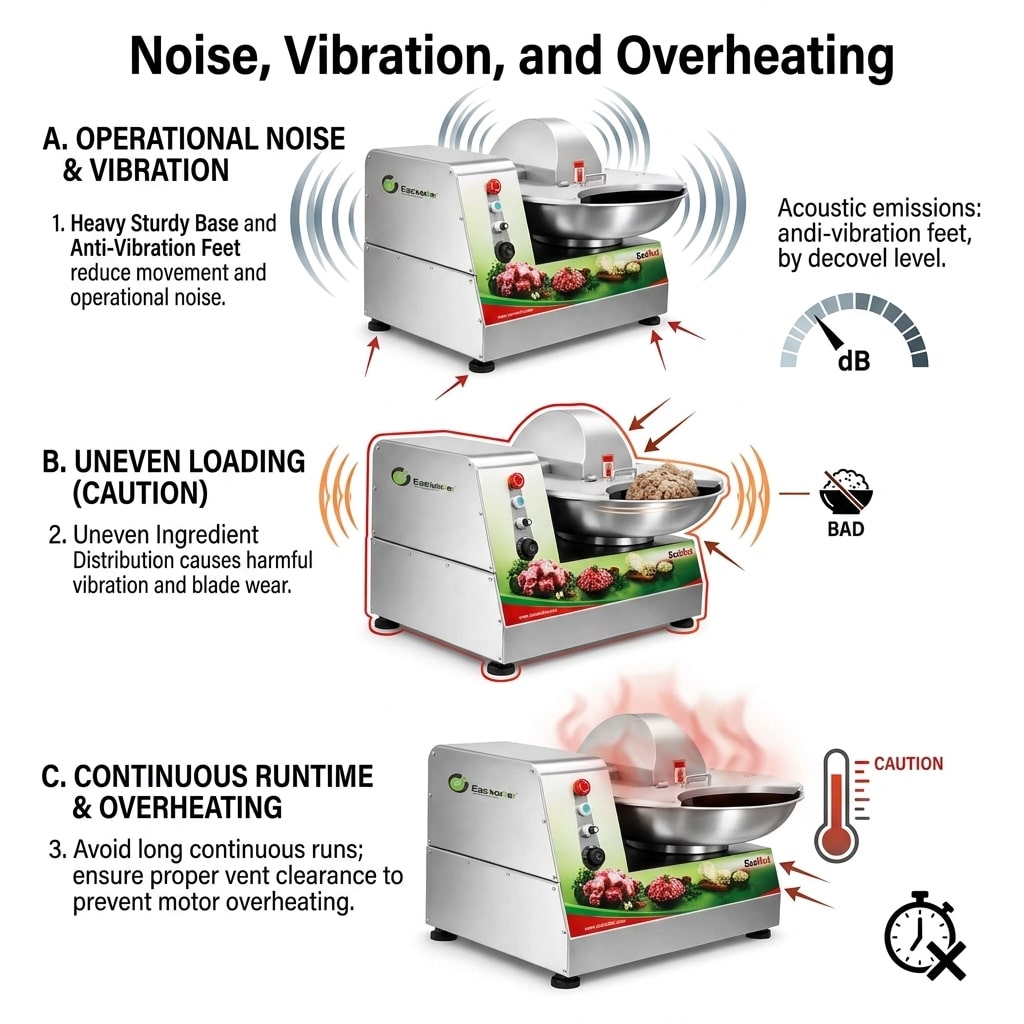
Noise, Vibration, and Overheating

Abnormal noise

Unusual scraping, knocking, squealing, or grinding is a stop condition. Isolate the machine before inspecting it. Check for loose hardware, material trapped near moving parts, an incorrectly fitted blade, contact between the bowl and a fixed component, or a damaged guard. Do not operate the machine to listen for the fault with the cover removed.

Normal operating sound varies by model and product. A new sound, a sound that changes with load, or noise accompanied by vibration should be recorded and reported. A service technician may need to inspect the drive, bearings, coupling, blade shaft, or other internal parts.

Excessive vibration

Check that the machine is level and stable. Then inspect the batch for uneven distribution, oversized pieces, foreign material, or a blade assembly that is not seated correctly. Confirm that the bowl and cover are correctly installed. If vibration remains after the load is removed, stop using the equipment until the cause is identified.

Motor or machine overheating

Overheating can be associated with excessive loading, extended continuous operation, restricted ventilation, high ambient temperature, incorrect electrical supply, or a mechanical problem. Allow the machine to stop and cool according to the manufacturer’s instructions. Check that ventilation openings are clear and that the processing cycle matches the equipment’s intended duty. Do not keep resetting thermal protection without investigating why it operated.

Burning smell, smoke, melted insulation, discoloured wiring, or repeated overheating requires immediate isolation and professional inspection. Operators should not continue production to determine whether the problem clears by itself.

Cleaning and Maintenance Checks

Cleaning and maintenance of a commercial bowl cutter after production

Cleaning problems can become operating problems. Food residue around the bowl, blade assembly, seals, covers, and discharge areas may restrict movement, affect hygiene, contribute to odour, or make it harder to identify damage.

Follow the machine manual for the approved cleaning method, chemical compatibility, water exposure, and component removal procedure. Before cleaning, stop the machine, isolate the electrical supply, and wait for all movement to cease. Use appropriate protective equipment when handling sharp blades and cleaning chemicals. Keep electrical controls, motors, and other non-washable components protected from water.

After cleaning, inspect the blade area and bowl for cracks, chips, corrosion, loose fasteners, and trapped residue. Check that removable parts are dry and correctly reinstalled before the next batch. Do not use a damaged knife or guard. A clean machine also makes it easier to notice changes in wear, alignment, and component condition.

For broader food-processing workflow guidance, the article on designing a hygienic food workstation explains practical principles such as cleanable surfaces, separation of raw and finished product areas, and safe access around equipment.

Keep a simple maintenance record. Note the date, operator, product, batch conditions, unusual sounds, cleaning completed, blade inspection result, and any service request. This information helps distinguish a one-off loading issue from a recurring mechanical or electrical fault.

When to Contact Service

Technician inspecting an isolated commercial bowl cutter for service

Stop troubleshooting at the operator level when the issue involves electrical components, internal wiring, the motor, drive system, bearings, shaft alignment, safety interlocks, structural damage, or repeated protection trips. These faults can create safety risks and may worsen if the machine is operated without a proper diagnosis.

Contact the manufacturer, distributor, or qualified technician when:

  • The machine will not start after basic power and safety-position checks.
  • The motor hums, trips the circuit, overheats, or gives off a burning smell.
  • The blade shaft, bowl, or drive shows abnormal movement or vibration.
  • A guard, lid, interlock, emergency stop, or control does not work correctly.
  • The machine leaks, has damaged seals, or shows cracks or deformation.
  • The same texture or production problem returns after loading and blade checks.

Before requesting assistance, prepare the model and serial information, electrical supply, product being processed, approximate batch conditions, operating sequence, cleaning history, and a clear description of what happened. Photos or short videos can help show the position of the blade, bowl, guard, or damaged component, provided they are taken with the machine stopped and isolated.

Do not modify the machine, substitute unknown parts, or change electrical components without confirming compatibility with the manufacturer. Correct spare parts and documented service procedures protect both equipment reliability and operator safety.

Commercial Bowl Cutter Buying Guide for Food Processors

Table of Contents

The right commercial bowl cutter should match your product recipe, batch size, texture requirements, workflow, cleaning routine, and available utilities. This guide explains the main buying factors for meat processors, food manufacturers, butcher shops, commissary kitchens, and other professional operations.

What Is a Commercial Bowl Cutter?

EasiKut BC25 commercial bowl cutter in a professional food processing workspace

A commercial bowl cutter is a food processing machine that combines a rotating bowl with high-speed cutting knives. As the bowl moves ingredients through the blade set, the machine can chop, mix, and develop a controlled texture. Depending on the recipe and operating settings, it may be used for sausage meat, emulsified products, meat fillings, pâté-style mixtures, vegetable preparations, and other processed foods.

Unlike a basic food processor, a commercial bowl cutter is designed for repeatable production, heavier workloads, and integration into a professional preparation area. The correct choice depends on more than bowl volume. Buyers should assess the product being processed, target texture, batch weight, available electrical supply, cleaning requirements, operator safety, and access to spare parts.

This commercial bowl cutter buying guide focuses on the practical questions food processors should answer before requesting a quotation or approving a machine for production.

Why Food Processors Use Bowl Cutters

Commercial bowl cutter integrated into a professional food preparation workflow

Bowl cutters are selected when a processor needs more controlled cutting and mixing than manual preparation or a general-purpose processor can provide. Common applications include preparing sausage farce, burger and meatball mixtures, fillings, seasoned minced products, and selected vegetable or plant-based formulations.

  • Texture control: A suitable blade arrangement and operating process can help produce a defined coarse, fine, or emulsified texture.
  • Repeatability: Standardized batch weights, processing times, and ingredient order make it easier to reproduce a recipe.
  • Workflow efficiency: Cutting and mixing in one machine can reduce transfers between preparation steps.
  • Commercial durability: A machine built for professional use is better suited to regular production than light-duty domestic equipment.

However, a bowl cutter is not automatically the best machine for every application. If your operation mainly needs occasional chopping, dry ingredient processing, or very small portions, another type of food processor may be more practical. The decision should follow the product and workflow rather than the machine category alone.

Key Buying Criteria

Commercial bowl cutter installation and workspace planning

Before comparing brands or requesting prices, create a short equipment specification for your operation. Include the ingredients, expected batch weight, target texture, production schedule, operator arrangement, and cleaning method. This prevents a low purchase price from hiding an unsuitable capacity or difficult daily workflow.

Product and recipe fit

Explain exactly what will be processed. Meat temperature, fat content, moisture, connective tissue, frozen or chilled condition, and ingredient size can affect the machine requirement. Also state whether the machine will chop only, mix after cutting, or perform both functions in the same batch.

Construction and food-contact materials

Look for a robust frame and clearly identified food-contact surfaces. Stainless steel is commonly preferred for surfaces exposed to food because it can support cleaning and corrosion control when correctly finished and maintained. Ask which parts are removable, how seals are protected, and whether the bowl and knives can be inspected without excessive disassembly.

Electrical and installation requirements

Confirm voltage, phase, frequency, rated power, plug or connection arrangement, machine footprint, working clearance, and floor loading. A machine must fit both the physical room and the electrical system available at the site. Ask for an installation drawing if the equipment will be incorporated into a production line.

Capacity and Production Planning

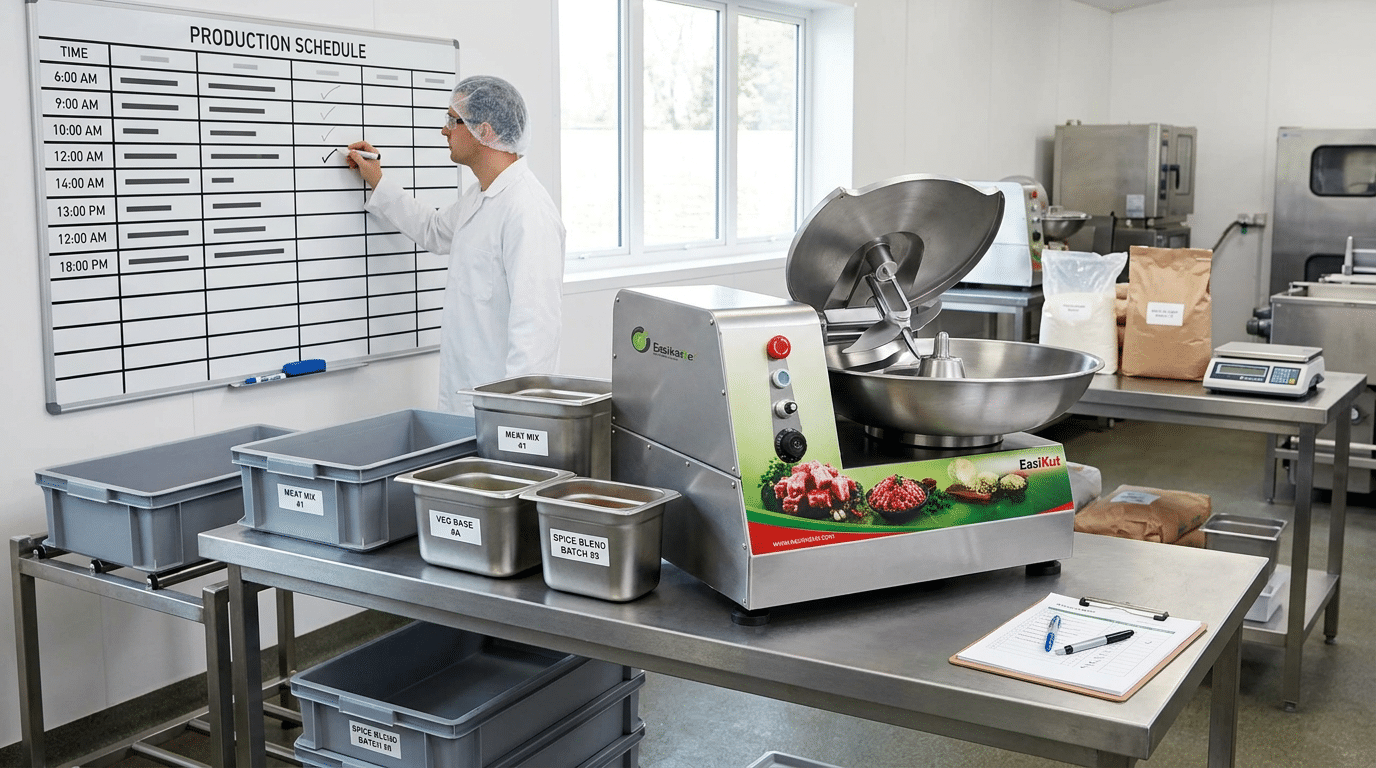
Food processor planning batch size and production workflow for a bowl cutter

Choose capacity according to the actual working batch, not simply the nominal bowl volume. The usable load can vary with ingredient density, recipe moisture, product temperature, blade configuration, and the amount of free space needed for effective circulation. A bowl that appears large on paper may not suit a dense or sticky mixture at the desired batch weight.

Calculate your requirement from the production schedule:

  1. Estimate the number of batches needed per shift.
  2. Record the target weight for each recipe.
  3. Allow time for loading, cutting, mixing, unloading, and cleaning.
  4. Check whether different products require separate batches or changeover cleaning.
  5. Compare the resulting workload with the supplier’s confirmed working capacity.

Do not treat an advertised capacity as a guaranteed output for every recipe. Ask the manufacturer to confirm the recommended working load for your ingredients and process. If possible, provide representative samples or detailed recipe information for a practical assessment.

Oversizing can also create problems. A machine that is too large for small batches may not circulate ingredients effectively, while an undersized machine may require too many batches and increase handling. The best choice balances batch size, production frequency, floor space, and future demand without relying on unsupported throughput claims.

Blades, Speed, and Texture Control

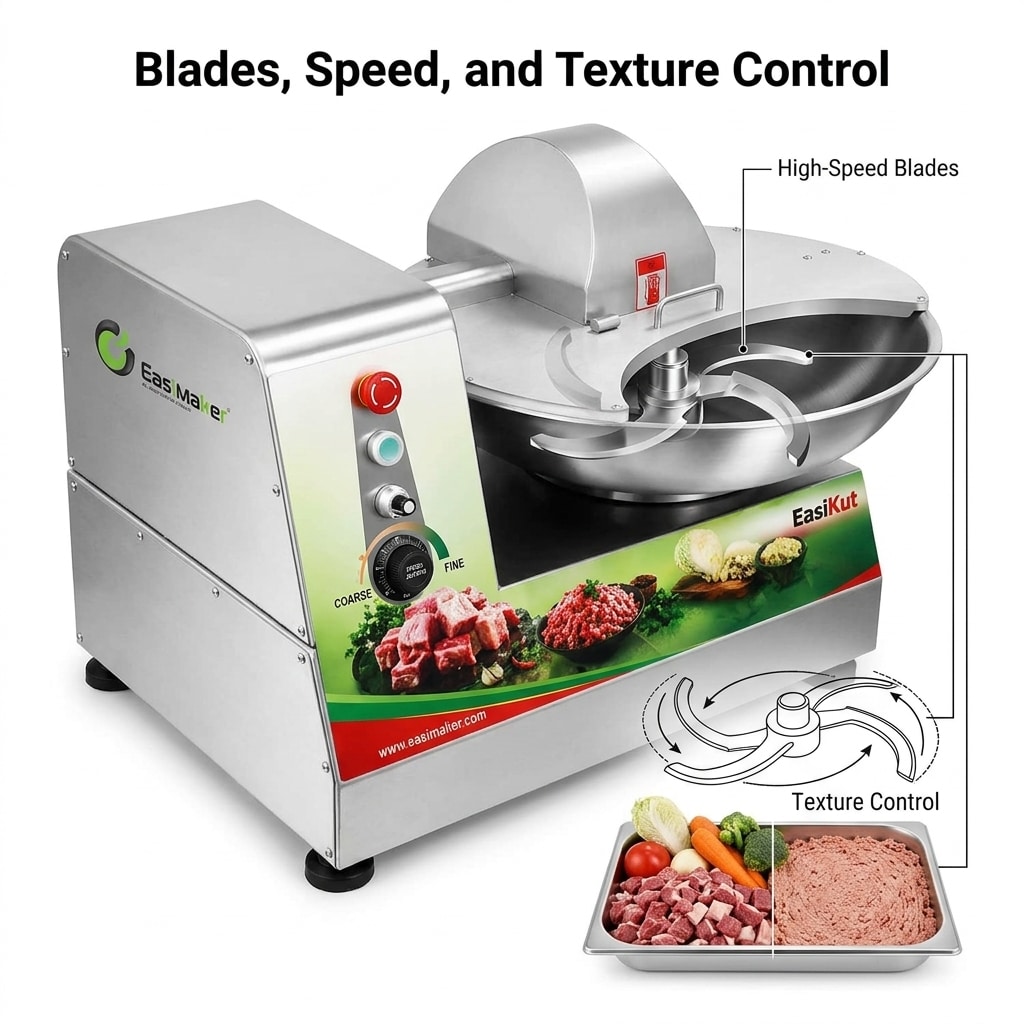
Blades, Speed, and Texture Control

The blade assembly is central to bowl cutter performance. Ask how many knives are fitted, what materials are used, how the knives are sharpened or replaced, and which product types the blade design is intended to handle. A supplier should be able to explain the relationship between blade geometry, bowl movement, cutting time, and the texture required by your recipe.

Speed control may be fixed, stepped, or variable depending on the machine design. Higher speed is not automatically better. The correct setting depends on whether the process requires coarse cutting, fine chopping, mixing, or controlled emulsion development. Excessive processing can change product temperature and texture, so operators need a repeatable recipe procedure rather than simply running the machine at maximum speed.

Ask whether the machine supports separate cutting and mixing stages, how the operator changes settings, and whether the controls are easy to use while wearing suitable protective equipment. Confirm the availability and expected service life of replacement knives, knife holders, seals, and other wear parts.

Hygiene, Safety, and Maintenance

Cleaning and maintenance of a commercial bowl cutter

Daily sanitation and operator safety should be considered during the buying process, not after installation. A machine with difficult-to-reach surfaces or complicated disassembly can increase cleaning time and create avoidable hygiene risks.

Hygiene points to check

  • Can food-contact components be accessed and cleaned thoroughly?
  • Are there unnecessary crevices, exposed threads, or product traps?
  • Can the bowl, knives, guards, and covers be inspected after cleaning?
  • Are cleaning chemicals and water exposure limits clearly explained?
  • Is there a documented cleaning and sanitation procedure?

Safety points to check

Confirm that guards, covers, interlocks, emergency stopping arrangements, and control switches are suitable for the machine design. Operators should never reach into the bowl while blades or moving parts can operate. The supplier should provide operating instructions, cleaning guidance, maintenance information, and warnings for knife handling.

Maintenance points to check

Ask about lubrication, belt or drive inspection, knife condition, seal replacement, electrical checks, and recommended service intervals. Request a spare-parts list and clarify which components are normal wear parts. Maintenance access should be practical for your technicians or local service provider.

Questions to Ask Before Buying

Questions to Ask Before Buying

A clear supplier discussion can reveal more than a product brochure. Use the following questions when comparing commercial bowl cutter machines:

  • What is the recommended working batch for my specific ingredients?
  • Which products and textures is this model designed to process?
  • What are the available voltage, phase, and power configurations?
  • How are cutting and mixing speeds controlled?
  • Which parts contact food, and what materials are used?
  • How are the bowl and knife assembly removed, cleaned, and inspected?
  • What safety devices are included?
  • Which components are considered wear parts?
  • Are operating manuals, electrical drawings, and cleaning instructions supplied?
  • What warranty, spare-parts, and after-sales support options are available in my market?
  • Can the machine be tested with a representative recipe before purchase?

Request written answers where possible. This creates a useful record for procurement, installation, operator training, and future service.

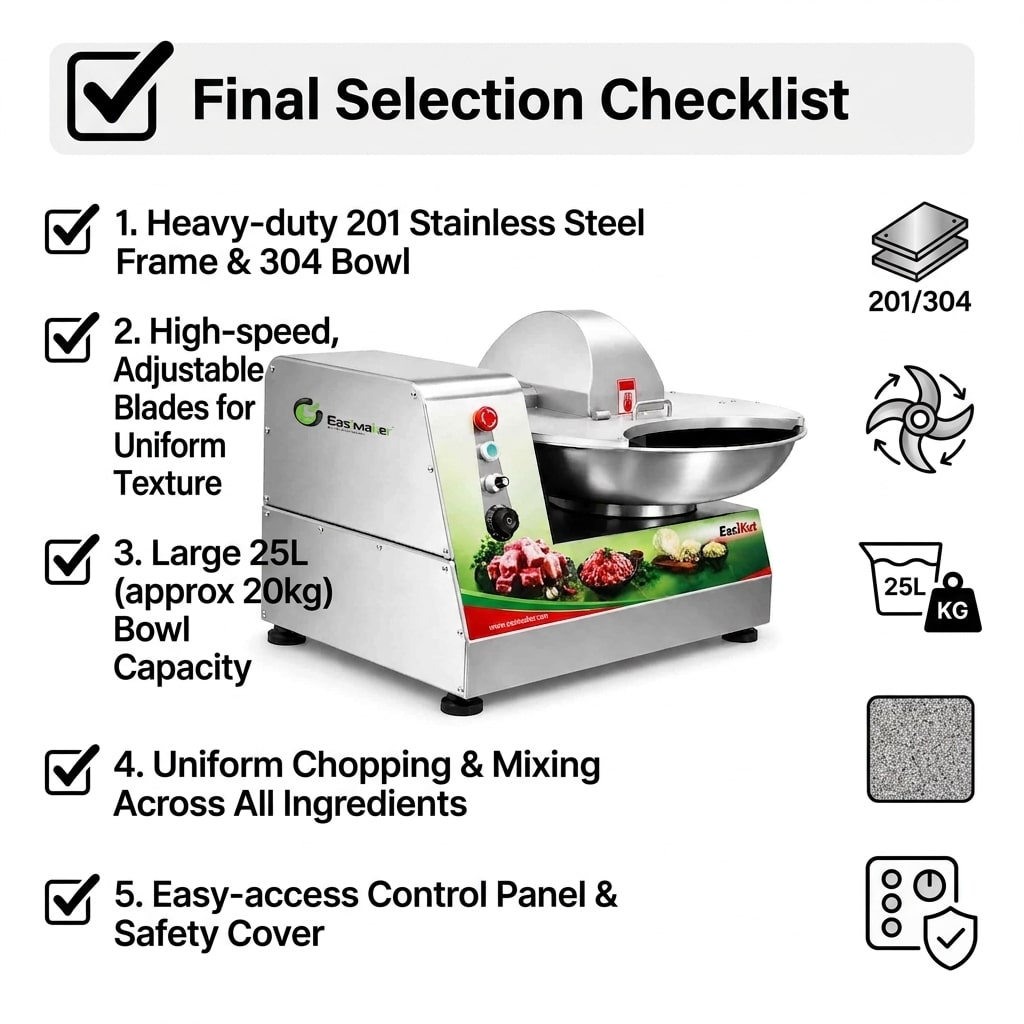
Final Selection Checklist

Final Selection Checklist

Before approving a commercial bowl cutter, confirm that the machine meets these practical requirements:

  • Application: The machine is suitable for the ingredients, recipes, and textures you produce.
  • Working capacity: The recommended batch weight matches your production plan.
  • Construction: The frame, bowl, guards, and food-contact components suit daily commercial use.
  • Controls: Operators can manage cutting and mixing stages consistently.
  • Installation: The footprint, clearance, floor, ventilation, and electrical supply are suitable.
  • Hygiene: Product-contact areas are accessible for cleaning, inspection, and sanitation.
  • Safety: Guards, interlocks, stopping systems, and training materials are clearly documented.
  • Service: Spare parts, manuals, warranty terms, and technical support are available for your market.
  • Validation: The supplier can explain the machine’s fit without relying on unverified capacity or performance claims.

The right bowl cutter is the one that fits your complete production system. Compare the working batch, recipe requirements, cleaning routine, operator skills, installation conditions, and long-term support together. A technically suitable machine should improve process consistency without adding unnecessary complexity to the production floor.

How Commercial Bowl Cutters Streamline High-Volume Food Preparation

In commercial kitchens and industrial food manufacturing, efficiency is the primary driver of profitability. High-volume food prep often creates bottlenecks, tying up labor hours and risking inconsistencies in product quality. For operations processing large batches of ingredients daily, relying on standard equipment or manual labor is no longer viable.

A commercial bowl cutter (often referred to as a meat chopping machine or bowl chopper) is an essential piece of industrial food processing equipment designed to solve this exact problem. By combining a rotating bowl with a high-speed multi-blade shaft, these machines deliver unmatched speed and precision.

This guide explores how commercial bowl cutters streamline high-volume food prep, detailing their versatility across different ingredient types, time-saving benefits, and the specific blade configurations that optimize kitchen workflows.

The Core Mechanics of a Commercial Bowl Cutter

Unlike standard food processors that rely on gravity to pull ingredients toward a single blade, a commercial bowl cutter operates on a dual-motion principle. The heavy-duty stainless steel bowl rotates at a controlled speed, feeding the product continuously into a set of vertically rotating blades. This mechanism ensures that every part of the batch is processed evenly without bruising or crushing the ingredients.

This design allows operators to achieve anything from a coarse chop to a perfectly smooth emulsion in a matter of minutes, simply by adjusting the run time and shaft speed.

Versatility in High-Volume Food Prep

One of the primary reasons restaurant owners and food manufacturers invest in an industrial food processor of this caliber is its extreme versatility. A single machine can replace multiple single-purpose prep tools.

Rapid Meat Processing

As a highly efficient meat chopping machine, the bowl cutter excels at processing proteins. Whether you are preparing coarse ground beef for burgers, mincing pork for dumplings, or creating ultra-fine meat pastes for sausages and hot dogs, the machine handles it effortlessly. The swift cutting action prevents the meat’s temperature from rising too quickly, preserving fat structure and preventing premature rendering.

Bulk Vegetable Chopping

Preparing mirepoix, salsas, or bulk chopped salads manually is highly labor-intensive. A commercial bowl cutter can process dozens of pounds of onions, carrots, and celery in seconds. Because the blades slice cleanly rather than mashing the vegetables, the ingredients retain their cellular integrity, resulting in less water loss and a fresher appearance.

High-Quality Emulsions

Creating stable emulsions—such as mayonnaise, hummus, pâté, or specialized sauces—requires high shear force. The rapid rotation of the blade shaft (often exceeding 3,000 RPM in high-end models) breaks down fat globules and blends them seamlessly with liquids, resulting in a smooth, stable, and uniform texture that is difficult to achieve with standard mixers.

Time-Saving Benefits for Commercial Kitchens

Integrating a bowl cutter into your prep workflow yields immediate and measurable efficiency gains:

  • Drastic Reduction in Prep Time: Tasks that take hours by hand or with smaller processors can be completed in under three minutes. For example, processing 40 liters of meat paste can be achieved in a single, short cycle.
  • Labor Optimization: By automating the most time-consuming chopping and blending tasks, skilled culinary staff can be reallocated to cooking, plating, and quality control.
  • Unmatched Consistency: Programmable time and speed settings ensure that every batch meets exact particle size and texture specifications, which is critical for portion control and cooking yields.

Optimizing Workflow: Blade Configurations Explained

The efficiency of a bowl cutter efficiency heavily relies on selecting the correct blade configuration. Most industrial units allow operators to swap or adjust blades based on the application.

Blade Type Best Used For Key Benefit
Straight Blades Coarse chopping, vegetables, salads Clean, precise cuts with minimal bruising or moisture loss.
Curved / Sickle Blades Meat pastes, emulsions, fine purees Maximum shear force; pulls ingredients inward for a smoother blend.
Serrated Blades Fibrous meats, tough root vegetables Grips and slices through tough connective tissues efficiently.

Furthermore, modern machines feature variable speed drives. Running the bowl slowly while the blades spin rapidly is ideal for fine emulsions, whereas a faster bowl speed with slower blades works best for coarse, uniform chopping.

Technical Specifications & Material Standards

When procuring a commercial bowl cutter, B2B buyers must evaluate several technical factors to ensure the equipment meets industrial demands:

  • Construction Materials: The entire machine, especially the bowl and blades, should be constructed from 304 or 316-grade food-safe stainless steel to resist corrosion and comply with international hygiene standards.
  • Motor Power & Cooling: High-volume processing generates heat. Look for heavy-duty, fan-cooled motors capable of continuous operation. Some advanced models feature double-jacketed bowls for water or gas cooling to keep meat temperatures low during processing.
  • Safety Features: Essential safety mechanisms include magnetic interlocks on the noise-dampening cover, emergency stop buttons, and automatic shut-off if the lid is lifted during operation.
  • Sanitation: IP65 water-resistant ratings allow for safe, low-pressure washdowns, significantly reducing end-of-shift cleaning times.

Procurement Guide: Choosing the Right Size

Selecting the correct capacity is vital for maximizing ROI. Bowl cutters are typically sized by bowl volume (in liters). As a general rule of thumb, the working capacity is roughly 60% to 70% of the total bowl volume.

  • 20L to 40L Models: Ideal for mid-sized restaurants, catering companies, and artisanal butcher shops.
  • 50L to 80L Models: Suited for large-scale commercial kitchens, institutional cafeterias, and mid-sized food processors.
  • 100L+ Models: Designed for heavy industrial food manufacturing, wholesale sausage production, and large continuous-batch operations.

Frequently Asked Questions (FAQs)

Can a commercial bowl cutter process frozen meat?

Standard bowl cutters are designed for fresh or slightly tempered meat (around -2°C to 0°C). Processing fully frozen blocks can damage the blades and motor. For deep-frozen products, a frozen meat flaker or grinder should be used prior to bowl chopping.

How often do the blades need to be sharpened?

This depends on usage volume and the toughness of the ingredients. In a high-volume setting, blades should be inspected weekly and typically require professional sharpening or replacement every 3 to 6 months to maintain optimal cutting efficiency.

Is a bowl cutter difficult to clean?

No. Industrial models are designed with sanitation in mind. Features like removable blade shafts, tiltable bowls (on larger models), and smooth stainless-steel surfaces make them easy to wash down and sanitize.

What is the typical lead time for ordering an industrial bowl cutter?

Lead times vary based on capacity and customization requirements. Standard sizes may be available for immediate dispatch, while highly customized units (e.g., specific voltage requirements or vacuum features) may take 4 to 8 weeks for manufacturing and delivery.

Conclusion

A commercial bowl cutter is a transformative investment for any high-volume food preparation facility. By delivering rapid processing, exceptional versatility, and consistent results, these machines eliminate prep bottlenecks and significantly lower labor costs. Whether you are producing fine meat emulsions or processing bulk vegetables, selecting the right machine size and blade configuration will ensure your kitchen operates at peak efficiency.

Ready to upgrade your food processing workflow? Request a quote / Get a sample today to discuss your specific capacity requirements and find the perfect equipment solution for your operation.