Table of Contents
- What Processors Should Look For
- What Is a Commercial Meat Bone Saw?
- Match the Saw to Your Products
- Evaluate Capacity and Workflow
- Check Construction and Hygiene
- Review Safety and Operation
- Plan Cleaning, Maintenance, and Service
- Commercial Meat Bone Saw Buying Checklist
Choosing a commercial meat bone saw requires more than comparing motor power. Processors should evaluate the products being cut, portion dimensions, workload, cleaning requirements, operator safety, installation conditions, and after-sales support. This guide explains the practical factors that affect machine selection and daily operation.
What Processors Should Look For
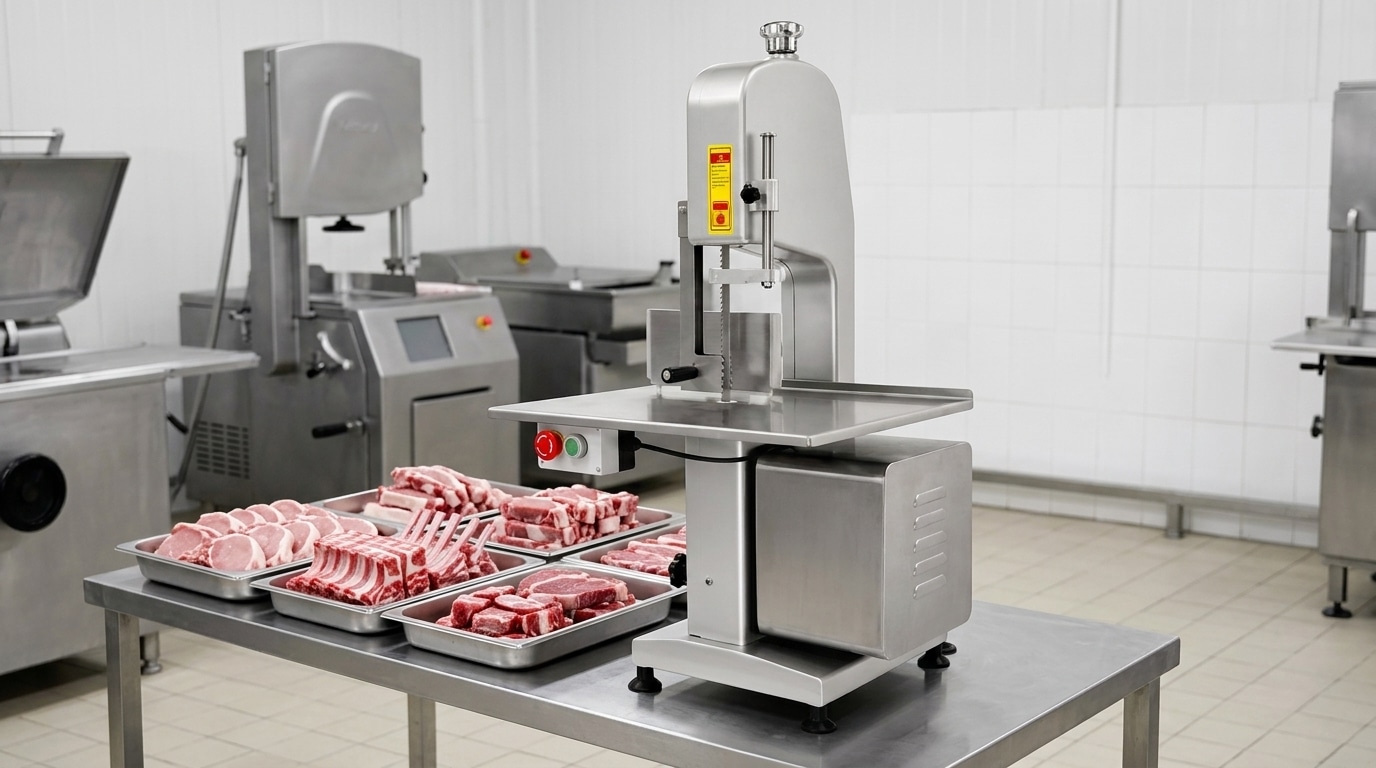
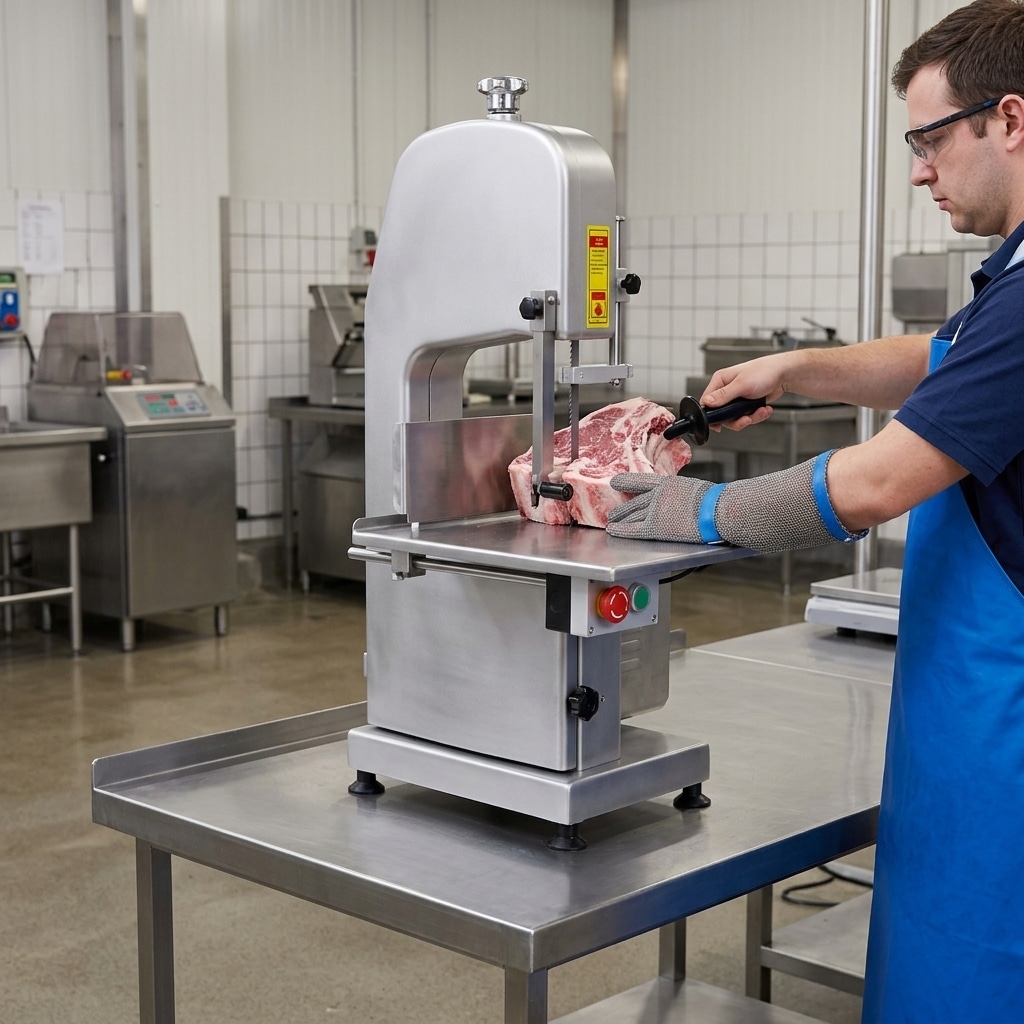
The right commercial meat bone saw should match the products you cut, the size and thickness of your portions, your daily workload, available floor or bench space, local electrical supply, cleaning procedure, and operator skill level. A suitable machine should provide stable cutting, practical access for cleaning, appropriate guarding, and dependable support for replacement and service parts.
Start by documenting the actual work the machine will perform. Record whether you cut fresh or chilled meat, frozen products, poultry, fish, or products containing hard bone. Note the largest product dimensions, the target portion sizes, the number of operating hours per day, and how many operators will use the saw. These details are more useful than choosing a machine from motor power alone.
For a broader purchasing checklist, see the guide to commercial bone saw machine buying considerations. It can help organize questions before requesting quotations.
What Is a Commercial Meat Bone Saw?
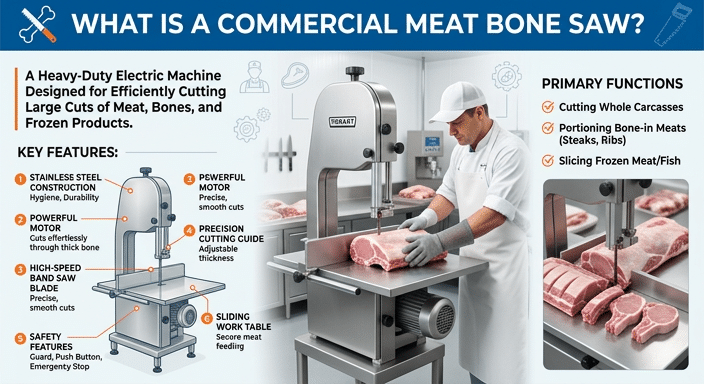
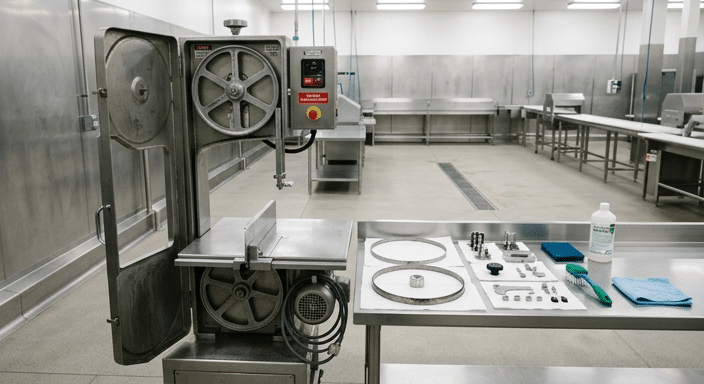
A commercial meat bone saw is a powered cutting machine that uses a continuous band blade to divide meat, bone, and selected frozen or semi-frozen food products into portions. The blade runs around a set of wheels while the operator guides the product across the cutting table or through the cutting area. Depending on the machine design, it may be installed on a workbench or supplied as a freestanding unit.
Bone saws are commonly used by butcher shops, meat processors, supermarkets, restaurants, hotels, catering businesses, and food distribution operations. They are intended for repeatable portioning and controlled cutting where a hand saw would be slower, less consistent, or more physically demanding.
A meat bone saw is not the same as a meat grinder or bowl cutter. A grinder reduces meat into smaller particles, while a bowl cutter chops, mixes, or emulsifies prepared ingredients. A bone saw divides larger pieces into sections or portions without performing the same mixing or mincing process.
The machine should be selected according to its intended product range. A saw designed for routine meat and bone portioning may not be suitable for every frozen product, oversized cut, or industrial production line. Always confirm the manufacturer’s stated application limits and operating instructions before purchase.
Match the Saw to Your Products
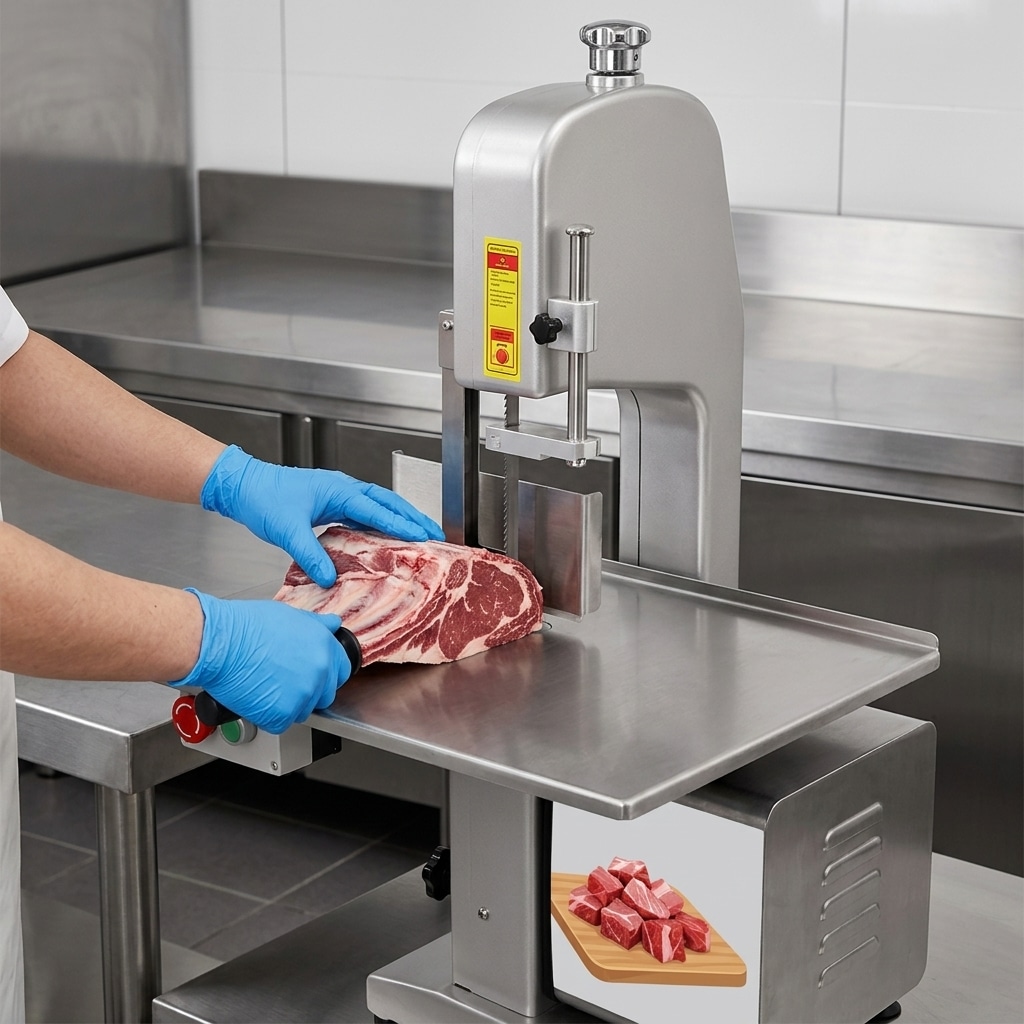
Product fit is the first technical question to resolve. The machine must accommodate the material’s size, temperature, structure, and cutting requirements. A processor handling small retail portions has different needs from a facility cutting large primal sections or frozen blocks.
Product dimensions and cutting height
Check the maximum cutting height and throat or passage width. These dimensions determine whether the saw can accept the largest piece you expect to process. Consider the product’s shape as well as its weight. An irregular cut may require more table space and operator clearance than a compact, uniform piece.
Fresh, chilled, frozen, or semi-frozen product
Product temperature affects cutting resistance, blade choice, surface quality, and operator control. Fresh and chilled meat may require a different operating approach from hard frozen material. Do not assume that a machine suitable for routine bone cutting is automatically suitable for every frozen product. Ask the supplier to confirm the intended temperature range and blade configuration.
Bone structure and portion requirements
Different bones and product shapes place different demands on the blade. Dense sections, joints, and mixed meat-and-bone cuts may require careful feeding and a suitable tooth pattern. If you need consistent portions, define the required thickness and confirm that the table, guide, and operator position support repeatable movement.
Practical cutting methods also matter. The guide to meat band saw cutting techniques for consistent portions covers product preparation, guide settings, blade condition, and controlled feed pressure.
Evaluate Capacity and Workflow

Capacity should be assessed from the complete workflow rather than a single advertised figure. A saw may have enough cutting power for the product but still be unsuitable if loading, unloading, cleaning, or portion handling creates a bottleneck.
Estimate the number of cuts per hour, the average product size, the expected peak workload, and the time available for cleaning and inspection. These figures help determine whether a tabletop machine is adequate or whether a floor-standing model would better support the operation. They also provide a clearer basis for comparing suppliers.
Consider the space around the machine. Operators need enough room to position raw material, guide it safely, collect portions, and keep finished product separate. The location should also allow access to surfaces, guards, blade components, and other areas that require routine cleaning.
Workflow design affects consistency. A stable infeed position, clear product path, practical thickness guide, and easy access to collection containers can reduce unnecessary handling. The best configuration depends on your facility layout, product flow, and staffing pattern.
Before ordering, ask for confirmed dimensions, net weight, table or working height, electrical requirements, blade information, and recommended operating limits. Where the supplier cannot confirm a figure, treat it as an open specification rather than estimating from a similar model.
Check Construction and Hygiene
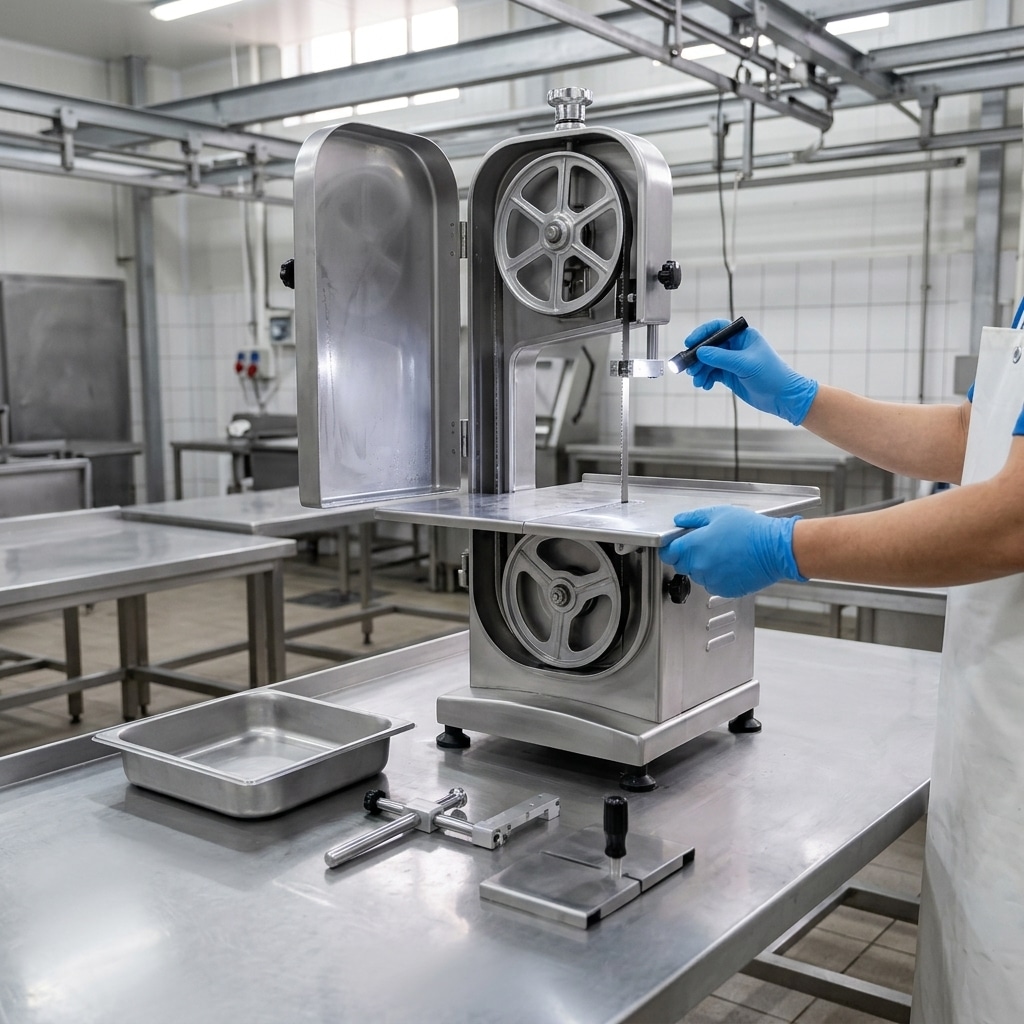
Construction influences durability, cleaning time, corrosion resistance, and the machine’s suitability for a food-processing environment. Review the materials used for the frame, table, guards, product-contact areas, and fasteners. The exact material specification should be confirmed in the quotation or technical documentation.
Look for a design that gives operators practical access to areas where meat particles, fat, moisture, and bone residue can collect. Smooth surfaces, limited dirt traps, removable components where appropriate, and clear cleaning instructions support a more consistent sanitation routine. A machine that is difficult to disassemble or inspect can create avoidable maintenance and hygiene problems.
Cleaning procedures must follow the manufacturer’s manual and the processor’s own food-safety program. Operators should understand which components may be removed, which electrical parts must be protected, which detergents are suitable, and how the machine must be dried before reassembly.
Bone dust is a process concern that should be managed through blade selection and condition, stable product preparation, controlled feeding, and correct guide use. See how to reduce bone dust when using a meat band saw for practical operating and maintenance points.
Review Safety and Operation

A commercial meat bone saw contains a continuously moving blade, so guarding, controls, operator training, and working discipline are essential selection factors. Ask the supplier to explain the safety functions included with the specific model and how they should be checked during operation.
Review the position and function of the start and stop controls, emergency stopping arrangements, blade guards, door or cover interlocks if fitted, product pusher or thickness guide, and any access restrictions around the cutting area. Confirm that these functions are described in the manual and can be maintained locally.
Operators should be trained to inspect the blade and guards before use, keep hands away from the cutting path, use the supplied guides or pushers, avoid forcing product through the blade, and stop the machine before clearing a blockage or making an adjustment. Only trained personnel should change or tension the blade.
A written operating procedure should also cover start-up, shutdown, cleaning, inspection, fault reporting, and blade replacement. Safe operation depends on the complete system of equipment, training, supervision, and maintenance, not on a machine feature considered in isolation.
Plan Cleaning, Maintenance, and Service
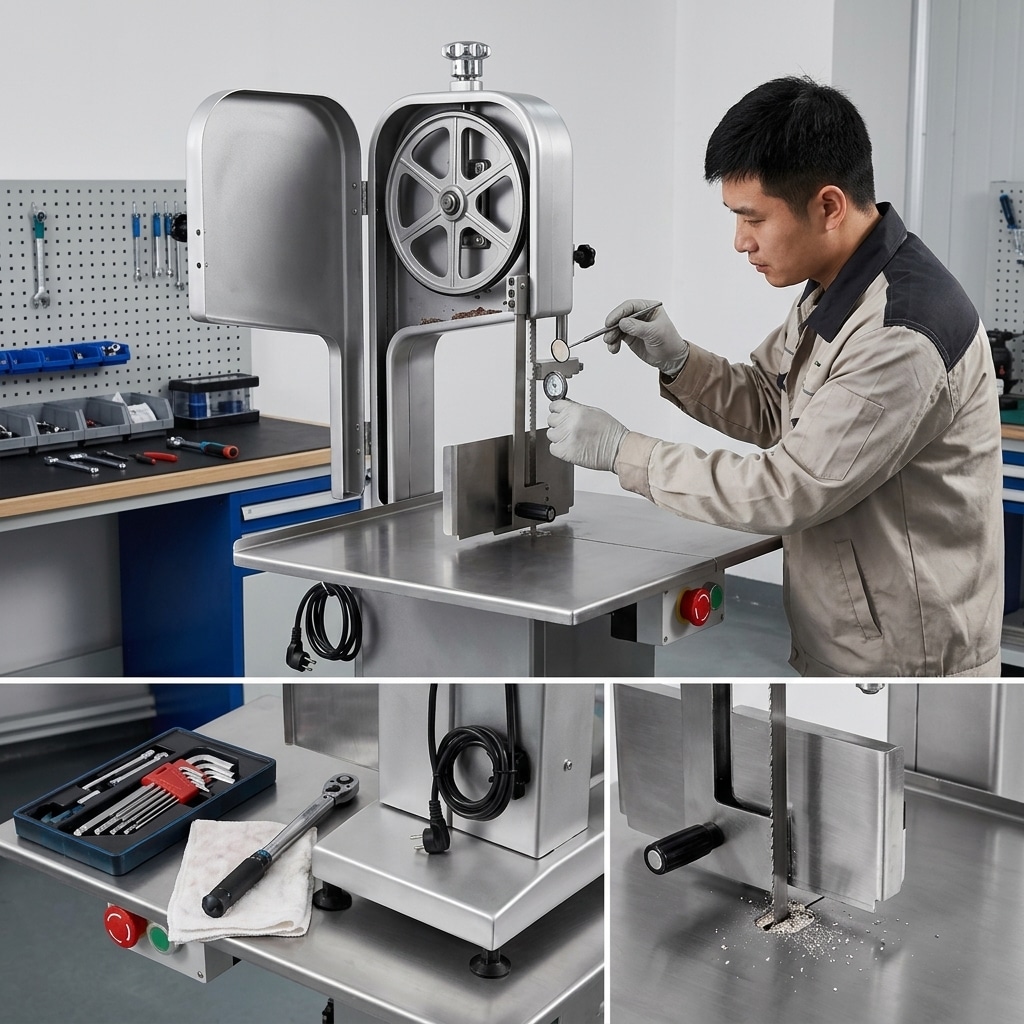
Before purchase, ask what routine maintenance the saw requires and which parts are considered wear items. The list may include blades, guides, scrapers, bearings, seals, switches, or other components, depending on the model. Confirm availability, lead times, and ordering channels for the market where the machine will operate.
Blade condition has a direct effect on cutting control and the quality of the cut. A damaged, dull, incorrectly tensioned, or incorrectly installed blade can increase resistance and create inconsistent results. Operators should follow the manual for inspection, tensioning, alignment, cleaning, sharpening policy, and replacement.
Daily checks should include the blade, guards, table, guides, wheels, controls, and visible electrical or mechanical damage. After production, clean and sanitize the machine according to the approved procedure, then dry and reassemble the relevant parts. Keep a simple record of cleaning, blade changes, faults, and service work.
Supplier support matters when a machine is part of a daily production process. Compare the clarity of the manual, training information, spare-parts response, troubleshooting assistance, warranty terms, and local dealer or service options. A lower purchase price may not be the most practical option if routine support is difficult to obtain.
Commercial Meat Bone Saw Buying Checklist
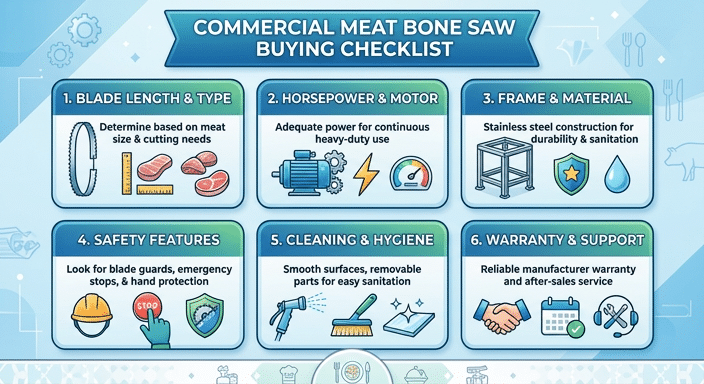
Use the following checklist when comparing commercial meat bone saw machines or preparing a request for quotation:
- Product: What meat, bone, poultry, fish, frozen, or semi-frozen products will be cut?
- Dimensions: What are the largest product height, width, length, and weight?
- Portions: What cut thickness and level of consistency are required?
- Workload: How many cuts, batches, or operating hours are expected per day?
- Installation: Is a tabletop or floor-standing format more suitable for the available space?
- Power: Does the machine match the site’s voltage, phase, frequency, and connection requirements?
- Hygiene: Can operators reach, remove, clean, dry, and reassemble the relevant parts?
- Safety: What guards, controls, emergency stops, guides, and interlocks are included?
- Blades: Which blade types are supplied, and how are replacements sourced?
- Support: What manuals, spare parts, warranty coverage, training, and service assistance are available?
Send this information to the supplier with photos or drawings of unusual products where possible. A clear application description allows the supplier to confirm suitability and identify specifications that still need verification.
For a second perspective on model selection, review how to choose a commercial meat bone saw machine. The final decision should be based on documented product fit, operating conditions, total workflow, and support arrangements.
Discuss Your Processing Requirements
Share your product dimensions, target portions, daily workload, installation conditions, and local power requirements with Easimaker. Our team can help clarify the suitable commercial meat bone saw configuration, confirm open specifications, and discuss quotation or support requirements for your market.