Table of Contents
- The safe cleaning sequence
- Why a controlled cleaning routine matters
- Prepare the machine and work area
- Remove components safely
- Wash, sanitise, and dry components
- Clean the fixed machine surfaces
- Inspect and reassemble the saw
- Set a cleaning frequency and record routine
- Avoid common cleaning mistakes
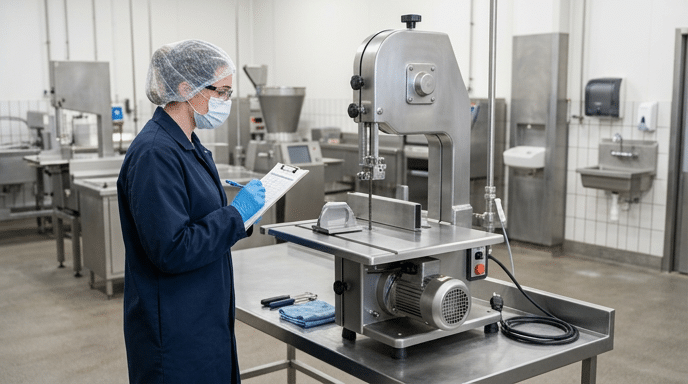
A commercial meat bone saw must be cleaned with the power isolated, removable parts handled safely, food residues removed before they dry, and all food-contact surfaces washed, sanitised, dried, and inspected before reassembly. This guide sets out a practical routine for butchers, processors, and commercial kitchens.
The safe cleaning sequence
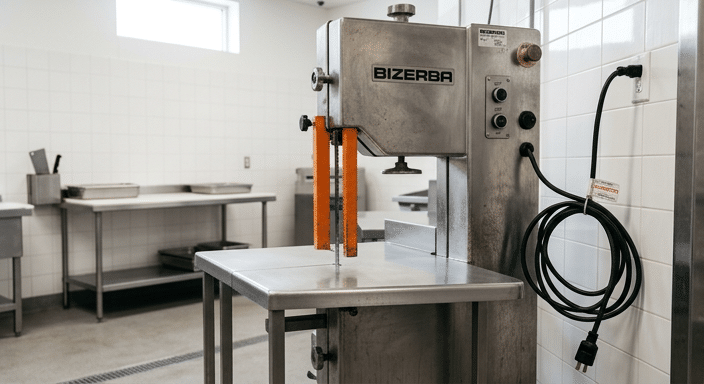
To clean a commercial meat bone saw safely, stop the machine, disconnect and isolate its electrical supply, wear suitable cut-resistant hand protection, remove the blade and removable food-contact parts according to the machine manual, then wash, sanitise, dry, inspect, and reassemble each component before the next use.
Do not clean a saw while it is connected to power or while the blade can move. Do not direct a high-pressure water jet at electrical controls, motor areas, bearings, or seals unless the manufacturer specifically permits that method. The correct details can vary by model, so the operating manual and the cleaning chemicals’ instructions always take priority.
A reliable routine has seven stages: isolate the machine; remove product debris; disassemble accessible parts; wash with an approved detergent; rinse where required; sanitise at the correct concentration and contact time; then air-dry, inspect, and reassemble. Completing the steps in that order helps reduce cross-contamination risk, protects operators from blade injuries, and makes faults easier to identify before production resumes.
Why a controlled cleaning routine matters
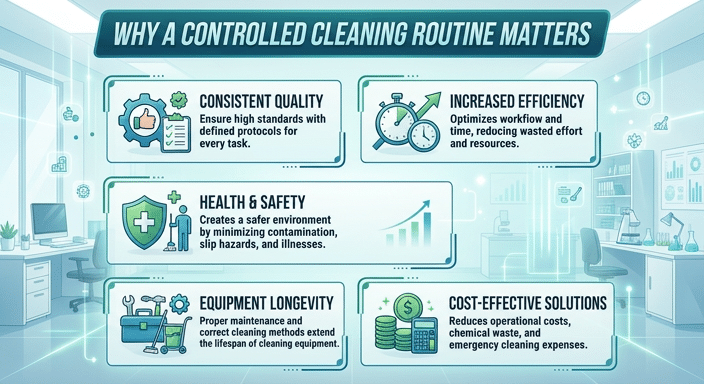
Bone saws handle raw meat, fat, connective tissue, bone fragments, and moisture. These materials can collect on the blade, table, blade guides, guards, pushers, scrapers, doors, and joints between components. If residue is allowed to dry, cleaning becomes slower and more difficult. It can also conceal damage, wear, or a loose part that should be corrected before the next shift.
Cleaning is not simply an end-of-day appearance task. It is part of food hygiene, operator safety, and machine care. Detergent removes grease and visible soil; a compatible sanitiser is used after effective washing to reduce microorganisms on clean surfaces. Sanitiser does not work properly through meat residue or fat, so it should not replace washing.
A disciplined routine also supports cutting quality. Bone debris around guides or the blade path can affect how the product moves through the saw. For operational guidance that helps control residue during production, see how to reduce bone dust when using a meat band saw. Cleaning still remains necessary even when cutting practices reduce loose bone particles.
Assign responsibility clearly. Operators should know who cleans the machine, who checks it before release for use, what chemicals are approved, and where the cleaning record is kept. In businesses with several shifts, this prevents an assumption that a previous team has completed a task that was only partly done.
Prepare the machine and work area
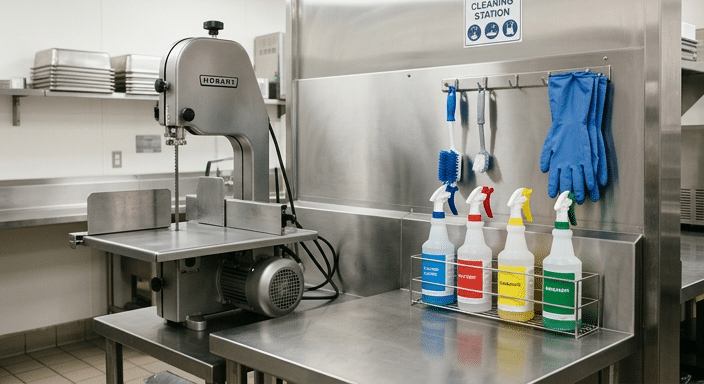
Begin only after all cutting has stopped and product has been removed from the immediate work area. Move finished product and exposed ingredients away from the cleaning zone to prevent splash or aerosol contamination. Remove loose packaging, cartons, and tools that could become wet or obstruct access.
Switch the saw off using its normal control, disconnect it from the electrical supply, and apply the site’s lockout or isolation procedure where applicable. Confirm that the blade has fully stopped. A stop button alone is not a substitute for electrical isolation during cleaning and disassembly.
Wear the personal protective equipment required by your risk assessment. This commonly includes protective apron or clothing, footwear with good grip, and cut-resistant gloves when handling the blade. Chemical-resistant gloves and eye protection may also be appropriate when mixing or applying cleaning products. Cut-resistant gloves help with blade handling, but they do not make unsafe blade handling acceptable.
Prepare only cleaning chemicals that are suitable for food-processing equipment and compatible with the saw’s materials. Follow the chemical supplier’s label for dilution, temperature, contact time, rinsing requirements, and personal protective equipment. Do not mix cleaning products. In particular, never mix chlorine-based products with acids or other chemicals, because hazardous gases can result.
Use dedicated brushes, cloths, and containers that are clean and in good condition. A narrow brush can be useful around guides and crevices; a larger brush or cloth can be used for broad stainless-steel surfaces. Avoid abrasive pads or harsh tools that may scratch food-contact surfaces unless the manufacturer permits them. Scratches can make future cleaning harder and may accelerate corrosion.
Remove components safely
Refer to the saw’s manual before removing any component. The removable parts differ between models, but may include the blade, blade guard, upper and lower wheel covers, table insert, product pusher, scrap tray, and guide-related components. Only remove parts that the manufacturer identifies as operator-removable for cleaning.
Remove loose debris first
Use a brush or scraper intended for food equipment to remove loose meat, fat, and bone particles from accessible areas. Work carefully and direct debris away from your body. Do not use bare fingers to clear material close to the blade teeth, guides, or narrow slots.
Handle the blade as a sharp component
When the machine manual permits blade removal, release tension and remove the blade following the stated sequence. Hold it in a controlled manner, keep your hands away from the teeth, and avoid allowing the blade to spring open. Place it in a designated blade-cleaning area or carrier. Do not leave a removed blade on a bench where it can be knocked, stepped on, or mistaken for waste.
Do not force guards, knobs, or guide parts. Resistance can indicate that a fastener is still engaged, residue is binding the component, or the part is not designed to be removed in that direction. Forcing parts can damage threads, distort guards, or create a safety issue when the machine is reassembled.
Good cutting setup reduces unnecessary residue and makes cleaning easier. Operators who need to review production handling can use this guide to meat band saw cutting techniques for consistent portions, alongside the machine’s own operating instructions.
Wash, sanitise, and dry removable components
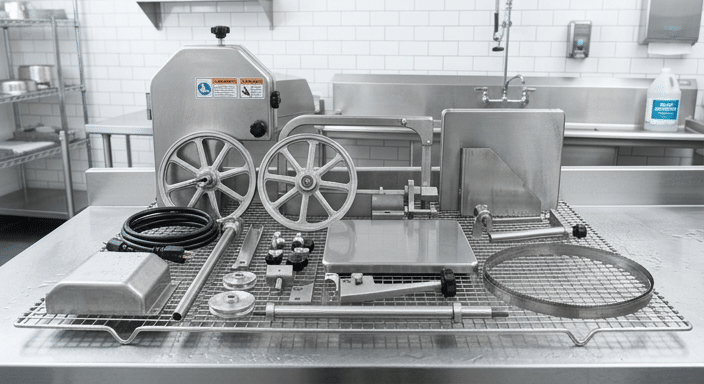
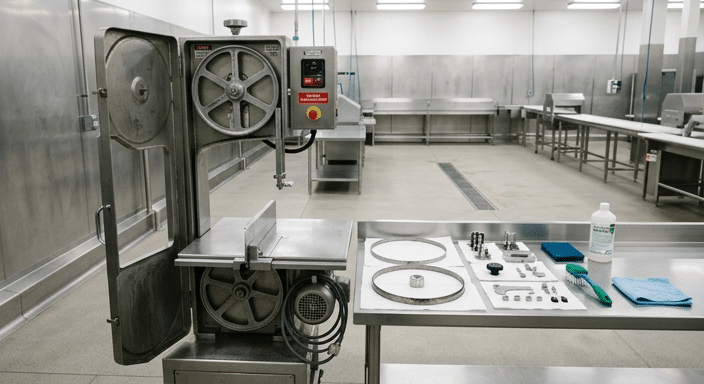
Wash removable components in a dedicated sink or cleaning area using warm water and the approved detergent, following the chemical supplier’s instructions. The objective is to remove visible food residue, fat, and protein film from every accessible surface. Give particular attention to the table insert, pusher, blade guards, scrap collection parts, guide surfaces, and the blade itself if the manual allows it to be washed.
Use brushes sized for the component. Brush from a controlled position and keep hands away from sharp teeth. Do not use a cloth wrapped around the blade because the cloth can catch on teeth and pull a hand toward the cutting edge. Where a component has slots, seams, fasteners, or hollow areas, inspect them closely for trapped residue.
Rinse washed parts if required by the detergent instructions. Then apply a food-contact-surface sanitiser at the correct dilution and for the full stated contact time. Using too little chemical, shortening contact time, or applying sanitiser over unwashed soil can make the process ineffective. Using a stronger solution than instructed is also not a substitute for correct procedure and can damage materials or leave an unsuitable residue.
Allow components to air-dry on a clean rack or approved clean surface. Avoid wiping them dry with a cloth that may reintroduce contamination or leave fibres behind. Do not store cleaned parts in a damp enclosed space. Moisture can encourage corrosion, leave water marks, and create conditions that require re-cleaning before use.
Inspect each part under adequate lighting after it dries. It should be free from visible meat, fat, bone debris, detergent residue, and damage. If a part cannot be cleaned effectively, remove it from service and have the issue assessed according to your maintenance process.
Clean the fixed machine surfaces
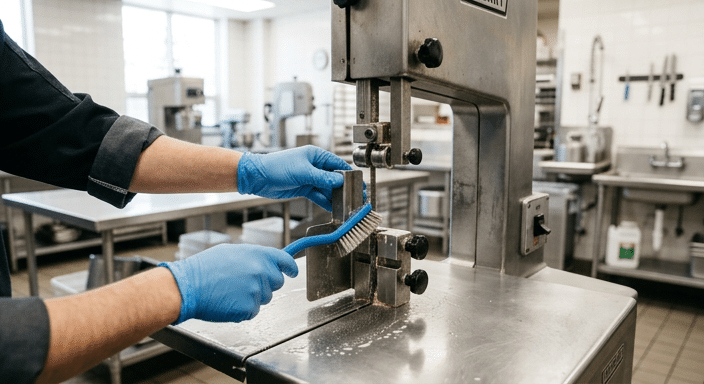
After removable parts are out of the way, clean the fixed surfaces of the saw: the frame, table area, door edges, accessible wheel housing surfaces, guide mounts, product feed area, and surrounding splash zones. Start by removing dry or loose debris, then apply detergent using a cloth, brush, or low-pressure method approved for the machine.
Keep water and chemical solution away from electrical controls, switches, plugs, motor ventilation openings, bearings, and any other area identified in the manual. Wipe these areas with a suitable lightly dampened cloth if the manufacturer permits it. Never assume a stainless-steel exterior means all areas of the machine can be hosed down.
Clean from cleaner areas toward dirtier areas and from higher surfaces toward lower surfaces so you do not spread residue back onto cleaned sections. Pay attention to the underside of the table, the junctions around guards, and the area beneath or behind the blade path, where debris can be missed during a quick visual check.
Rinse only where the detergent instructions and machine guidance allow. Then sanitise the cleaned food-contact and adjacent exposed surfaces using the correct method for the sanitiser. Observe the required contact time. Let the machine air-dry with covers open only where this is safe and permitted, so accessible moisture can evaporate before reassembly.
While cleaning, look for signs of wear such as cracked guards, loose hardware, damaged scrapers, hard-to-clean corrosion, or a guide that no longer holds its setting. These observations are valuable because they occur when surfaces are visible and the machine is isolated. Record defects and do not return the saw to use until safety-related faults have been addressed.
Inspect and reassemble the saw before use
Reassemble the saw only when all parts are clean, dry, and in serviceable condition. Follow the manual’s reassembly order. Refit guards, inserts, trays, and guide components securely, and make sure there are no cleaning tools, cloths, fasteners, or packaging materials left inside the machine.
Fit and tension the blade only as specified by the manufacturer. Confirm that the blade is correctly seated on the wheels and guides, with the teeth facing in the required cutting direction. Incorrect blade fitment can damage the saw, cause poor cutting, or create a serious safety risk. Close and secure covers before reconnecting power.
Before processing food, complete the pre-use check required by your site. This may include confirming that guards are fitted, doors are closed, the table and pusher move correctly, the blade is appropriately tensioned, and emergency-stop and interlock functions are operating as intended. Do not bypass a guard, switch, or interlock to speed up restart.
Run the saw empty only if the manufacturer permits a functional check after cleaning. Listen and observe from a safe position. Unusual vibration, rubbing, noise, or blade tracking should be investigated before product is loaded. For a broader review of selecting and maintaining a saw around your operation, see the commercial bone saw machine buying checklist for butchers.
Set a cleaning frequency and record routine
Cleaning frequency should be based on the food safety procedures that apply to your operation, the products being processed, and the manufacturer’s instructions. In many commercial environments, a full clean is completed at the end of each production period and whenever the saw changes from one task to another in a way that could create contamination risk. Visible build-up should be removed promptly and safely rather than left until it becomes difficult to clean.
Use a short, practical cleaning checklist. It can include isolation confirmed; blade and removable components cleaned; fixed surfaces washed and sanitised; parts air-dried; defects recorded; guards refitted; and pre-use check completed. A signed or digital record makes the process consistent across staff and helps supervisors identify recurring issues.
Build preventive maintenance into the same system, but keep it distinct from routine washing. Blade condition, tracking, tensioning components, guide wear, door seals, fasteners, and electrical parts may need periodic inspection by a trained person. Cleaning reveals problems; it does not replace maintenance. Where a manual gives a different interval or procedure, follow the manual.
Staff training matters most at the points with the highest risk: isolation, blade removal, chemical handling, cleaning around the blade path, and reassembly. New staff should be shown the model-specific procedure and supervised until they can complete it correctly. A general method is useful, but it cannot replace the instructions for the machine installed in your facility.
Avoid common cleaning mistakes
The most common problems are usually procedural rather than complicated. Avoid these mistakes:
- Cleaning before isolation: never rely only on the normal stop control when disassembling or cleaning around the blade.
- Sanitising a dirty surface: remove meat residue and fat with detergent first, then sanitise the cleaned surface.
- Using unsuitable chemicals: use only products compatible with food equipment and the saw materials, mixed and applied as directed.
- Flooding protected parts: do not spray motors, switches, electrical connections, bearings, or seals unless the manufacturer explicitly allows it.
- Handling a blade casually: remove, wash, carry, and store it with controlled movements and suitable protection.
- Reassembling wet parts: allow components to dry and inspect them before fitting them back to the saw.
- Ignoring damage found during cleaning: record faults and remove the machine from service when a defect affects safety, cleanability, or reliable operation.
A bone saw that is easy to access, clean, inspect, and service is generally easier to manage over its working life. When comparing equipment for a new operation or replacement purchase, this guide to choosing a commercial meat bone saw machine can help you assess cleaning access alongside cutting requirements, workspace, electrical supply, and service support.