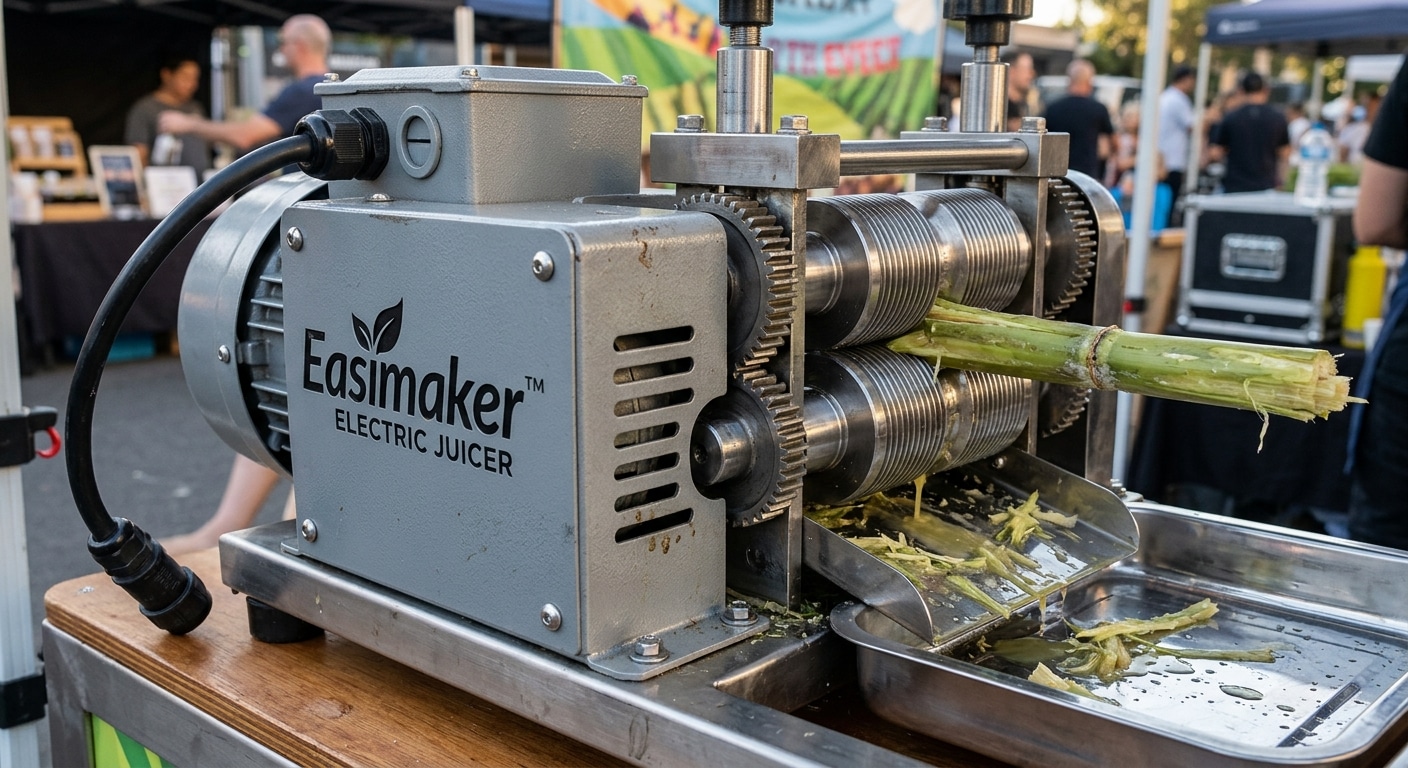
Weight and Portability: Choosing the Right Sugarcane Machine for Pop-Up Events

Introduction: The Mobile Vendor’s Dilemma

For event caterers, market vendors, and mobile food entrepreneurs, logistics dictate profitability. Operating a mobile juice stand requires moving equipment quickly, setting up in confined spaces, and breaking down efficiently at the end of the day. When it comes to sugarcane juice extraction, vendors face a specific challenge: balancing the heavy-duty mechanics required to crush dense sugarcane with the strict weight and footprint limitations of pop-up event equipment.

Investing in the right portable sugarcane juicer ensures that you can achieve commercial-grade extraction rates without overburdening your transport vehicles or staff. This guide explores how machine dimensions, weight, and engineering impact mobile operations, helping you select the ideal electric juicer for your mobile business.

Understanding Machine Dimensions and Weight Factors

Sugarcane juicers are inherently heavy due to the immense pressure required to extract juice from fibrous stalks. However, modern engineering has optimized the weight-to-power ratio for mobile applications. When evaluating a lightweight commercial juicer, consider the following components that contribute to its overall footprint and weight:

  • Electric Motor and Gearbox: The heart of the machine. High-torque electric motors equipped with precision gear reducers provide the necessary crushing force. Advanced copper-core motors offer a more compact footprint while maintaining continuous operational stability.
  • Roller Configuration: Most portable electric models utilize a 3-roller or 4-roller system. While more rollers can marginally increase extraction yield, they also add significant weight and widen the machine dimensions. For pop-up events, a highly optimized 3-roller system often provides the best balance of yield (typically 70-80%) and portability.
  • Casing and Frame Materials: Food-grade 304 stainless steel is non-negotiable for hygiene and durability. While solid stainless steel adds weight compared to aluminum or plastic, it is essential for structural integrity, vibration reduction, and compliance with health department standards.

Balancing Extraction Power with Portability

A common pitfall for mobile vendors is sacrificing extraction power for a lighter machine. If a machine is too light, it may feature a weak motor or hollow rollers, leading to frequent jamming, low juice yield, and eventual motor burnout during high-demand event rushes.

The goal is to find a compact electric juicer that maximizes output per square inch of your vendor table. Look for machines that feature enclosed gearboxes and direct-drive systems. These designs eliminate bulky belts and pulleys, significantly reducing the machine’s overall dimensions while ensuring maximum power transfer from the motor to the crushing rollers.

Comparing Portable Sugarcane Juicer Options

When selecting equipment for a mobile juice stand, buyers generally choose between two categories of electric machines:

Machine Type Typical Weight Range Best Used For Pros & Cons
Ultra-Compact Tabletop 40kg – 55kg Farmers markets, small pop-up tents, highly mobile setups. Pros: Easily lifted by two people, fits in standard vehicles.
Cons: May have a slightly lower hourly throughput.
Mid-Size Mobile Unit 60kg – 85kg High-volume festivals, dedicated food trucks, semi-permanent stands. Pros: Higher continuous crushing capacity, robust motors.
Cons: Requires a heavy-duty cart or ramp for transport.

Manufacturing, Quality, and Testing Considerations

As a B2B buyer or operations manager, sourcing reliable equipment is critical to minimizing downtime. When evaluating manufacturers, inquire about their quality assurance (QA) processes. A reputable supplier will test electric motors under load to ensure they do not overheat during continuous operation—a common scenario at busy summer festivals.

Additionally, inspect the design for ease of maintenance. Pop-up events rarely offer comprehensive cleaning facilities. A well-designed portable sugarcane juicer should feature easily removable parts or a fully sealed roller compartment that can be flushed safely with water without risking damage to the electrical components.

Buying Guide for Mobile Entrepreneurs

If you are outfitting a fleet of mobile juice stands or purchasing for a catering business, keep these procurement factors in mind:

  • Minimum Order Quantities (MOQ): Many manufacturers offer flexible MOQs, allowing you to purchase a single unit for testing before outfitting multiple carts.
  • Customization: Ask about custom branding. Having your logo laser-etched or wrapped on the stainless steel casing can elevate the professionalism of your pop-up event equipment.
  • Logistics and Lead Times: Factor in shipping weights. Because these machines are heavy, air freight for a single unit can be expensive. Plan your procurement 6-8 weeks ahead of your event season to take advantage of more economical sea freight options.
  • Power Compatibility: Ensure the electric motor is configured for the voltage and frequency of your operating region (e.g., 110V/60Hz for North America, 220V/50Hz for Europe/Asia) to avoid needing bulky transformers on-site.

Frequently Asked Questions (FAQs)

Can one person lift a portable electric sugarcane juicer?

Most commercial-grade portable electric models weigh between 40kg and 60kg. While a strong individual might be able to lift the lighter models, it is highly recommended to use a two-person team or a heavy-duty rolling cart to prevent injury and protect the equipment during transport.

What power source do I need for a pop-up event?

Portable electric sugarcane juicers typically draw between 400W and 750W. They can easily run on standard generator power or a high-capacity portable power station, making them ideal for off-grid event catering.

How do I clean the machine at an outdoor market?

Look for machines with a sealed roller compartment. Vendors typically run clean water through the running rollers at the end of the shift, collecting the runoff in a bucket. A thorough breakdown and sanitization should be completed once you return to your commissary kitchen.

Does a smaller machine mean less juice?

Not necessarily. The yield depends on the roller tolerance and motor torque, not just the physical size of the machine. A well-engineered compact electric juicer can achieve the same 70-80% extraction rate as a larger floor model.

Are manual juicers better for portability?

While manual juicers are lighter, they are entirely impractical for commercial pop-up events. They require immense physical labor, slow down service drastically, and yield less juice. A compact electric juicer is always the recommended choice for professional vendors.

Ready to Upgrade Your Mobile Setup?

Selecting the right equipment is the foundation of a successful mobile beverage business. If you need a reliable, high-yield, and easily transportable electric sugarcane juicer for your next event season, we can help you find the perfect specification for your operational needs.

Request a quote / Get a sample today to discuss technical specifications, shipping logistics, and pricing for our premium portable sugarcane juicers.

Integrating Sugarcane Juicers into Food Trucks: Power and Space Requirements

The Rise of the Mobile Juice Business

The mobile food industry has seen a massive surge in demand for fresh, functional beverages. For entrepreneurs and food truck builders, integrating a commercial sugarcane juicer presents a highly profitable opportunity. However, unlike standard blenders or citrus presses, commercial sugarcane machines are heavy-duty industrial equipment. They require specific considerations regarding electrical load, physical footprint, and operational workflow.

This guide provides technical advice for food truck operators, engineers, and equipment distributors on how to successfully install a portable sugarcane juicer into a compact mobile layout, ensuring safety, efficiency, and compliance.

Power Supply Requirements for Juicers

One of the most critical factors in mobile food truck equipment integration is managing the electrical load. Sugarcane juicers require robust motors with high starting torque to crush dense fibrous stalks, which impacts your truck’s power supply design.

Calculating Electrical Load and Surge Wattage

Commercial sugarcane juicers typically feature gear-driven motors ranging from 400W (0.5 HP) to 1500W (2 HP) depending on their capacity. While the continuous running wattage might fit comfortably within a standard generator’s capacity, the surge wattage (starting wattage) is the primary concern. Electric motors can draw two to three times their running wattage for a fraction of a second upon startup.

  • Example Calculation: A 750W sugarcane juicer may require a surge capacity of up to 2200W to start without tripping breakers.
  • Actionable Tip: Ensure your generator or inverter/battery bank is sized to handle the cumulative running load of all active food truck equipment, plus the highest single surge wattage of your heaviest motor.

Voltage and Power Source Compatibility

Depending on your region and truck build, you must select a machine with the correct voltage (e.g., 110V/60Hz for North America, 220V/50Hz for Europe/Asia). For mobile setups relying on off-grid battery banks, pure sine wave inverters are mandatory. Modified sine wave inverters can cause motor overheating and premature failure in commercial juicers.

Food Truck Layout and Space Optimization

Space is the most valuable commodity in a mobile juice business. A well-planned food truck layout ensures high throughput and safe operation.

Dimensions and Clearance Requirements

Sugarcane juicing is a linear process. Operators must feed long stalks (often 1 to 2 meters in length before cutting) into the machine. Therefore, the juicer cannot be placed in a cramped corner.

  • Feeding Clearance: Allow at least 1 meter of unobstructed linear space in front of or to the side of the feed chute.
  • Vertical Clearance: If using a countertop model, ensure there is adequate space above the machine for easy cleaning and maintenance.

Waste Management (Bagasse)

Sugarcane extraction produces a high volume of fibrous waste known as bagasse. In a compact food truck layout, letting bagasse pile up on a counter is a sanitation hazard and a workflow bottleneck.

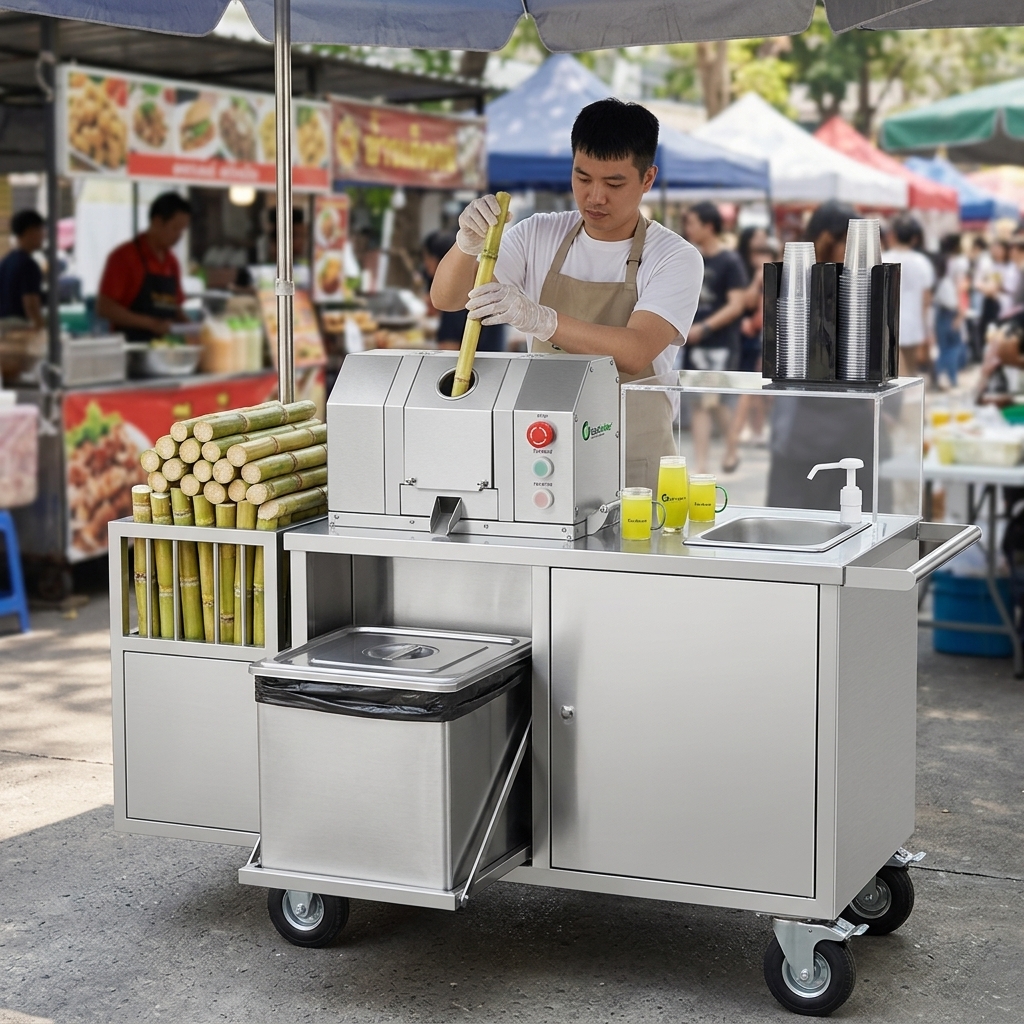
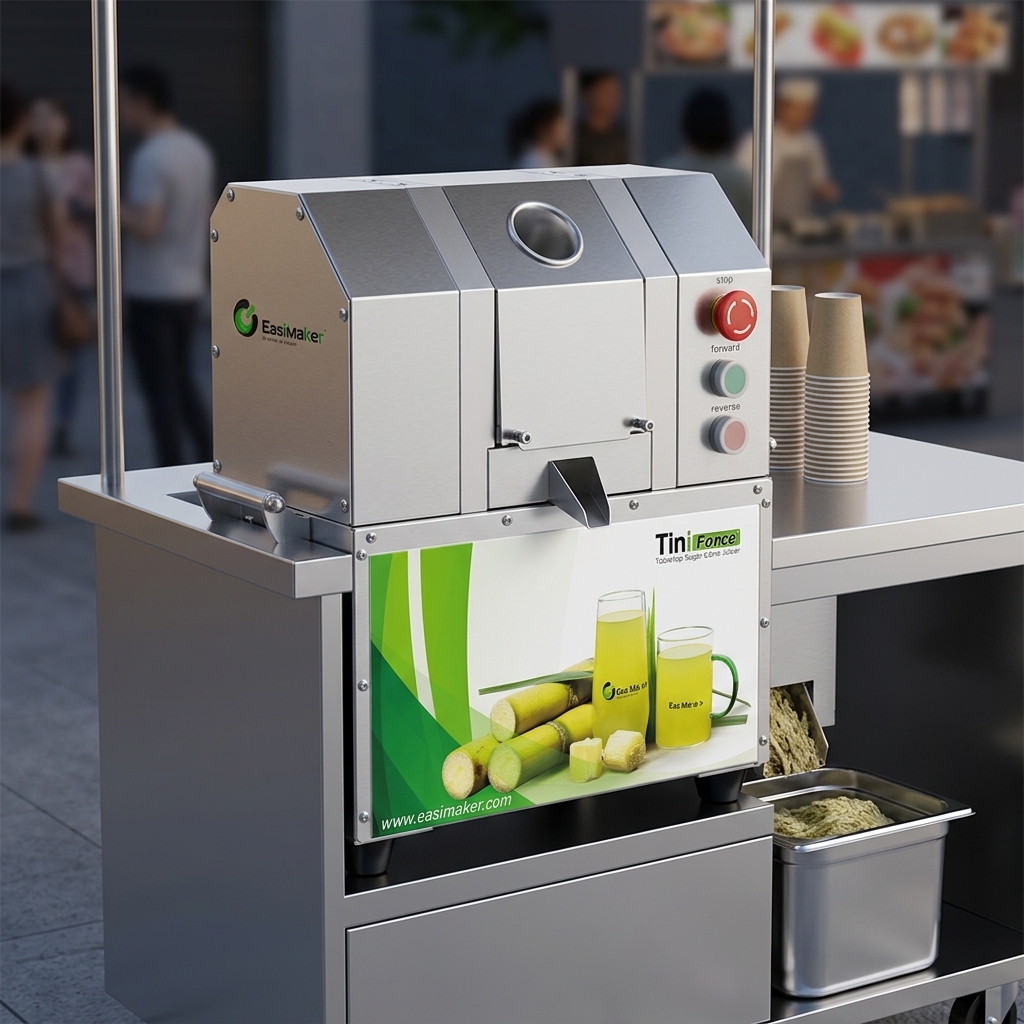
Design the counter with a dedicated drop-hole directly beneath or adjacent to the machine’s waste ejection chute. This allows the bagasse to fall seamlessly into a large, concealed waste bin under the counter, keeping the primary workspace clean and maximizing efficiency.

Weight Distribution and Mounting

Commercial sugarcane juicers are constructed from heavy-duty 304 stainless steel and feature solid steel rollers. Even compact portable sugarcane juicers can weigh between 40kg and 80kg (88 lbs to 176 lbs).

  • Weight Distribution: Position the machine over the truck’s axles rather than at the extreme rear or front to maintain vehicle stability.
  • Vibration Isolation: Food trucks experience constant road vibrations. The juicer must be bolted directly to a reinforced stainless steel counter. Use heavy-duty rubber mounting pads to absorb operational vibrations and protect both the machine and the counter structure.

Equipment Selection: Countertop vs. Standalone

When selecting a portable sugarcane juicer for a mobile setup, buyers generally choose between two form factors. Here is a brief comparison to guide your procurement strategy:

Feature Countertop Models Standalone / Cart Models
Footprint Minimal; utilizes existing counter space. Requires dedicated floor space.
Weight Lighter (approx. 40-60kg). Heavier (approx. 80-120kg+).
Best For Multi-purpose food trucks with limited space. Dedicated juice trucks with open floor plans.
Waste Setup Requires custom counter modification for waste. Often includes built-in waste compartments.

Sanitation and Maintenance in a Mobile Setup

Health department regulations for food trucks are strict, particularly concerning equipment that processes raw agricultural products. Ensure the juicer you source features a fully enclosed gearbox to prevent contamination. The crushing rollers and juice collection tray must be easily accessible for frequent washdowns. Ensure your truck’s fresh water tank and water pump can supply adequate pressure for the daily cleaning of the stainless steel components.

Buying Guide for Mobile Juice Operators

If you are procuring equipment for a fleet of food trucks or starting a new mobile venture, keep these purchasing factors in mind:

  • Customization: Verify that the manufacturer can supply the exact voltage and plug type required for your truck’s electrical panel.
  • Material Specifications: Insist on food-grade 304 stainless steel for all parts that touch the juice (rollers, trays, filters) to resist corrosion from acidic juices and frequent washing.
  • Sampling & MOQ: For fleet builders, request a single sample unit to test the electrical load and physical fit in your prototype truck before committing to a larger Minimum Order Quantity (MOQ).
  • Lead Times: Factor in manufacturing and shipping lead times, which typically range from 15 to 45 days depending on customization requirements and logistics.

Frequently Asked Questions (FAQs)

1. Can I run a commercial sugarcane juicer on a solar-powered food truck?

Yes, provided your battery bank and pure sine wave inverter can handle the continuous wattage and the high surge wattage required during motor startup.

2. How much space do I need around the juicer for ventilation?

Leave at least 10-15 cm (4-6 inches) of clearance around the motor housing vents to prevent overheating during continuous operation.

3. Are portable sugarcane juicers noisy?

High-quality commercial juicers with gear-driven motors operate relatively quietly (usually between 60-75 decibels), which is acceptable for a food truck environment.

4. How do I secure the machine for driving?

Never rely on gravity. The machine must be bolted through the counter using heavy-duty hardware, preferably with rubber dampeners to absorb road shocks.

5. What is the best way to handle sugarcane stalks in a small truck?

Pre-cut and wash the stalks at a commissary kitchen before loading them onto the truck. Store them in vertical, food-safe PVC or stainless steel bins near the machine to save horizontal space.

Ready to Upgrade Your Mobile Setup?

Integrating the right equipment is the foundation of a successful mobile juice business. If you need reliable, commercial-grade machinery engineered for efficiency and durability, we are here to help. Request a quote / Get a sample today to find the perfect sugarcane juicer for your food truck layout.

The Ultimate Guide to Setting Up a Mobile Sugarcane Juice Cart

The global shift toward healthier, natural beverages has created a significant market opportunity for fresh sugarcane juice. Unlike processed sodas, fresh cane juice appeals to health-conscious consumers looking for raw, unpasteurized options. For entrepreneurs and distributors, a mobile sugarcane juice cart represents a high-margin, low-overhead entry point into this sector.

However, mobility introduces specific technical challenges that brick-and-mortar operations do not face. Power independence, machine weight, vibration control, and hygiene compliance are critical factors. This guide outlines the essential equipment specifications, power configurations, and operational considerations for deploying a successful mobile sugarcane juice business.

Core Equipment: Selecting the Right Portable Sugarcane Machine

The centerpiece of the operation is the extractor. In a mobile setting, you cannot rely on heavy, belt-driven industrial crushers. You require a compact, direct-drive unit that balances torque with portability.

1. Roller Configuration and Material

Efficiency in a mobile unit is defined by extraction rate—how much juice is extracted in a single pass. Multi-pass crushing slows down service and increases labor.

  • 3-Roller vs. 4-Roller Systems: A 3-roller system is the industry standard for compact machines. It typically offers a single-pass extraction rate of 75-80%. A 4-roller system increases extraction slightly but adds weight and complexity. For most mobile carts, a high-quality 3-roller system is the optimal balance.
  • Material Specification: Rollers must be manufactured from Food Grade Stainless Steel (typically SS304). Avoid galvanized iron or lower-grade steels, which can rust and violate health codes. Solid steel rollers provide better durability than hollow ones, preventing deformation under the high pressure required to crush cane.

2. Safety Protocols

Mobile environments are often crowded. Machines must have emergency stop buttons and, crucially, a narrow feed inlet that prevents operators from accidentally inserting hands or fingers. Look for machines with reverse-switch functionality to easily clear jams without dismantling the unit.

Powering Your Mobile Unit: AC vs. DC vs. Generators

Power availability is the primary constraint for mobile vendors. Your choice of power source dictates your location flexibility.

Battery-Operated (DC) Machines

Modern mobile machines often come with integrated battery systems or compatibility with external deep-cycle batteries.

  • Pros: Silent operation (ideal for indoor events, corporate parks, or noise-restricted zones), zero emissions, and complete mobility.
  • Cons: Limited runtime (typically 4-6 hours depending on load). Requires disciplined charging routines.
  • Technical Requirement: Ensure the machine runs on a 24V or 48V DC motor with sufficient torque. 12V systems often lack the power to crush thick cane stalks without stalling.

Generator-Powered (AC) Setup

Standard AC machines (110V/220V) powered by a portable generator.

  • Pros: Unlimited runtime as long as fuel is available. Can power ancillary equipment like blenders or fridges.
  • Cons: Noise and exhaust fumes can limit operating locations. Higher ongoing fuel costs and maintenance.
  • Recommendation: If using a generator, opt for an inverter generator for cleaner power delivery to protect the machine’s electronic components.

Cart Design and Workflow Optimization

Space is at a premium in a mobile cart. An efficient layout minimizes movement and maximizes throughput.

The “Clean to Dirty” Workflow

Design the cart layout to follow a linear process to prevent cross-contamination:

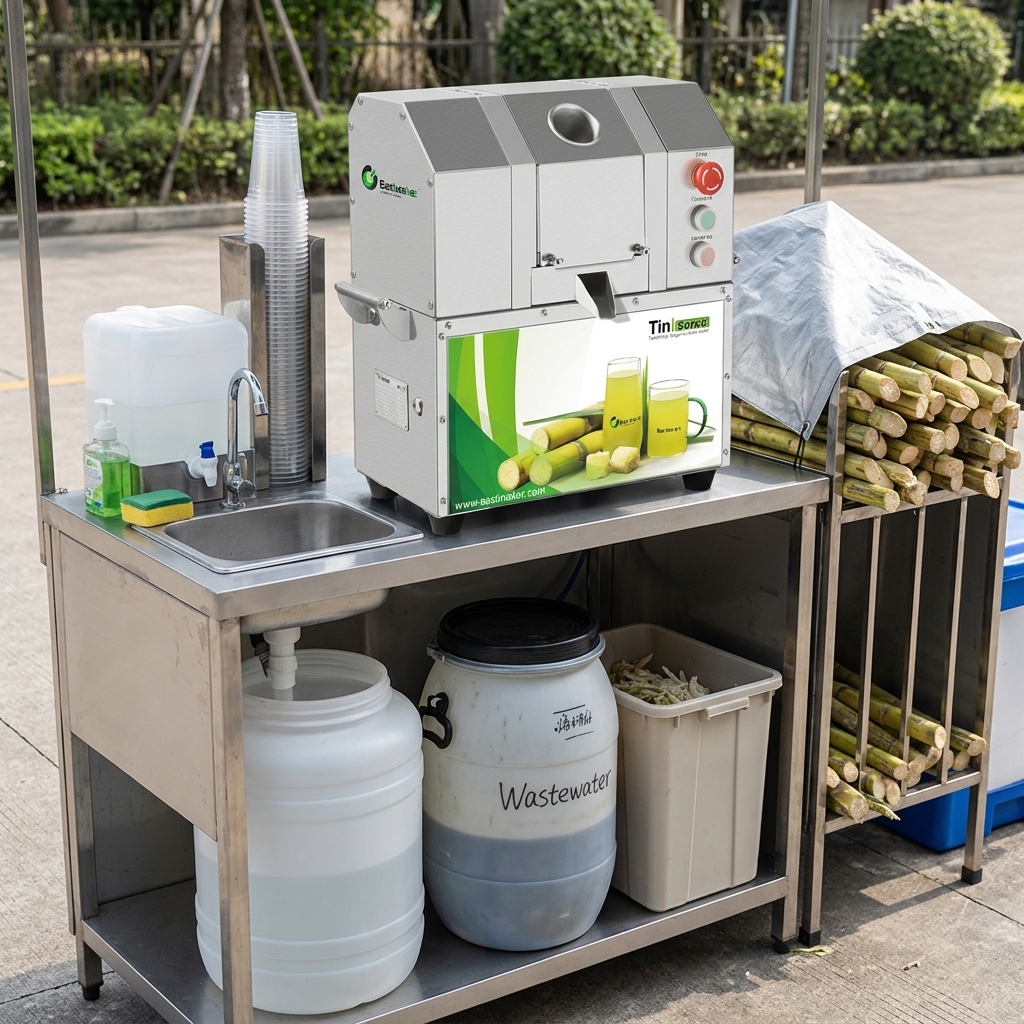
  1. Storage: Raw cane should be stored in a cool, shaded section, ideally vertically to prevent spoilage.
  2. Washing: A small dedicated sink or spray zone for rinsing cane before crushing.
  3. Crushing: The machine placement should allow bagasse (waste fiber) to drop directly into a concealed bin below the counter. This keeps the visual frontage clean.
  4. Filtration & Serving: Juice should pass through a strainer immediately.
  5. Payment: The transaction area should be separate from the food handling area.

Waste Management (Bagasse)

Sugarcane crushing generates significant volume in waste fiber. A mobile cart must have a high-capacity, concealed waste compartment. If the bagasse bin is too small, the operator will be forced to stop frequently to empty it, disrupting service during peak hours.

Hygiene and Compliance Considerations

Regulatory bodies inspect mobile food units rigorously. Your equipment choice directly impacts compliance.

  • Closed-Loop Design: Choose machines with enclosed crushing areas. Exposed rollers attract flies and dust, which is a major red flag for health inspectors.
  • Cleanability: The juice extraction box should be detachable or easily accessible for daily washing. Fermented sugar residue builds up quickly and ruins the taste of fresh juice.
  • Glass/Plexiglass Guards: Ensure the cart has a sneeze guard separating the customer from the preparation area.

Buying Guide: Sourcing and Manufacturing

When procuring equipment for a fleet of carts or a single startup unit, consider the following supply chain factors.

Spare Parts Availability

Sugarcane machines operate under high mechanical stress. Bearings, gears, and chains are wear components. Ensure your supplier provides a comprehensive spare parts kit and has a documented supply chain for replacements. A machine that cannot be repaired is a sunk cost.

Customization and Branding

For B2B buyers distributing these carts, the ability to apply custom vinyl wraps or laser-cut logos is essential. Check if the manufacturer offers “white label” manufacturing or ready-to-brand surfaces.

Warranty and Support

Verify the warranty terms. Does it cover the motor and gearbox? For battery-operated units, what is the warranty on the battery cells? Standard industrial warranties should cover the motor for at least 12 months.

Frequently Asked Questions

What is the typical juice yield per kilogram of sugarcane?

On a high-efficiency 3-roller machine, you can expect a yield of roughly 600ml to 750ml of juice per 1kg of sugarcane, depending on the cane variety and freshness.

Can a mobile machine handle frozen sugarcane?

No. Sugarcane must be thawed before crushing. Crushing frozen cane can damage the rollers, bearings, and gearbox due to the extreme hardness.

How often does the machine need greasing?

Chain drives and exposed gears typically require food-grade grease weekly. Sealed gearboxes usually require oil changes every 6-12 months, depending on usage intensity.

Is a cooling system necessary for the cart?

While not mandatory for the machine itself, serving cold juice is a market standard. If the machine does not have an integrated cooling system (which is heavy and power-hungry), you must allocate space for an insulated ice bin or a portable DC-powered refrigeration unit.

Next Steps

Launching a mobile sugarcane juice business requires balancing portability with industrial-grade durability. Whether you are outfitting a single food truck or procuring a fleet of carts for a franchise, selecting the right machinery is the first step toward operational success.

Ready to configure your mobile setup? Contact us today to discuss machine specifications, power options, and custom cart designs tailored to your market needs.

Request a quote / Get a sample