
Table of Contents
- The Basic Sugarcane Juice Break-Even Formula
- Identify Fixed and Variable Costs
- Calculate Contribution Margin per Serving
- Worked Break-Even Example
- Use Realistic Sales and Operating Assumptions
- Connect Break-Even with ROI and Sensitivity Analysis
- Practical Ways to Improve the Break-Even Point
To calculate a sugarcane juice business break-even point, divide total fixed costs by the contribution margin per serving. This guide explains the formula, cost inputs, sales assumptions, ROI considerations, and practical ways to build a reliable break-even model for a commercial juice operation.
The Basic Sugarcane Juice Break-Even Formula
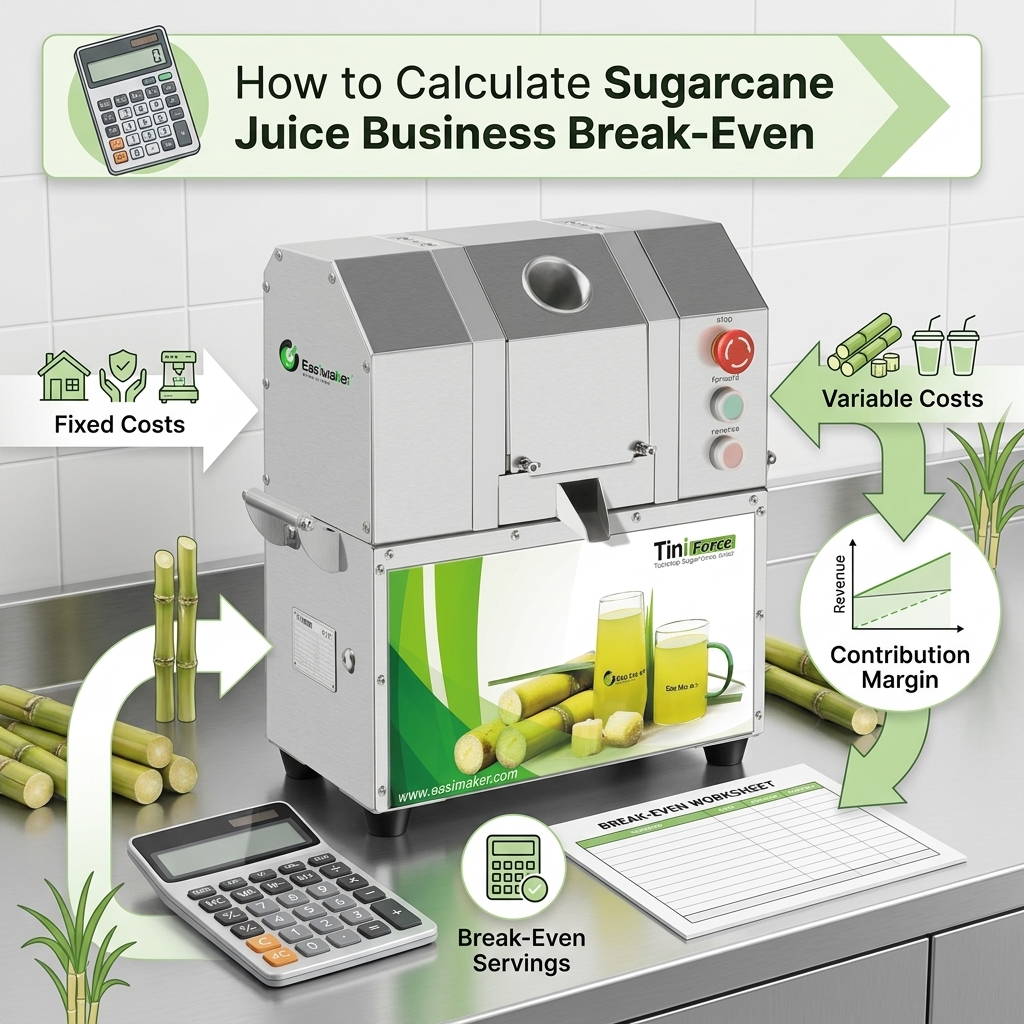
The sugarcane juice business break-even point is the sales level at which total revenue equals total costs. At this point, the business has covered its operating expenses but has not yet generated operating profit.
Use this formula:
Break-even servings = Total fixed costs ÷ Contribution margin per serving
To calculate the break-even point in sales revenue:
Break-even revenue = Break-even servings × Selling price per serving
The contribution margin is the selling price minus the variable cost of producing and selling one serving. This calculation is more useful than comparing machine price with daily sales because it includes the costs that change with every cup.
For a reliable model, calculate the result by day, month, and year. Also separate one-time startup investment from recurring operating costs so you can understand both operating break-even and investment payback.
Identify Fixed and Variable Costs
The quality of a sugarcane juice break-even analysis depends on how completely you list costs. Start with two categories: fixed costs and variable costs.
Fixed costs
Fixed costs generally remain stable during the period being analysed, even when sales volume changes. They may include:
- Shop, kiosk, or market-stall rent
- Base salaries or guaranteed wages
- Business registration, permits, and recurring service fees
- Equipment depreciation or monthly finance payments
- Insurance, accounting, software, and communications
- Basic utilities that do not vary significantly with output
- Planned maintenance allowances
Some costs are semi-fixed. For example, electricity may include a fixed connection charge plus a usage charge. Estimate each part separately where possible.
Variable costs
Variable costs increase as more servings are sold. Include:
- Raw sugarcane consumed per serving
- Cups, lids, straws, bags, labels, and other packaging
- Ice, water, flavouring, or optional ingredients
- Payment processing fees based on transaction value
- Sales commissions or delivery charges
- Waste and spoilage associated with each serving
Do not overlook startup items such as the juicer, preparation table, water system, signage, initial stock, transport, installation, and staff training. These may not all enter the monthly operating break-even formula, but they matter when calculating payback and overall business ROI.
For a broader equipment budget, review this guide to sugarcane juicer cost and business budgeting.
Calculate Contribution Margin per Serving
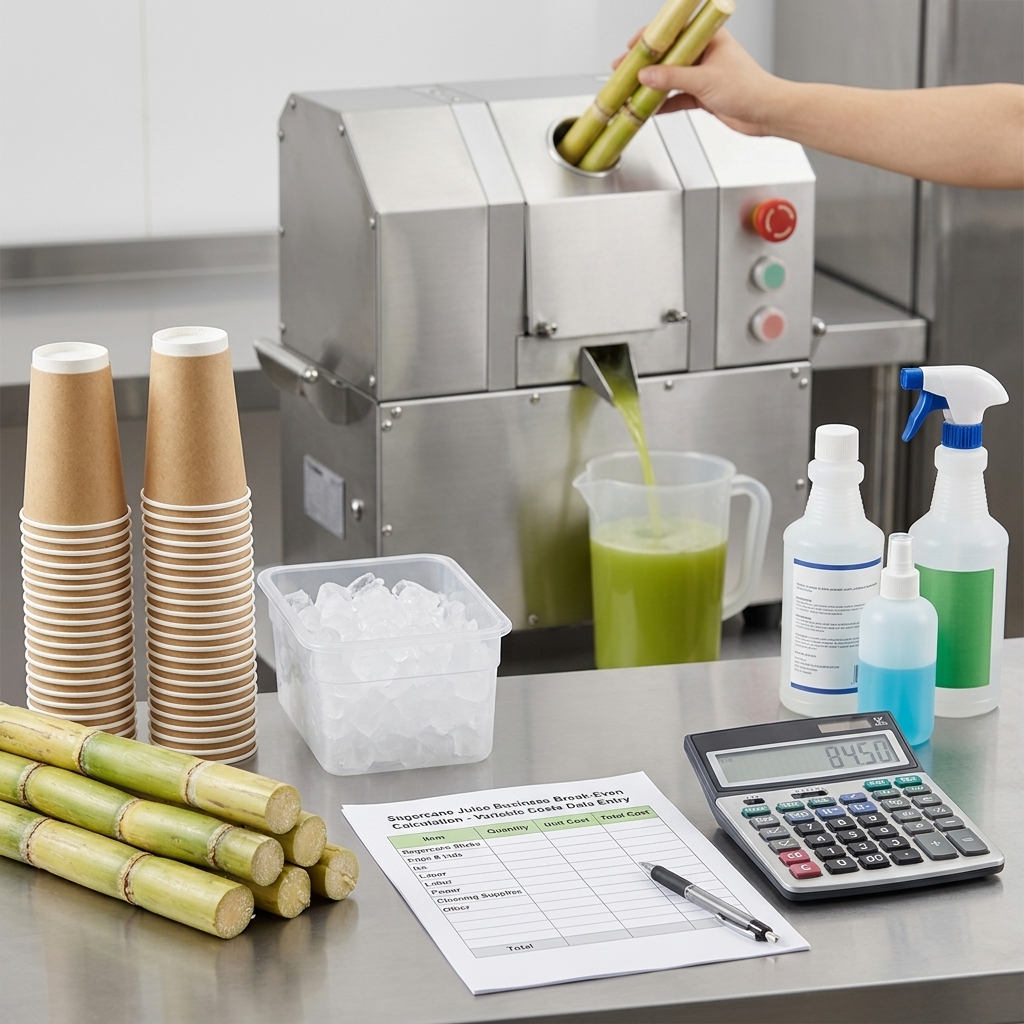
Contribution margin shows how much of each sale is available to cover fixed costs and then produce profit.
Contribution margin per serving = Selling price − Variable cost per serving
For example, suppose a business sells one standard cup for 3.00 in its local currency. If sugarcane, packaging, ice, transaction fees, and expected waste total 1.20 per cup, the contribution margin is 1.80.
Do not use the raw purchase price of sugarcane alone. Measure or estimate the amount of usable cane required for the serving size, account for trimming and extraction waste, and update the figure when supplier prices change. If the menu has several sizes or products, calculate a separate margin for each one.
For a mixed menu, use a weighted average contribution margin. This requires an estimated sales mix, such as the proportion of small, regular, large, and add-on sales. If the sales mix is uncertain, prepare a low-margin and high-margin scenario rather than relying on one optimistic average.
Equipment selection affects the cost model indirectly. A machine that does not match the intended service volume may create excess labour, slower service, avoidable downtime, or unnecessary capital cost. Use the commercial sugarcane juicer selection guide to compare real output needs, workspace, power supply, cleaning, and technical support before finalising the investment.
Worked Break-Even Example
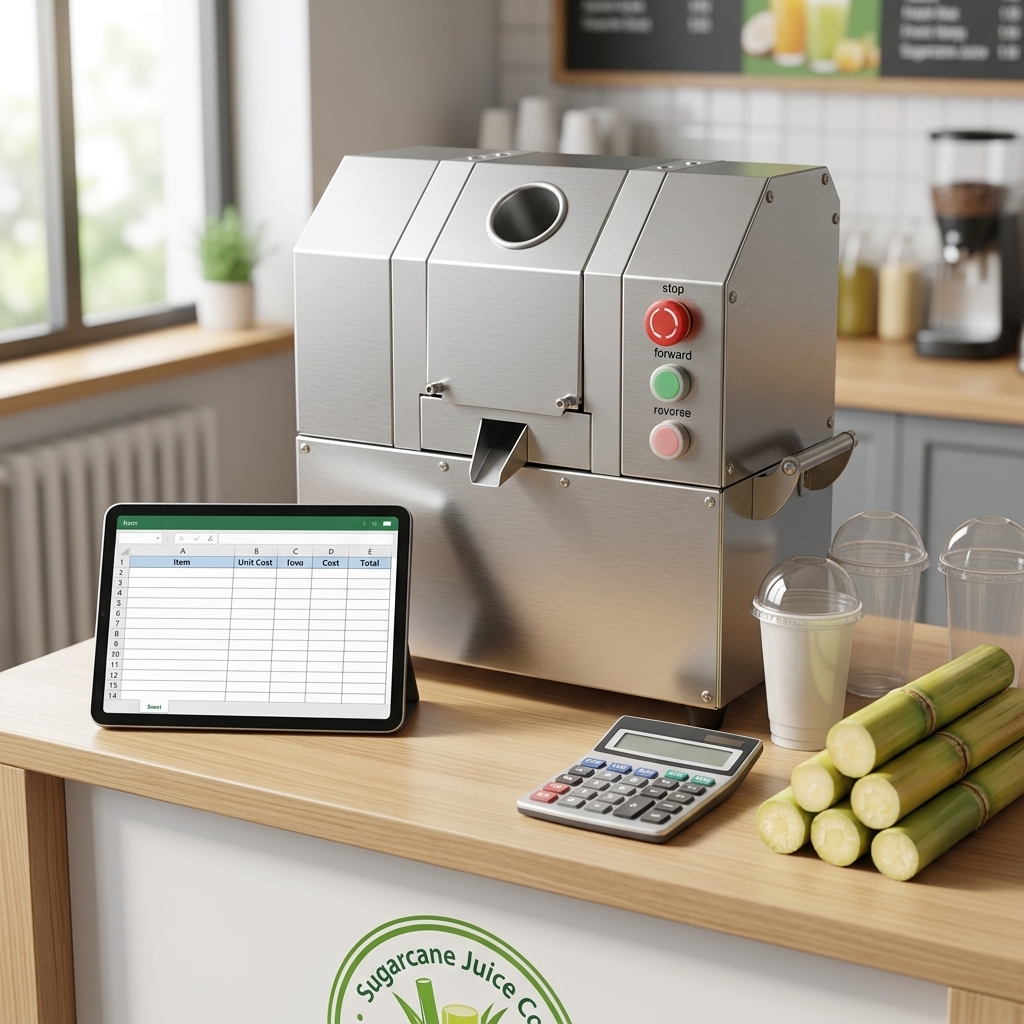
The following example is illustrative only. Replace every amount with local prices, taxes, wages, rent, and operating conditions.
| Input | Illustrative amount |
|---|---|
| Monthly fixed costs | 5,400 |
| Selling price per serving | 3.00 |
| Variable cost per serving | 1.20 |
| Contribution margin per serving | 1.80 |
Using the formula:
5,400 ÷ 1.80 = 3,000 servings per month
The business must therefore sell 3,000 servings per month to cover the listed fixed costs under these assumptions. If it operates 26 days per month, the daily break-even target is approximately:
3,000 ÷ 26 = 115.4 servings per operating day
Because a business cannot sell a fraction of a serving, the practical target would be at least 116 servings per day, subject to opening hours and demand patterns. Break-even revenue is:
3,000 × 3.00 = 9,000 per month
If the operation sells 4,000 servings at the same assumptions, the monthly operating profit before tax, owner drawings, loan interest, and other excluded items would be:
(4,000 × 1.80) − 5,400 = 1,800
This is not the same as total investment ROI. It is an operating-profit example and should be adjusted for the items included in your own accounting method.
Use Realistic Sales and Operating Assumptions
A break-even result is only as useful as the assumptions behind it. Estimate sales by location, opening day, season, weather, service speed, menu price, and available staff rather than using maximum machine output as expected demand.
Build a daily operating model that includes:
- Expected customer traffic and conversion rate
- Average servings per transaction
- Peak and quiet periods
- Opening days and hours
- Stock availability and supplier delivery schedule
- Service interruptions, cleaning time, and planned downtime
- Different prices or product sizes
Separate capacity from demand. A juicer may be capable of supporting a target workflow, but the business may not have enough customers to use that capacity. Conversely, a machine that is too small for peak service can create queues and lost sales. Your model should use expected sellable volume, not theoretical production volume.
Raw material planning also affects the result. Review practical guidance on storing sugarcane for fresh juice service to reduce avoidable spoilage and keep purchasing aligned with demand.
For hygiene-related labour, layout, and cleaning time, see the guide to designing a hygienic sugarcane juice workstation. A more efficient workflow may improve saleable service time, but any benefit should be verified with actual operating data.
Connect Break-Even with ROI and Sensitivity Analysis
Break-even tells you when operating revenue covers operating costs. ROI asks whether the profit generated is adequate compared with the total investment.
A simple annual operating ROI estimate is:
Annual operating ROI = Annual operating profit ÷ Total invested capital × 100
Total invested capital may include equipment, shipping, installation, site preparation, deposits, permits, opening inventory, signage, and other startup costs. Define whether the calculation includes financing costs, taxes, owner labour, and depreciation. Different definitions can produce different ROI results.
Payback period is another useful measure:
Payback period = Total initial investment ÷ Average monthly cash operating surplus
Use sensitivity analysis to test what happens when important assumptions change. At minimum, model:
- Lower, expected, and higher daily serving volume
- Changes in cane and packaging costs
- Different selling prices and product mixes
- Seasonal operating days
- Unexpected repairs or equipment downtime
- Higher rent, wages, delivery, or payment fees
A useful spreadsheet should show the break-even servings and monthly result for each scenario. This helps you judge whether the business remains viable when actual sales or costs differ from the initial plan.
Practical Ways to Improve the Break-Even Point
Once the model is complete, the objective is not simply to increase the selling price. Improve the relationship between contribution margin, fixed costs, and reliable sales.
- Reduce avoidable waste: Match cane purchasing to expected demand, rotate stock, and record actual yield and discarded material.
- Review serving sizes: Confirm that each size has a clear margin after cane, packaging, ice, and transaction costs.
- Control fixed overhead: Compare rent, staffing, utilities, and service arrangements with the sales volume the location can support.
- Protect service uptime: Follow cleaning and maintenance procedures and keep a practical process for responding to faults. The commercial sugarcane juicer troubleshooting guide can help operators identify common issues before they become prolonged interruptions.
- Choose equipment around the workflow: Consider actual service volume, operator count, cleaning requirements, power supply, footprint, and local support instead of selecting only by purchase price.
- Track actual results: Record daily servings, sales value, cane purchased, waste, labour hours, downtime, and maintenance cost. Update the model monthly.
The most dependable break-even plan is a living operating document. Recalculate it when supplier prices, rent, wages, menu prices, opening hours, or equipment arrangements change.