Sugarcane Juice Machine Waste Management: Bagasse, Cleanup, and Cost Control

Table of Contents

Effective sugarcane juice machine waste management helps commercial operators control bagasse, reduce cleanup time, maintain a sanitary workstation, and understand the real cost of daily waste handling.

What is the best way to manage sugarcane juice machine waste?
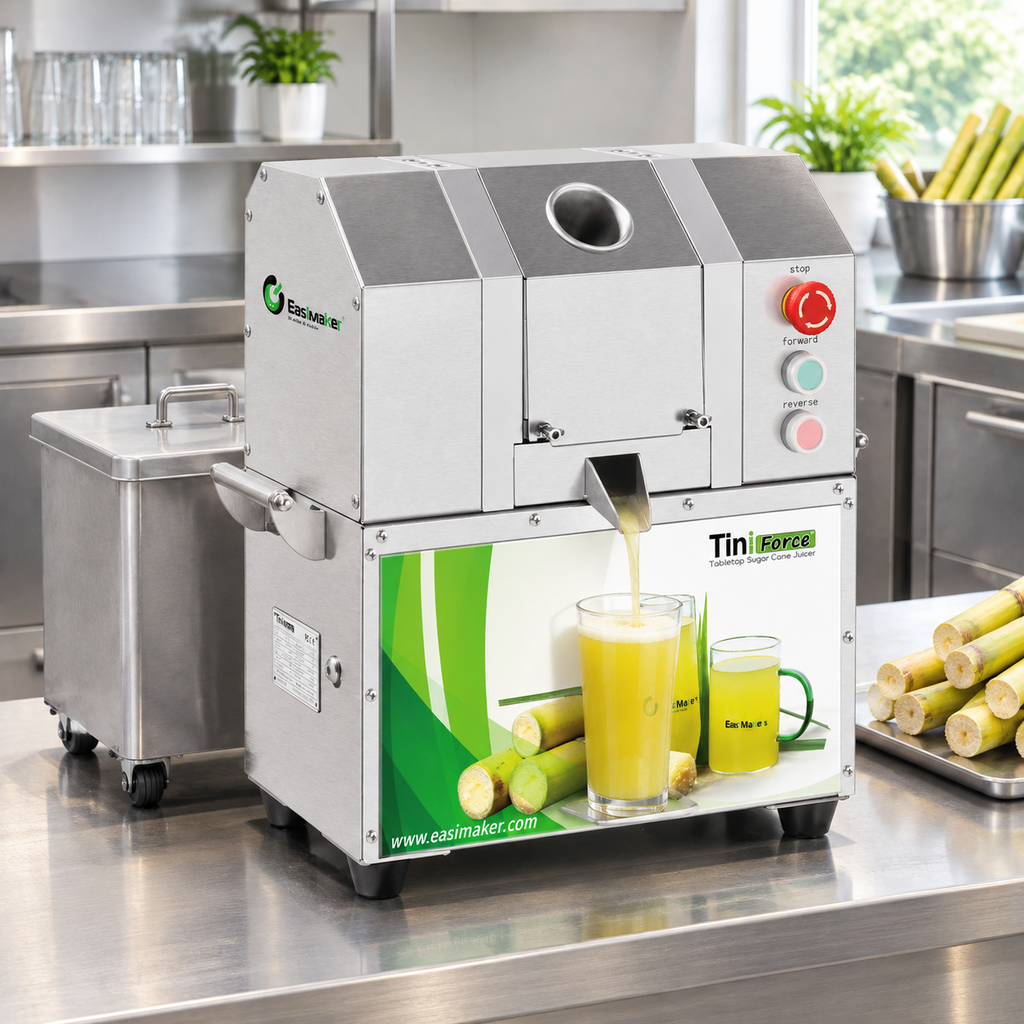
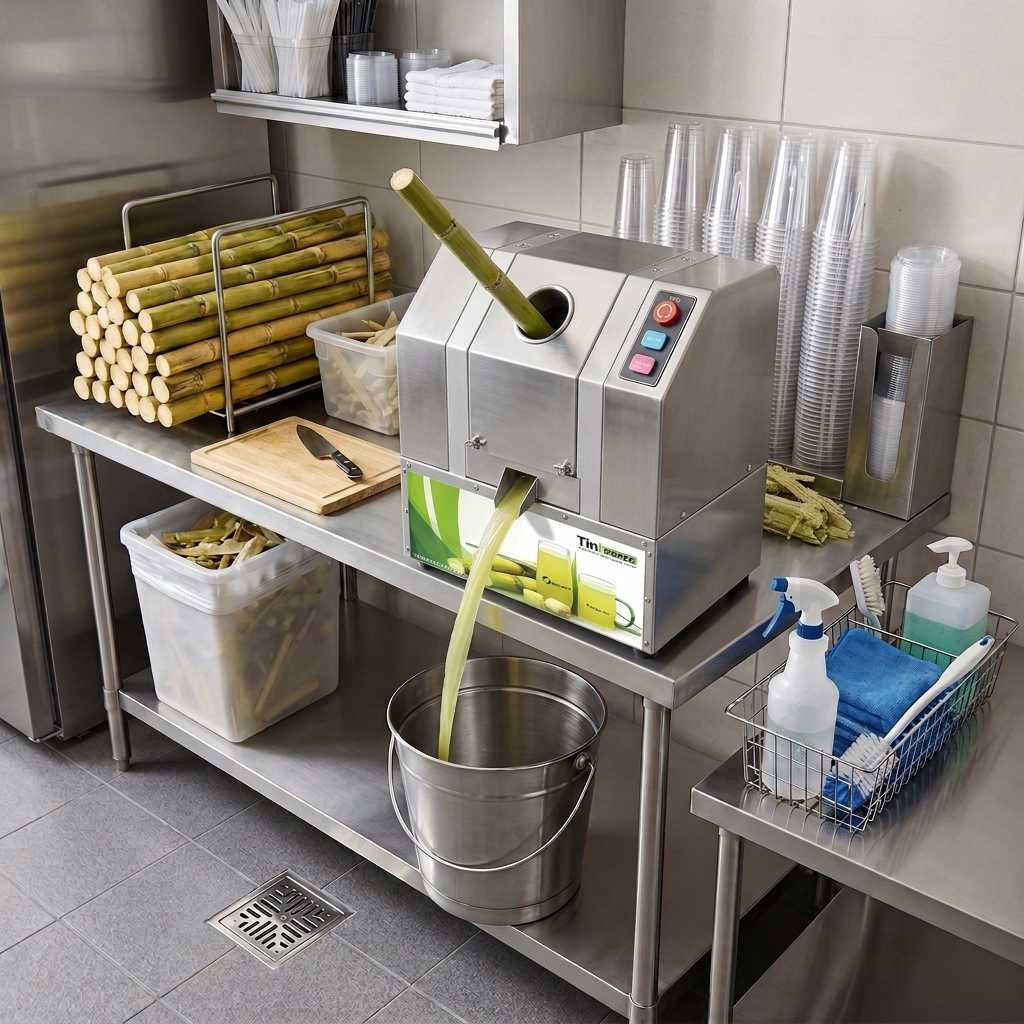
Sugarcane juicer positioned for separate juice and bagasse collection

The most practical approach is to separate bagasse from liquid waste at the point of discharge, collect it in a covered container, remove it from the service area regularly, and follow a documented end-of-shift cleanup routine. Commercial operators should also record disposal fees, labor time, cleaning supplies, and any lost product so waste management becomes part of normal operating-cost control.

A machine with a predictable discharge path makes this workflow easier. For example, the referenced sugarcane juicer feeds cane from the front, sends juice through the front outlet, and expels residue from the rear. Its rear discharge direction should be considered when positioning the collection container and planning access for removal.

What waste does a sugarcane juice machine produce?
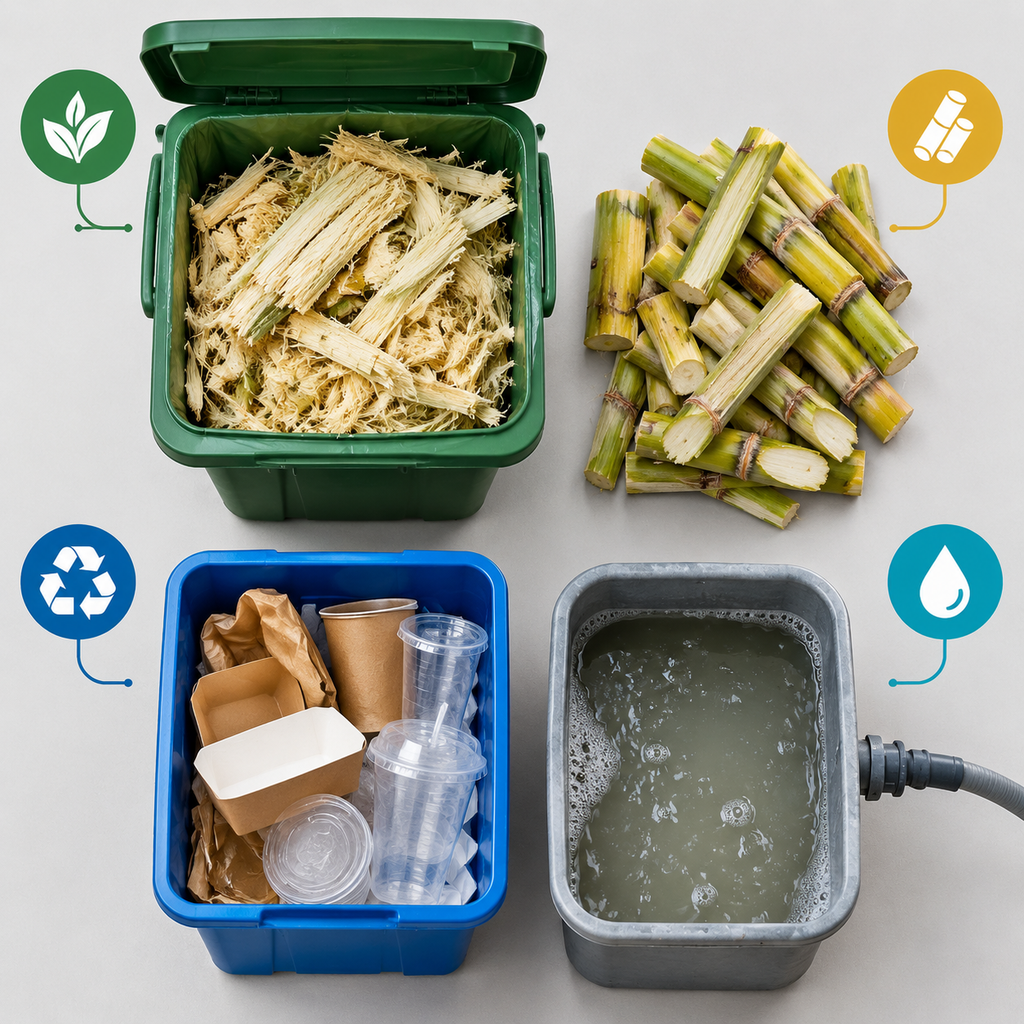
Separated bagasse, cane preparation waste, packaging, and wastewater streams

Sugarcane juice operations usually produce several distinct waste streams:

  • Bagasse: the fibrous cane residue discharged after pressing or extraction.
  • Drips and spilled juice: liquid around the outlet, collection cup, work surface, or floor.
  • Cane preparation waste: trimmed ends, leaves, dry outer material, and damaged cane removed before feeding.
  • Packaging waste: cups, lids, straws, napkins, and transport containers.
  • Cleaning wastewater: water and approved cleaning or sanitizing solutions used during service and shutdown.

These materials should not automatically be placed in one container. Bagasse is bulky and wet, while packaging and wastewater may follow different local disposal requirements. Separating them improves housekeeping and may make organic material easier to transfer to a collector, composting operation, or other permitted outlet.

Sugarcane bagasse disposal and reuse options
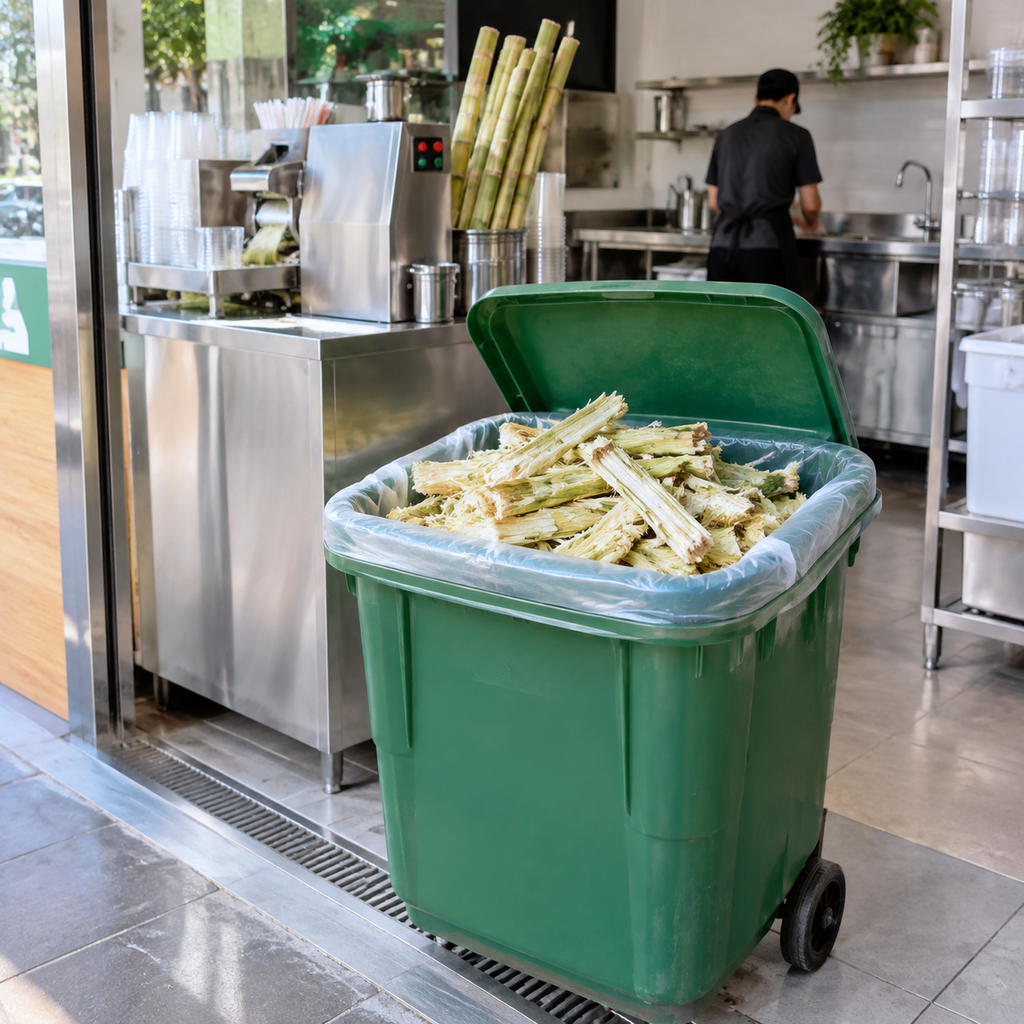
Covered washable container used for sugarcane bagasse collection

Bagasse disposal depends on local rules, available collection services, moisture content, and the volume generated by the shop. Before choosing a reuse route, confirm that the receiving party accepts food-processing residue and that transport and storage conditions are suitable.

1. Scheduled organic-waste collection

This is often the simplest option for a busy shop. Use a covered, washable container, keep it away from finished drinks, and arrange collection often enough to prevent overflow, insects, or odor. Do not assume that a municipal organic-waste program accepts bagasse without checking.

2. Composting or agricultural use

Clean bagasse may be suitable for a composting or agricultural partner, but the material may require mixing, drying, or controlled processing. Avoid presenting it as a guaranteed fertilizer or animal-feed product. The receiving operator should define acceptable conditions.

3. Licensed biomass or processing partner

In some markets, a specialist may collect fibrous plant residue for further processing. This can be practical for larger operators, although transport cost and minimum collection volume must be evaluated.

4. General waste disposal

Where no separate route exists, bagasse may need to enter the permitted general-waste stream. Use smaller collection batches if the material is heavy when wet, and follow local requirements for commercial food waste.

Commercial sugarcane juice cleanup workflow
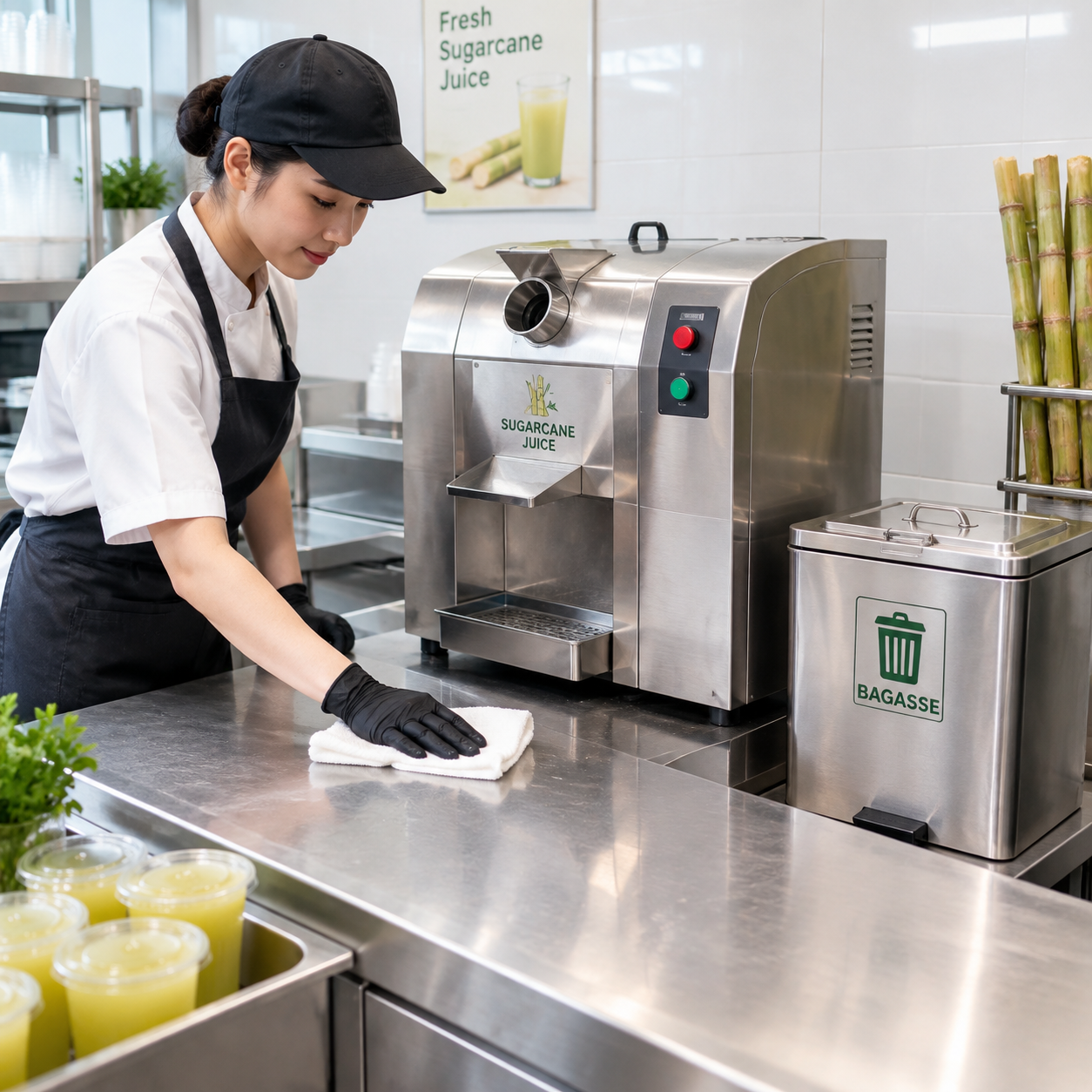
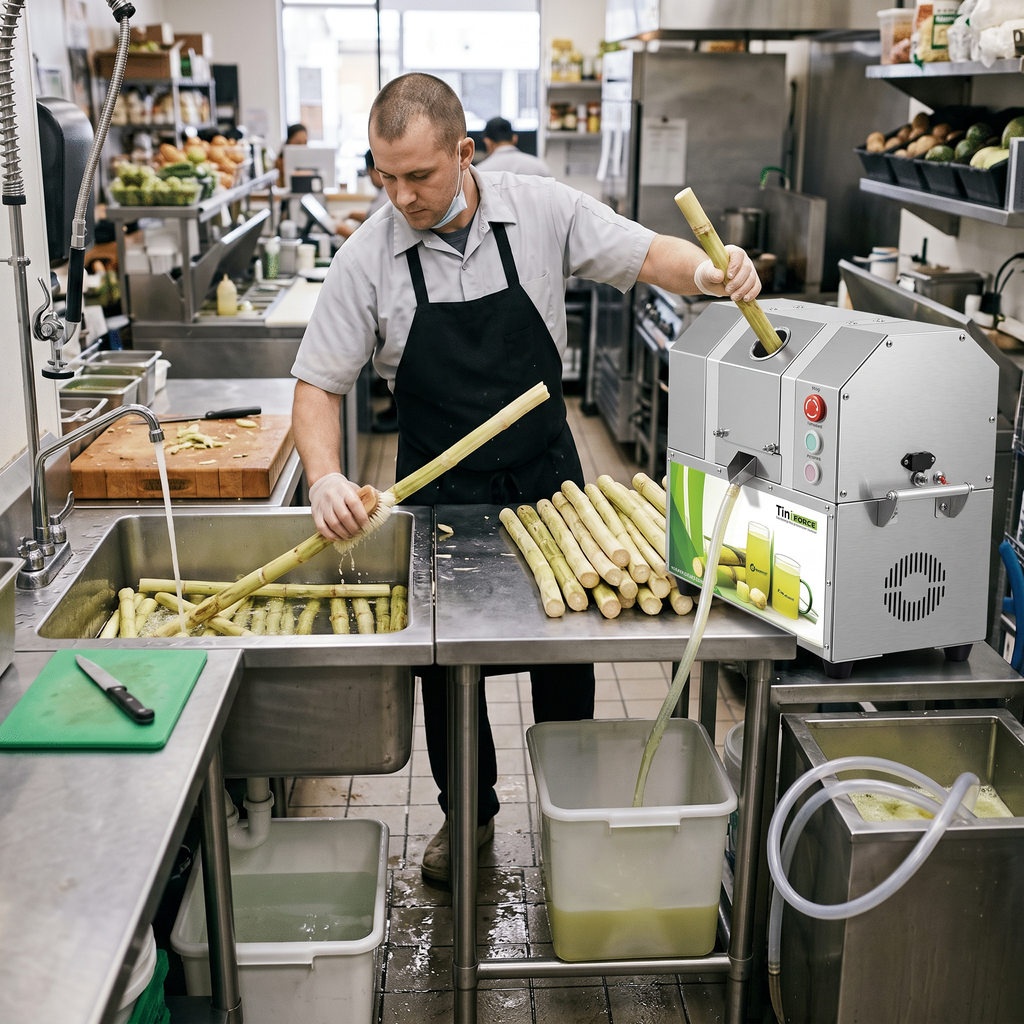
Commercial sugarcane juice workstation during a safe cleanup routine

A consistent cleanup routine reduces buildup and makes waste handling easier for every shift. Follow the machine manufacturer’s manual and local food-safety requirements; the steps below are a general operating framework.

  1. During service: Keep a collection container close to the bagasse discharge, but do not block ventilation, access panels, or operator movement.
  2. Control spills immediately: Wipe juice from the outlet, counter, and floor before it becomes sticky or attracts pests.
  3. Separate waste: Keep bagasse, packaging, and liquid waste in the correct containers. Do not pour fibrous material into drains.
  4. Close the service cycle: Stop the machine according to its instructions, isolate power where required, and remove remaining cane residue from accessible areas.
  5. Wash and sanitize: Clean food-contact parts with suitable products and concentrations. Rinse or dry only where the equipment instructions require it.
  6. Inspect before reuse: Check the outlet, collection area, guards, seals, and surrounding floor for residue or standing water.

Record who completed the task and note unusual buildup, leaks, odor, or difficult-to-clean areas. These observations can identify a need for operator training or service.

How to control waste-related operating costs
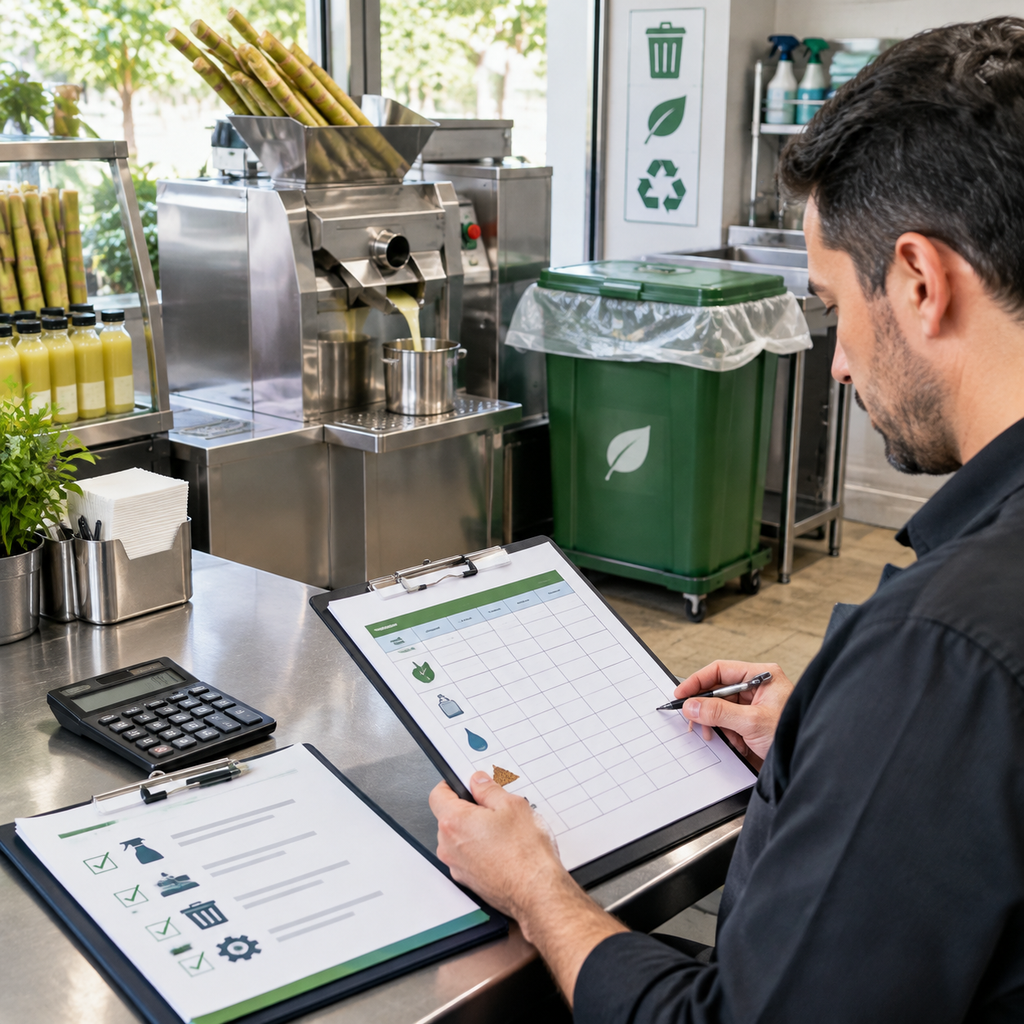
Manager tracking bagasse disposal and cleanup costs in a juice operation

Waste cost is more than the disposal invoice. A useful calculation includes collection fees, bags or bins, cleaning chemicals, water, labor minutes, pest-control measures, floor maintenance, and product lost through spills or poor preparation.

Track these figures for several operating weeks and compare them with sales volume. Useful measures include:

  • bagasse container count per shift;
  • estimated bagasse weight or volume, if weighing is practical;
  • cleanup minutes per shift;
  • disposal cost per collection;
  • juice spilled or discarded;
  • maintenance calls related to residue, blockage, or leakage.

Cost control should not mean delaying necessary cleaning or overloading a waste container. Instead, improve the workflow: prepare cane consistently, position the receptacle correctly, schedule collection around busy periods, train staff to control drips, and purchase containers that are durable, covered, and easy to move.

Include these operating figures in the wider business model. A break-even calculation for a sugarcane juice machine should reflect realistic waste, labor, maintenance, and disposal costs rather than equipment price alone.

Comparing bagasse management options
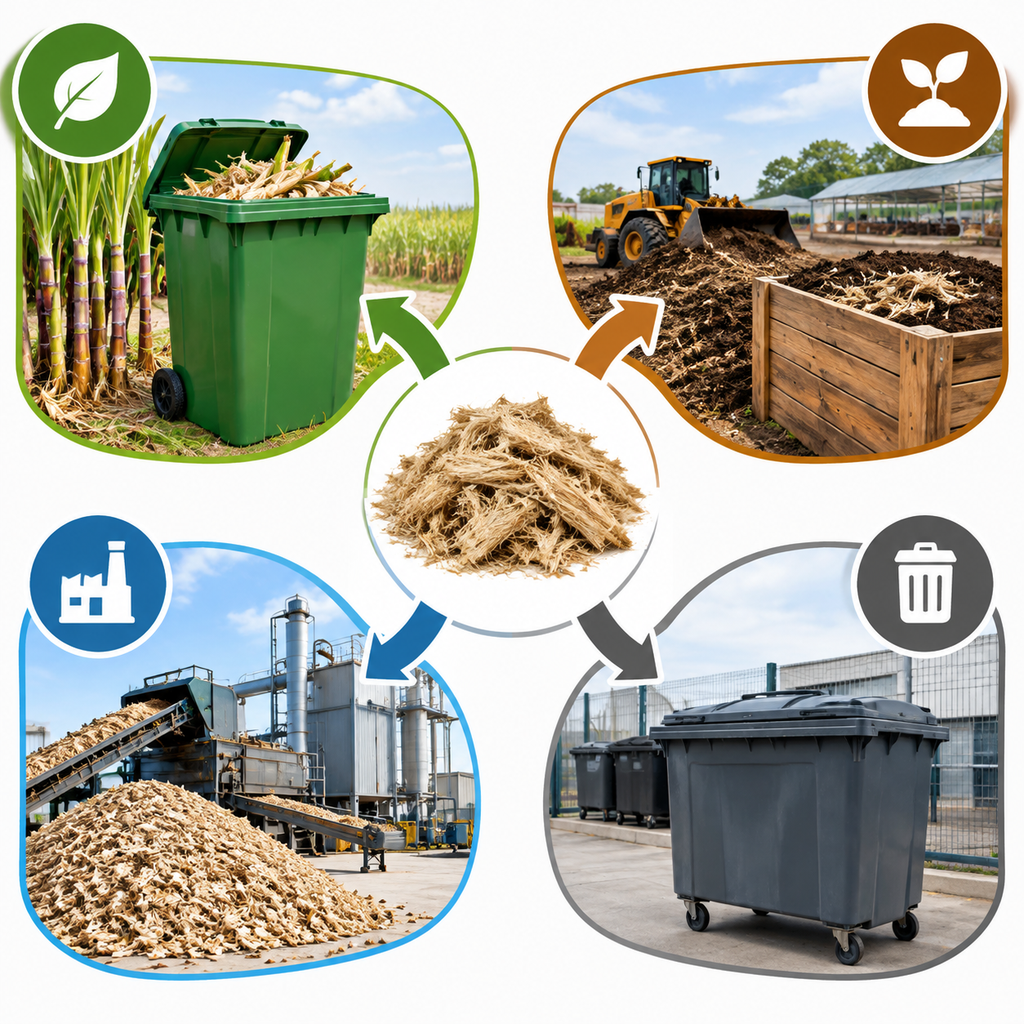
Planning options for sugarcane bagasse disposal and collection

The right option depends on volume, local infrastructure, labor, and the distance to the receiving facility. Treat the table as a planning aid, not a universal recommendation.

OptionBest fitAdvantagesPoints to verify
Organic-waste collectionShops with regular municipal or private serviceSimple and predictableAcceptance rules, container limits, pickup frequency
Composting partnerOperators near an approved composting outletCan divert clean plant residueMoisture, contamination, transport, and receiving requirements
Biomass or processing partnerLarger sites with consistent volumePotentially suitable for organized bulk handlingMinimum volume, contracts, logistics, and permitted use
General commercial wasteLocations without separate organic collectionWidely available routeHigher volume, weight, odor, and disposal charges

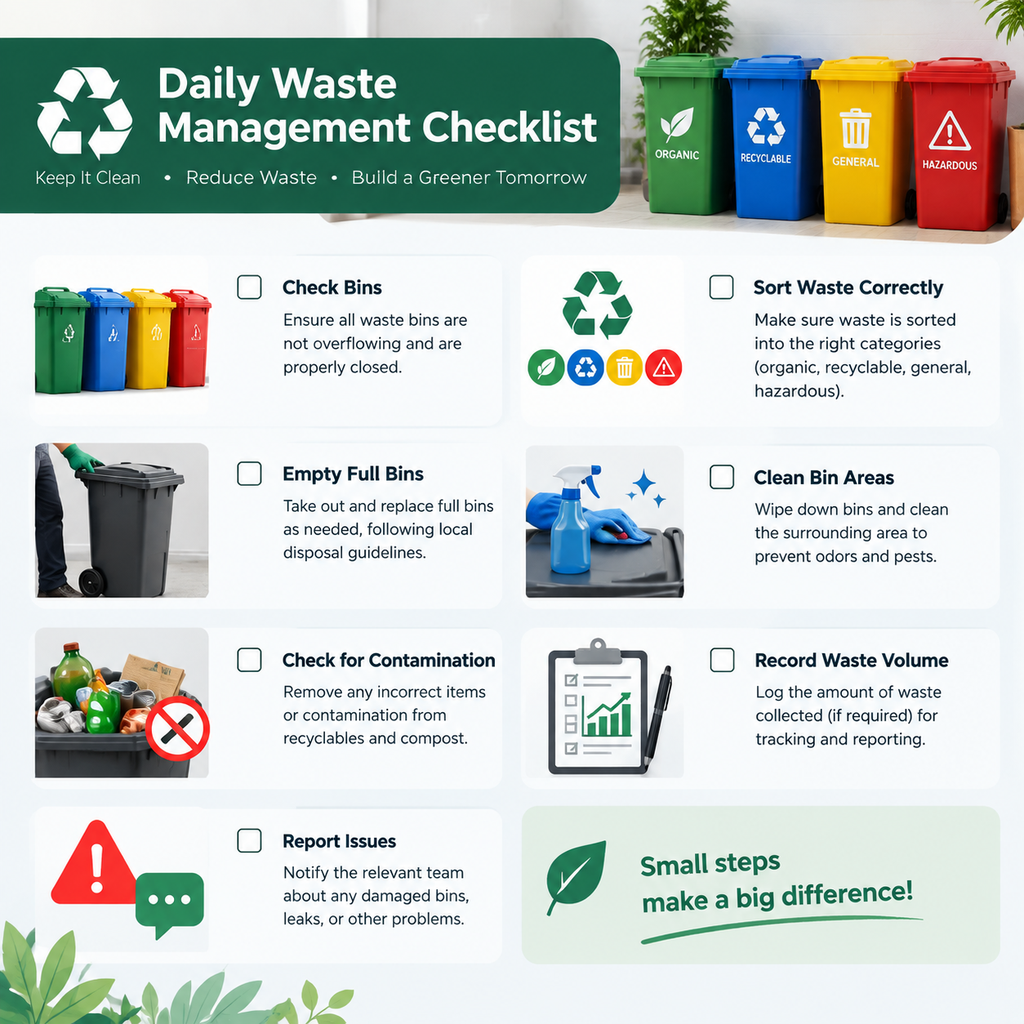
Daily waste management checklist

Daily waste management checklist
  • Place a covered bagasse container at the machine’s discharge side.
  • Keep the container clear of the juice outlet and customer-service path.
  • Remove bagasse before the container becomes difficult or unsafe to move.
  • Keep packaging, bagasse, and wastewater separated.
  • Wipe juice drips and spills during service.
  • Complete the shutdown cleaning routine after the final production period.
  • Inspect for residue, leaks, blockages, pests, and standing water.
  • Record disposal volume, cleanup time, and unusual maintenance needs.
  • Review the disposal route whenever sales volume, premises, or local rules change.

Good sugarcane juice machine waste management is a repeatable operating system. It protects the service area, supports consistent sanitation, and gives managers better information for labor, disposal, and equipment decisions.

FAQ

What is sugarcane bagasse?

Sugarcane bagasse is the fibrous residue left after sugarcane is pressed or extracted for juice. It is usually wet and bulky, so it should be collected separately from packaging and liquid waste where local systems allow.

Can sugarcane bagasse go down a drain?

No. Fibrous bagasse can contribute to blockages and should be placed in an appropriate solid-waste container or transferred through a permitted reuse or collection route.

How often should bagasse be removed from a commercial juice shop?

Remove it before the container overflows, becomes difficult to move, or creates odor and pest risks. The exact frequency depends on sales volume, container size, temperature, and local requirements.

Does waste management affect sugarcane juice machine costs?

Yes. Disposal fees, container purchases, labor time, cleaning supplies, spills, and residue-related maintenance all affect operating cost. These items should be included in internal cost and break-even calculations.

What should operators do with cleaning wastewater?

Follow local wastewater rules and the machine manufacturer’s cleaning instructions. Do not discharge solids, concentrated chemicals, or fibrous residue into drains, and keep wastewater handling separate from finished juice production.

Plan a cleaner, more practical sugarcane juice workstation

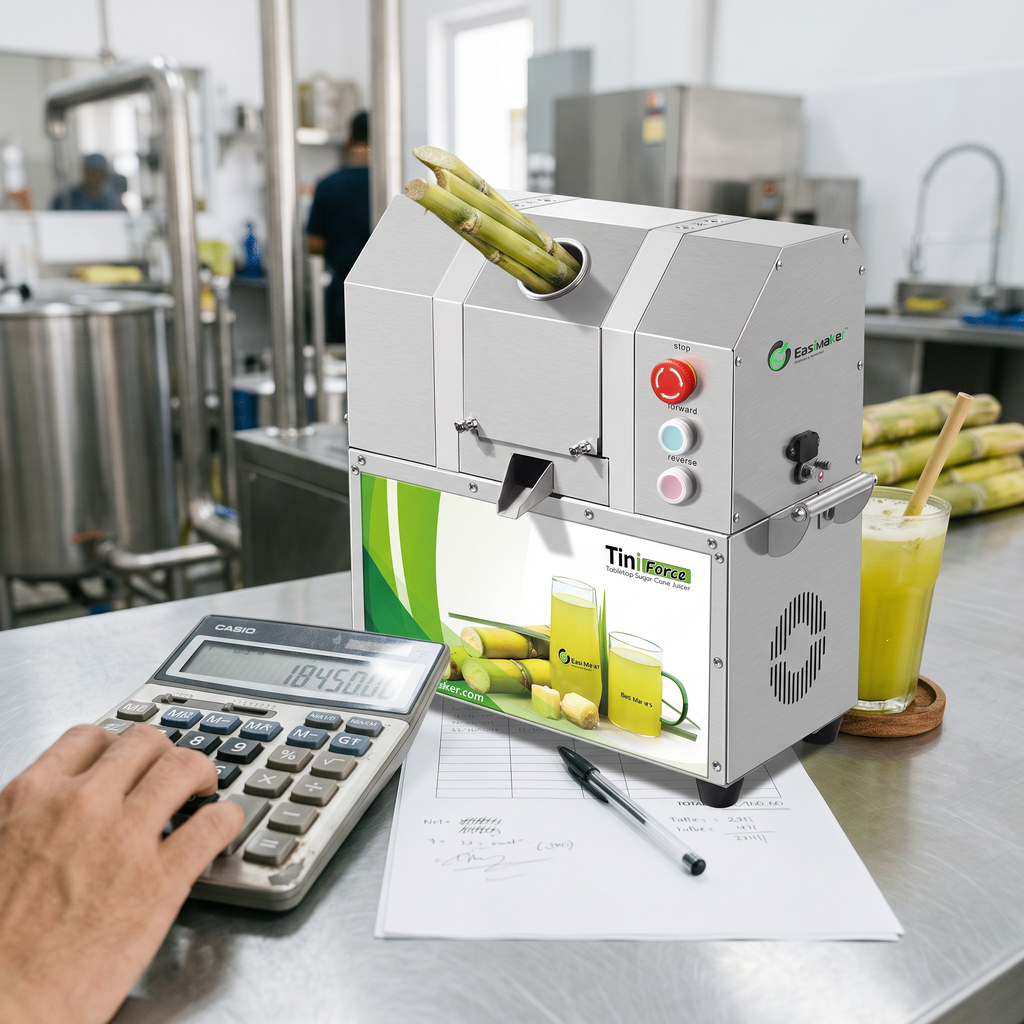
If you are selecting equipment or reviewing a current juice-service layout, Easimaker can discuss the machine arrangement, bagasse discharge direction, cleaning access, and expected operating environment. Contact Easimaker to request a quote or discuss the suitable commercial setup for your market.
Discuss Your Equipment Setup

How to Calculate Sugarcane Juice Machine Break-Even

Table of Contents

Calculate a sugarcane juice machine break-even point by dividing total startup investment by contribution per cup, then test the result against realistic daily sales, operating days, waste, and maintenance costs.

The Sugarcane Juice Machine Break-Even Formula

Calculator and cost worksheet used to calculate sugarcane juice machine break-even

To calculate a sugarcane juice machine break-even point, first find the contribution earned from each cup sold, then divide your total startup investment by that amount.

Break-even cups = Total startup investment / Contribution per cup

Contribution per cup = Selling price per cup – Variable cost per cup

The result is the number of cups you must sell before the initial investment is recovered. To turn this into a time estimate, divide break-even cups by the realistic number of cups you expect to sell per operating day. This is a planning estimate, not a guaranteed result: customer demand, local pricing, cane quality, staffing, waste, rent, and downtime can all change the outcome.

For an established operation, it is often more useful to calculate a monthly break-even point as well. In that case, divide monthly fixed operating costs by contribution per cup. This shows the cups required each month to cover recurring costs after the initial purchase has been made.

Define the Costs in Your Calculation

Operating supplies and commercial sugarcane juicer used in a cost calculation

A useful break-even calculation separates one-time startup costs, recurring fixed costs, and costs that rise with every cup sold. Combining all of them in one number can make a result difficult to check or update.

One-time startup investment

  • Commercial sugarcane juice machine purchase price
  • Freight, import duties, local delivery, and installation where applicable
  • Electrical work, water access, drainage, counters, or a kiosk fit-out
  • Initial tools, food-safe containers, cleaning supplies, and opening stock
  • Permits, deposits, signage, and point-of-sale setup where relevant

Recurring fixed costs

  • Rent or site fees
  • Base payroll or management costs
  • Insurance, licences, communications, and accounting
  • Scheduled maintenance allowance and general overhead

Variable cost per cup

  • Sugarcane used for that serving, including an allowance for trimming and unusable material
  • Cup, lid, straw or alternative, napkin, and seal if used
  • Ice, flavour additions, fruit, lemon, or other ingredients sold with the drink
  • Payment processing cost when it varies with the transaction value
  • Labour directly tied to making and serving each drink, if you choose to model it per cup

Do not assume the machine price is the complete investment. A commercial machine is one part of a working service station. For a closer view of unit economics, see this guide to calculating juice cost per cup for commercial operations.

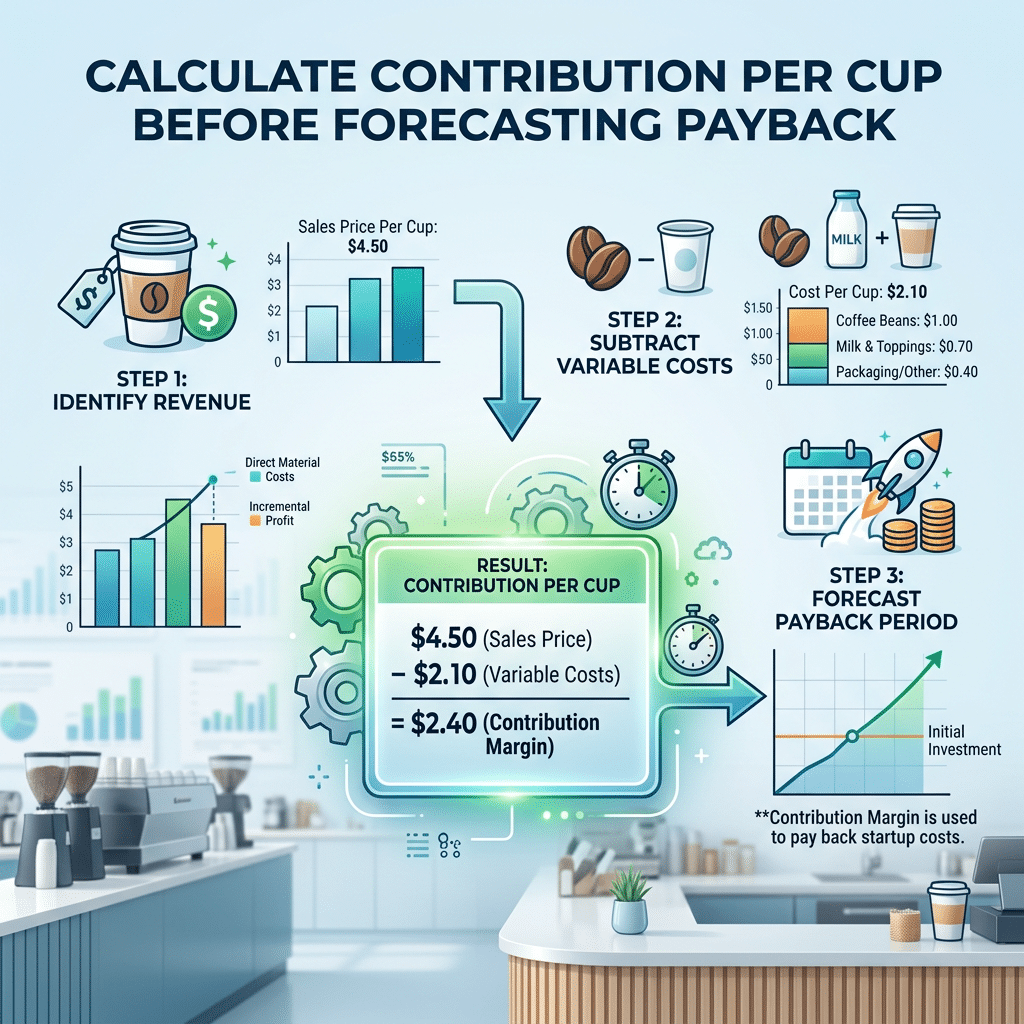
Calculate Contribution Per Cup Before Forecasting Payback

Calculate Contribution Per Cup Before Forecasting Payback

Contribution per cup is the amount remaining from each sale to cover fixed costs and recover startup investment. It is not the same as gross sales and should not be confused with final net profit.

Start with the actual menu price customers pay. Then subtract the variable cost of producing and serving one cup. Where a recipe includes different cup sizes or add-ons, calculate each version separately. A large serving with more cane, ice, packaging, and preparation time may have a different contribution from a standard serving.

Use a recent purchasing period to establish the cane cost. Record the quantity purchased, usable production after trimming, and total cups served. This helps avoid basing the calculation on an ideal extraction assumption. Cane condition, stalk diameter, supplier consistency, preparation method, and operator practice can affect usable output. If you do not yet have operating records, use conservative assumptions and review them after the first weeks of trade.

Include a modest allowance for product loss, remakes, samples, spoilage, and unsold prepared ingredients. It is better to identify uncertainty in the model than to hide it inside an optimistic sales forecast. Review packaging and ingredient costs regularly because they can change independently of the menu price.

When comparing machine options, use the same selling price, ingredient assumptions, and operating hours for each option. The decision then becomes clearer: whether a machine’s purchase cost, workflow, cleaning time, and expected service capacity fit the intended outlet.

Work Through a Practical Break-Even Example

The following example shows the method only. Replace every number with your own supplier quotes, recipe costs, local selling price, and site costs.

Assume a new juice counter has a total startup investment of 12,000 in its local currency. This includes equipment and the direct costs needed to begin service. The standard drink sells for 5.00. Cane, packaging, ice, minor ingredients, and transaction-related variable costs total 2.00 per cup.

  • Selling price per cup: 5.00
  • Variable cost per cup: 2.00
  • Contribution per cup: 3.00
  • Total startup investment: 12,000

Break-even cups = 12,000 / 3.00 = 4,000 cups

If the outlet sells an average of 40 cups per day, the simple investment recovery estimate is 100 operating days. At 20 cups per day, it becomes 200 operating days. At 60 cups per day, it becomes about 67 operating days. These figures do not include recurring fixed costs unless they were included in the startup investment, so they should not be presented as a profit forecast.

For a fuller monthly test, assume monthly fixed costs are 3,000 and contribution remains 3.00 per cup. The business needs 1,000 cups per month to cover those monthly fixed costs: 3,000 divided by 3.00. If it operates 25 days per month, that is 40 cups per day before considering recovery of the original investment.

Use realistic local demand rather than choosing a daily sales number simply because it produces an attractive payback period. A sensible forecast can use a low, expected, and high sales case.

Test Sales Volume and Operating Assumptions

Operator workflow at a commercial sugarcane juice machine

The quality of a sugarcane juice machine break-even calculation depends more on its assumptions than on the formula. Sales volume is often the largest unknown, particularly for a new kiosk, restaurant menu, market stall, or distributor-supported launch.

Build at least three cases:

  • Low case: slower footfall, a reduced conversion rate, weather disruption, or a gradual customer adoption period.
  • Expected case: the daily sales level supported by your location, trading hours, menu fit, and staff capacity.
  • High case: strong demand during peak periods, events, or a successful repeat-customer base.

Use the expected case for purchase planning and keep the low case visible when assessing cash requirements. Also consider seasonality. A location may have high demand in warm months and substantially lower demand in other periods. A daily average drawn only from peak season can distort the decision.

Machine workflow matters because a forecasted sales volume must be operationally achievable. Review cane washing and trimming, feeding, juice collection, drink assembly, payment, cleaning between service periods, and staff handover. A machine with an appropriate workflow for the site can help the team serve demand consistently, while an oversized or poorly matched setup may add cost without solving the main constraint.

Before committing, use a structured purchasing discussion. This list of questions to ask a sugarcane juicer manufacturer can help you confirm electrical requirements, cleaning access, parts planning, and the operating conditions that affect your model.

Ways to Improve the Break-Even Point Without Distorting the Model

A lower break-even point usually comes from increasing contribution per cup, reducing avoidable startup costs, or improving sustainable sales volume. The right action depends on what is limiting the operation.

  • Price with local evidence: compare the full offer, serving format, site position, and competitors. Do not raise prices in the spreadsheet without checking whether customers will accept them.
  • Control portion and recipe standards: document cup size, ingredients, ice policy, and serving method so staff can produce a consistent product and cost.
  • Reduce avoidable waste: improve stock rotation, cane preparation, and purchasing quantities. Track waste separately instead of assuming it does not exist.
  • Protect uptime: establish daily cleaning, inspection, and parts procedures. Unplanned downtime can reduce sales and create avoidable expense.
  • Plan labour around demand: align staffing with peak periods while maintaining practical cleaning and food-handling routines.
  • Use add-ons carefully: only add menu items or formats that fit the available preparation space, operator skill, and customer demand.

Break-even should be reviewed after launch. Compare planned and actual cups sold, average selling price, variable cost, waste, and operating days. Update only the assumptions supported by records. For wider launch planning, the guide on starting a sugarcane juice business covers practical commercial considerations beyond the machine purchase.

Use Break-Even Analysis Before Buying Equipment

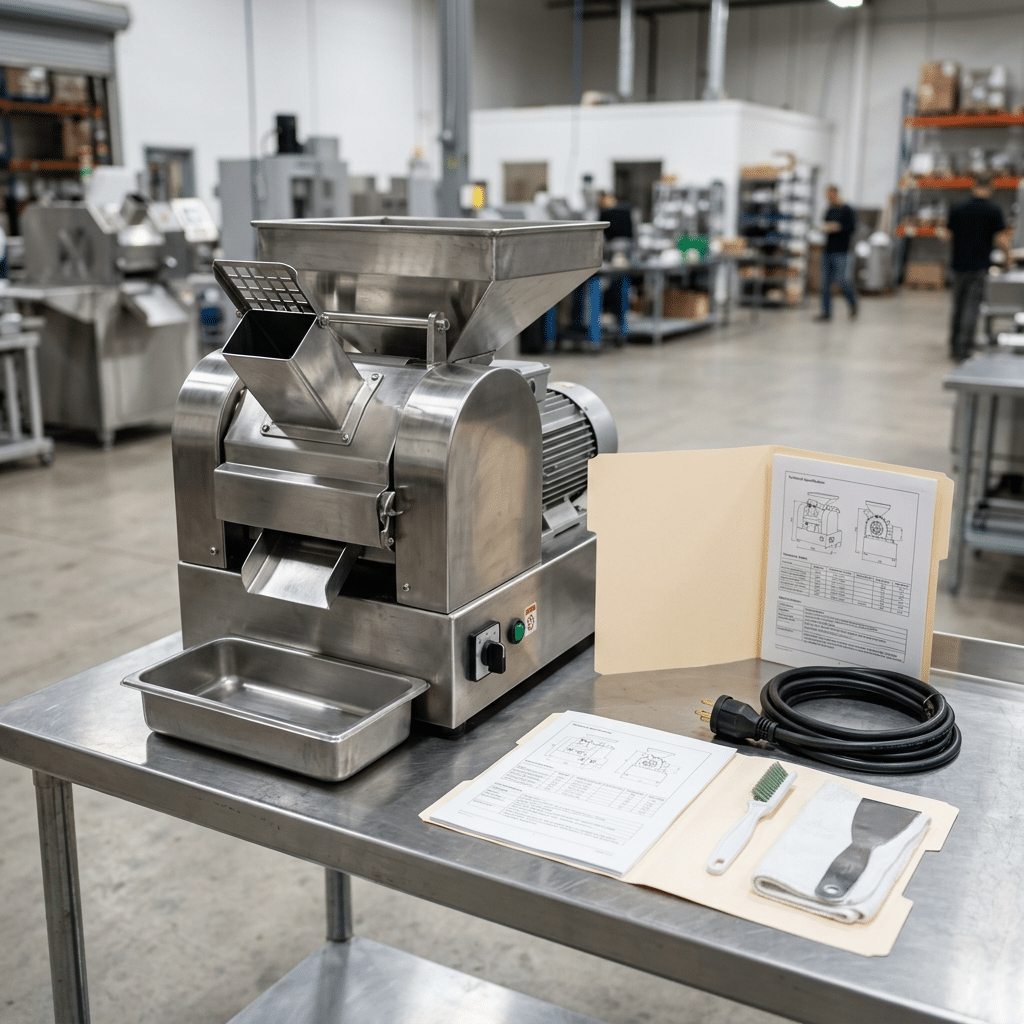
Commercial sugarcane juicer evaluated with operating and support documentation

Use the calculation to compare complete operating options, not just quoted machine prices. A lower purchase price can be less suitable if the machine does not match local electrical supply, cane type, daily workflow, cleaning requirements, service access, or expected demand. Conversely, a higher initial investment should be tested against the actual operational benefit it provides, rather than assumed to pay back automatically.

Ask suppliers for the information needed to make the model specific: supplied configuration, electrical compatibility, installation considerations, cleaning routine, available spare parts, warranty terms, and support process. Do not use unsupported extraction, capacity, or payback figures in your calculation. Where an input is uncertain, label it and test a range.

For distributors and brands considering a private-label programme, additional costs may include product configuration, packaging, documentation, market-specific electrical requirements, inventory, and after-sales support. The OEM sugarcane juicer guide for distributors and brands explains the planning questions that should sit alongside a commercial forecast.

A sound model is simple enough to update, conservative enough to withstand normal variation, and detailed enough to support a purchasing decision. Keep source quotes and operating records with the worksheet so each assumption can be checked later.

Energy Efficient Commercial Juicers: Lowering Overheads for High-Volume Juice Bars

The Impact of Motor Efficiency on Juice Bar Profitability

In the competitive landscape of the beverage industry, margins are often dictated by operational efficiency. For high-volume juice bars, cold-press manufacturers, and commercial kitchens, the cost of electricity is a significant variable expense. While ingredient costs (COGS) often take center stage in financial planning, the ongoing operational expenditure (OPEX) of running heavy machinery for 8 to 12 hours a day is a critical factor in the bottom line.

Modern commercial juicers have evolved significantly. The industry is moving away from the “higher wattage equals better performance” fallacy. Instead, the focus has shifted to torque, gear reduction ratios, and motor efficiency. By upgrading to or sourcing energy-efficient equipment, businesses can maintain high throughput while drastically reducing power consumption and associated overheads.

Wattage vs. Torque: Understanding the Physics of Extraction

A common misconception among equipment buyers is that a higher wattage rating on a specification sheet guarantees a more powerful machine. In reality, wattage simply measures the amount of electricity the motor consumes, not the force it delivers to the produce.

For commercial juicing, specifically cold press and masticating styles, the critical metric is torque—the rotational force applied to crush fibrous vegetables and hard fruits.

The Role of Gear Reduction

Modern energy-efficient juicers often utilize advanced gear reduction systems. These systems allow a motor with lower input wattage (e.g., 750W) to generate crushing force equivalent to or greater than an older, direct-drive induction motor rated at 1500W or higher.

  • High-Efficiency Motors: Brushless DC (BLDC) motors are increasingly standard in high-end commercial units. They offer higher efficiency (converting more electrical energy into mechanical energy) and generate less waste heat than traditional brushed motors.
  • Smart Load Sensing: Advanced motors can adjust power consumption based on the resistance of the produce. The motor draws peak power only when crushing a dense carrot, and throttles back when processing softer items like cucumber or leafy greens.

Calculating the ROI: Energy Savings in High-Volume Operations

When procurement teams evaluate capital equipment, the Total Cost of Ownership (TCO) must replace the initial purchase price as the primary decision metric. The cumulative savings of energy-efficient motors become evident when machines operate continuously.

Scenario: The High-Volume Kitchen

Consider a juice production facility operating four commercial juicers for 10 hours a day, 360 days a year.

  • Legacy Equipment: 4 machines x 1.5 kW consumption = 6 kW/hour.
  • Modern Efficient Equipment: 4 machines x 0.8 kW consumption = 3.2 kW/hour.

In this scenario, the facility reduces consumption by 2.8 kWh for every hour of operation. Over a year (3,600 operating hours), this equates to a reduction of roughly 10,080 kWh. Depending on local commercial electricity rates, this reduction translates directly into thousands of dollars in retained earnings annually, purely from motor efficiency.

The Hidden Cost: Heat Generation and HVAC Load

Energy inefficiency in electric motors manifests primarily as heat. A motor that is only 60% efficient turns 40% of the electricity it consumes into waste heat. In a confined commercial kitchen or a small juice bar kiosk, this heat buildup is substantial.

This creates a “double penalty” for the business:

  1. Direct Cost: You pay for the electricity wasted as heat.
  2. Indirect Cost: The facility’s HVAC system must work harder to remove that heat to maintain food safety temperatures and staff comfort, further increasing the electricity bill.

Energy-efficient juicers run significantly cooler. This protects the integrity of the juice (preventing premature oxidation or heat-damage to enzymes) and reduces the thermal load on the facility’s air conditioning infrastructure.

Durability and Maintenance Considerations

Efficiency is often a proxy for build quality. Motors that run cooler experience less thermal stress on internal components, windings, and bearings.

When selecting equipment, consider the relationship between efficiency and lifespan:

  • Thermal Protection: Efficient motors are less likely to trigger thermal overload shut-offs during peak service hours, ensuring continuous operation.
  • Vibration and Noise: Precision-engineered, efficient motors typically operate with less vibration and lower decibel levels, improving the working environment for staff.

Buying Guide: Specifications to Analyze

When requesting quotes for commercial juicers, procurement officers should look beyond the marketing claims and analyze the technical specifications.

Specification What to Look For Why It Matters
Motor Type Brushless DC (BLDC) or Induction with Gear Reduction Higher efficiency, lower maintenance, consistent torque.
Wattage (Input) Lower is better if torque is high Indicates power consumption. Compare this against yield/output capacity.
Duty Cycle Continuous vs. Intermittent Commercial units must handle continuous loads without overheating.
Soft Start Yes Reduces inrush current spikes that can trip breakers and spike demand charges.

FAQs: Energy Efficiency in Commercial Juicing

Does a lower wattage motor mean the juicer is weaker?

Not necessarily. In commercial applications, gearing and motor type determine the crushing power (torque). A well-engineered 800W motor with high gear reduction can outperform a 2000W direct-drive motor in terms of actual juicing capability while using less than half the energy.

How does motor efficiency affect juice quality?

Efficient motors generate less heat transfer to the drive shaft and the juicing chamber. Keeping the produce cool during extraction is vital for cold-pressed juice quality, preserving enzymes and extending shelf life.

Are energy-efficient commercial juicers more expensive?

The initial capital expenditure (CapEx) may be slightly higher due to the advanced engineering of the motor and gearbox. However, the return on investment (ROI) is realized quickly through lower utility bills and reduced maintenance costs.

What is the typical lifespan of a high-efficiency commercial motor?

While lifespan varies by usage intensity, brushless motors generally outlast brushed counterparts because there are no brushes to wear out. Combined with lower operating temperatures, these units are designed for long-term industrial use.

Conclusion

Reducing overheads in a commercial juice business requires a holistic look at equipment performance. By selecting juicers that utilize modern, energy-efficient motor technology, businesses can secure a competitive advantage—lowering monthly utility costs, reducing HVAC loads, and ensuring reliable, high-torque operation during peak demand.

Ready to upgrade your production line?

Contact us today to discuss your volume requirements and request a quote for our latest energy-efficient commercial juicing solutions.