The Economics of Extraction: Why Margins Matter
In the commercial beverage sector, particularly with fresh extraction businesses like sugarcane juice, the gap between gross revenue and net profit is often determined by cents, not dollars. For B2B operators—whether you are launching a specialized juice kiosk, adding a revenue stream to a restaurant, or distributing machines—understanding the granular economics of a single cup is mandatory.
Sugarcane juice is widely regarded for its high profit margins compared to bottled beverages or complex smoothies. However, realizing this potential requires a rigorous analysis of your Cost of Goods Sold (COGS). This guide provides a detailed financial framework to calculate the true cost per cup, factoring in raw material yield, machine efficiency, electricity, and labor.
1. Raw Material Yield: The Primary Variable
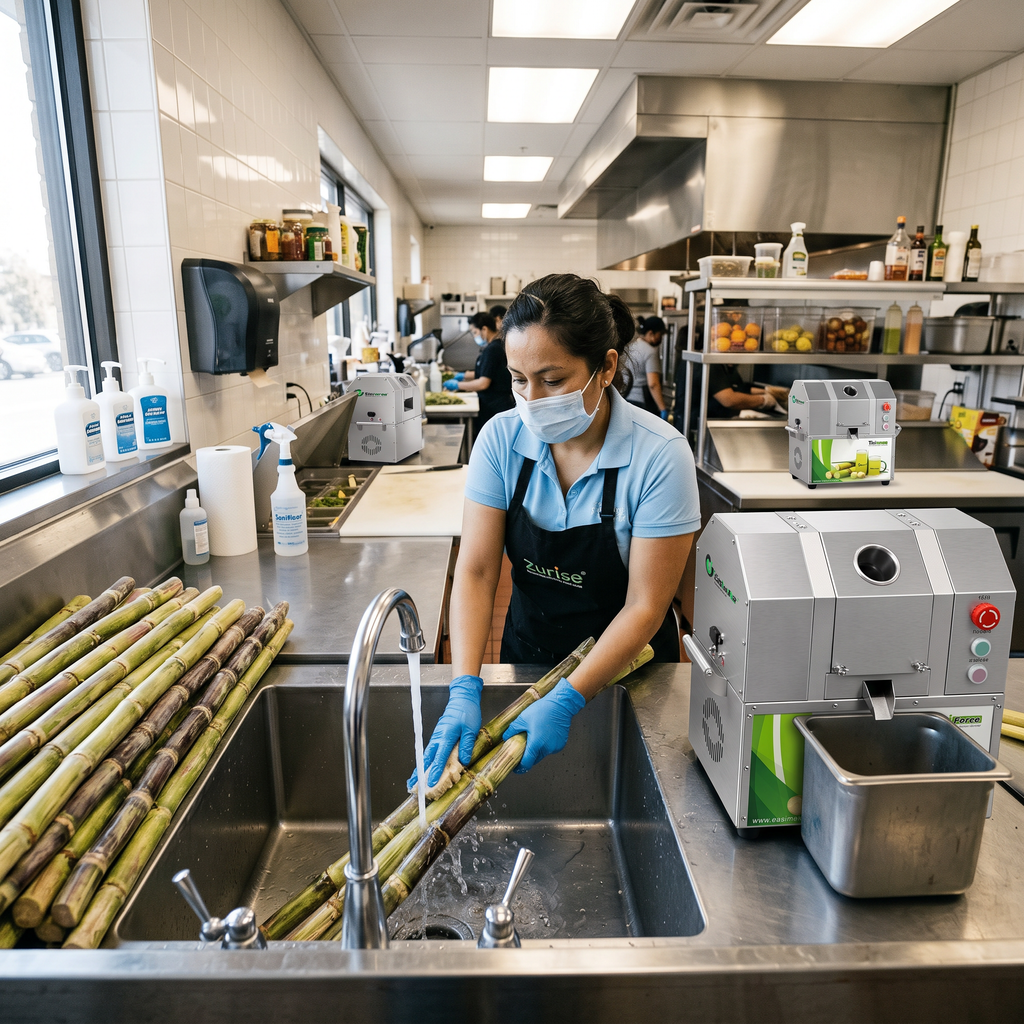
The most significant cost component in fresh juice production is the raw ingredient. Unlike syrups or powders, sugarcane varies in size, moisture content, and sugar density (Brix). To calculate cost accurately, you must first establish your Extraction Rate.
- Typical Yield: High-quality commercial rollers typically achieve an extraction rate of 70% to 80% by weight. This means 1 kg of raw sugarcane yields approximately 700ml to 800ml of juice.
- Calculation Example: If raw sugarcane costs $0.50 per kg and your machine yields 750ml per kg, your raw material cost is approximately $0.06 per 100ml.
Note: Inefficient machines with poor roller tension may only yield 50-60%, significantly inflating your raw material costs over time.
2. The Breakdown: Variable Costs Per Cup
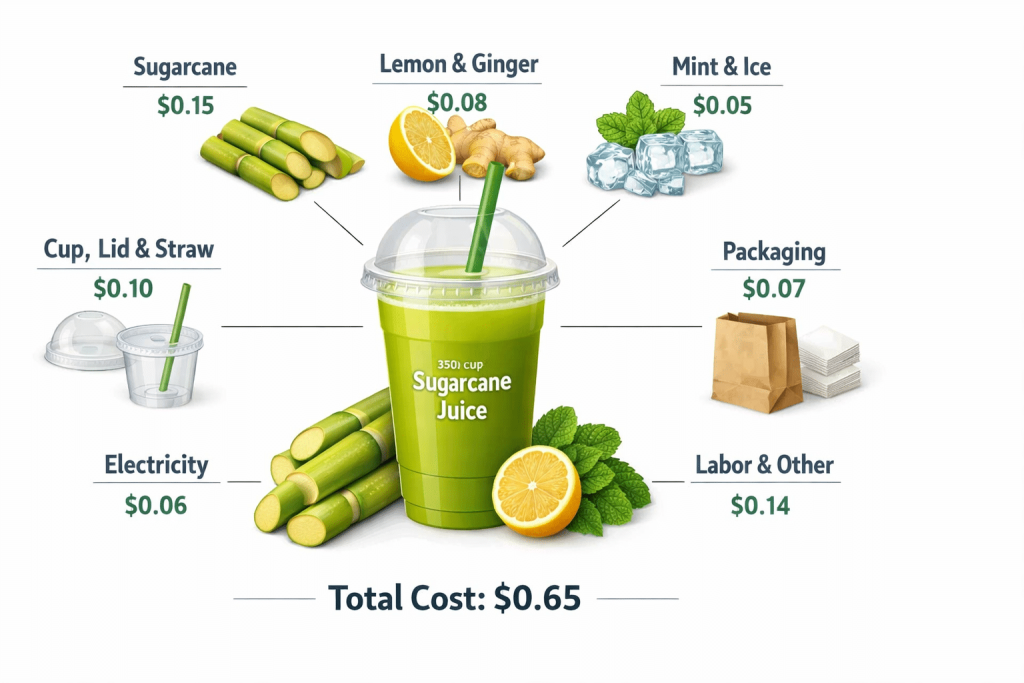
To determine the true cost of a standard 350ml (12oz) serving, we must aggregate all direct variable costs. Below is a representative breakdown based on typical global market averages. Operators should adjust these figures based on local supplier rates.
Raw Ingredients
- Sugarcane: Assuming a 350ml serving requires roughly 0.5kg of raw cane (at 70% yield).
- Additives: Cost of lemon, ginger, or mint often added for flavor balance.
- Ice: If serving over ice, the liquid volume decreases, lowering the cane cost, but the ice production cost must be added.
Packaging (Consumables)
Never overlook the vessel. In premium markets, the packaging is part of the value proposition.
- Cup (PET/PLA/Paper): $0.05 – $0.15
- Lid/Sealing Film: $0.02 – $0.05
- Straw: $0.01 – $0.03
Electricity & Utilities
Commercial sugarcane machines usually range from 400W to 800W. Even at high commercial electricity rates, the cost per cup is negligible but should be tracked.
- Example: An 800W machine running for 1 hour consumes 0.8 kWh. If electricity is $0.15/kWh, the hourly cost is $0.12. If that machine produces 120 cups per hour, the electricity cost is $0.001 per cup.
3. Labor and Operational Efficiency
Labor is often a fixed cost (hourly wages), but for profitability modeling, it helps to view it as a variable cost per unit based on throughput.
If an employee is paid $15/hour and can prep, press, and serve 30 cups an hour, the labor cost is $0.50 per cup. Increasing throughput via faster machines or automated feeding systems directly reduces this cost. High-efficiency machines that require only one pass (rather than multiple feeds) significantly reduce operator time.
4. Profitability Scenario: The 350ml Cup
The following table illustrates a hypothetical cost structure for a standard serving in a mid-range commercial setting.
| Cost Component | Estimated Cost (USD) | Notes |
|---|---|---|
| Raw Sugarcane (0.5kg) | $0.25 | Based on $0.50/kg bulk price |
| Flavor (Lemon/Ginger) | $0.05 | Optional but recommended |
| Cup, Lid, Straw | $0.12 | Standard clear PET cup |
| Electricity | $0.01 | Negligible per unit |
| Total Material Cost | $0.43 | Excluding Labor |
| Labor (Allocated) | $0.40 | Varies by volume |
| Total Cost Per Cup | $0.83 | |
| Average Selling Price | $4.00 – $6.00 | Premium market pricing |
| Gross Profit Margin | ~80% – 85% | Depending on pricing strategy |
5. Hidden Costs: Maintenance and Depreciation
While the gross margin on sugarcane juice is impressive, net profit calculations must account for equipment longevity.
Machine Depreciation
A high-quality stainless steel press is an asset. If a machine costs $2,500 and has a lifespan of 5 years (producing 100,000 cups), the depreciation cost is $0.025 per cup. Cheaper machines may have a lower upfront cost but fail sooner, increasing the depreciation cost per cup and risking downtime revenue loss.
Waste Management
Sugarcane bagasse (the fibrous waste) is voluminous. Disposal logistics or composting arrangements can incur costs in urban environments. However, some operators monetize this by selling bagasse as animal feed or fertilizer.
6. Pricing Strategy for B2B Clients
Once the baseline cost is established ($0.83 in our example), pricing should be determined by market positioning rather than a simple markup.
- Volume Strategy: Lower price ($3.00) to maximize throughput in high-traffic areas (malls, transit hubs).
- Premium Strategy: Higher price ($6.00+) for organic cane, glass bottle packaging, or boutique cafe settings.
Understanding the break-even point is critical. If your fixed monthly overhead (rent, insurance) is $2,000, and your profit per cup is $3.17 ($4.00 price – $0.83 cost), you need to sell approximately 631 cups per month (or ~21 cups per day) to break even.
Frequently Asked Questions
How does machine efficiency affect the cost per cup?
A machine with higher extraction efficiency (e.g., 80% vs. 60%) reduces raw material waste. Over a year, a 20% difference in juice yield can amount to thousands of dollars in saved sugarcane costs.
Should I factor in cleaning time?
Yes. Machines that are difficult to clean increase labor hours at the start and end of shifts. Look for designs with removable rollers or easy-flush systems to minimize non-productive labor costs.
Is it better to buy pre-peeled cane or peel it on-site?
Pre-peeled cane costs more per kg but significantly reduces labor and prep time. For high-volume kiosks with limited staff, the higher material cost is often offset by the reduction in labor and faster service times.
What is the typical ROI for a commercial sugarcane machine?
Due to the high margins (often exceeding 80%), many operators see a return on investment (ROI) on the equipment within 2 to 4 months, depending on daily volume.
Conclusion
Profitability in the juice business is not just about sales volume; it is about rigorous cost control. By analyzing the cost per cup down to the cent—factoring in yield, consumables, and labor—operators can set prices that ensure sustainability and growth. The choice of equipment plays a pivotal role here; a reliable, high-yield machine is an investment in lower long-term operating costs.
Ready to optimize your juice business margins? Contact us today to discuss high-efficiency extraction equipment tailored to your volume requirements.