
Table of Contents
- Quick Answer: How to Choose Between the Two Models
- What This Sugarcane Juicer Comparison Should Cover
- Match the Machine to Your Daily Workflow
- Compare the Supplied Configuration, Not Just the Model Name
- Check Site, Counter and Utility Requirements
- Plan Cane Preparation and Juice Service Together
- Cleaning, Training and After-Sales Support
- A Practical Buying Checklist
- Making the Final Decision
The right choice between the TiniForce S3 and EasiDeMax S4 depends on your service volume, cane preparation process, counter space, cleaning routine and local electrical requirements. Compare the actual supplied configurations before buying rather than relying on model names alone.
Quick Answer: How to Choose Between the Two Models
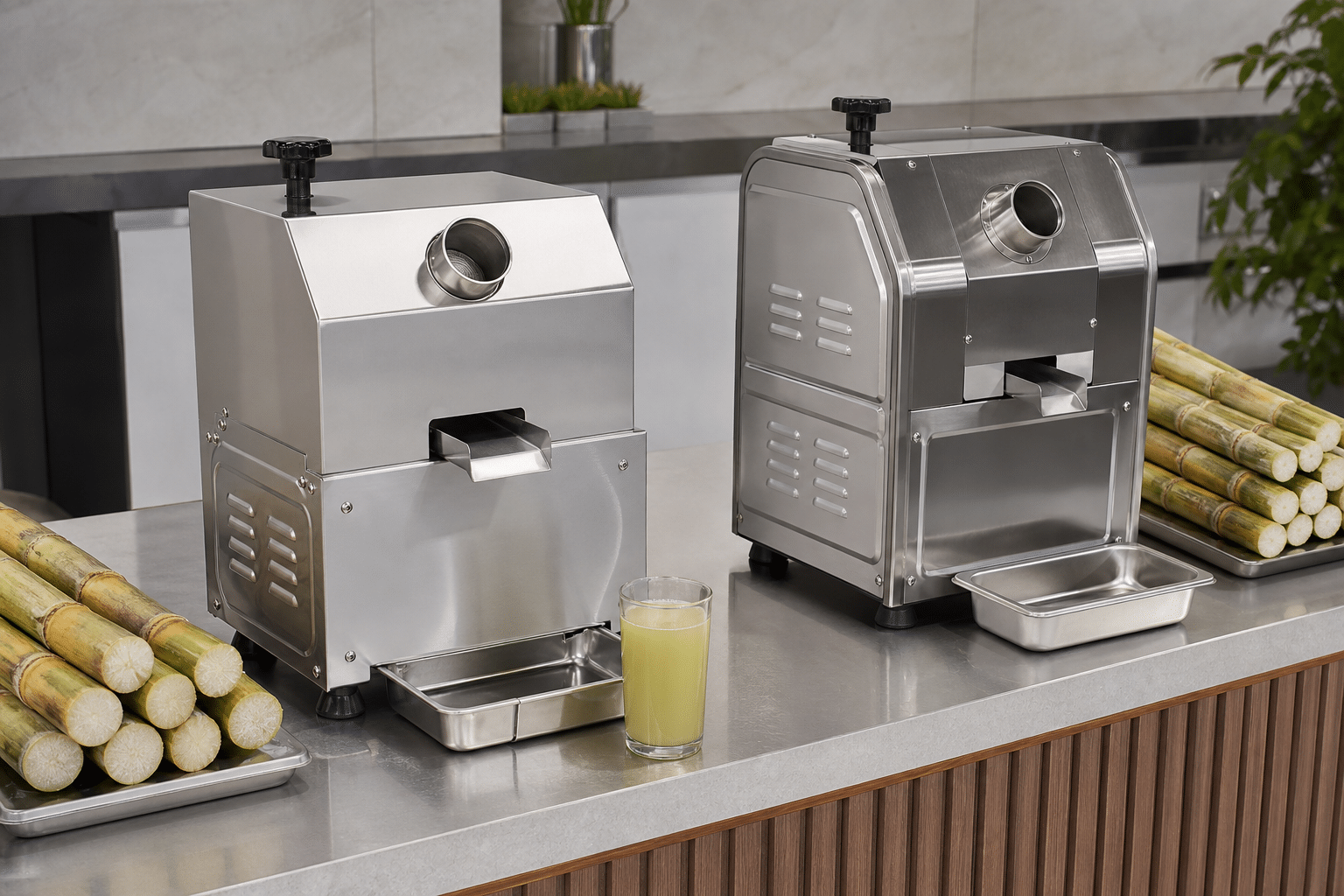
Choose the TiniForce S3 or EasiDeMax S4 only after matching the supplied machine configuration to your actual service conditions. For a lower-volume counter, a compact workflow and straightforward staff operation may be the main priorities. For a busier outlet, the better fit may be the machine configuration that supports your intended service pace, cane size, operator routine and cleaning schedule.
A model name alone does not confirm every purchasing detail. Motor specification, electrical requirement, dimensions, roller arrangement, guards, included accessories and regional configuration can vary by version or market. Ask for the current product specification, dimensional drawing, electrical details and operating documentation for the exact unit being quoted.
In this sugarcane juicer comparison, the most useful question is not simply, “Which model is better?” It is, “Which machine can our team operate, clean and support reliably in our own location?” A good answer considers daily demand, counter layout, cane preparation, local food-service rules and access to service parts.
What This Sugarcane Juicer Comparison Should Cover
Both the TiniForce S3 and EasiDeMax S4 should be assessed as commercial sugarcane crushing equipment: machines designed to press prepared cane and collect fresh juice for immediate service or a controlled downstream process. They are not general-purpose fruit juicers. Their suitability depends on how cane enters the machine, how operators manage feeding and collection, and how the machine is cleaned between service periods.
For a fair comparison, avoid reducing the decision to a single headline figure. A machine that appears suitable on paper can still be a poor operational fit if the counter is too shallow, the available power supply is incorrect, the cane is not prepared consistently, or the outlet has no practical wash-up procedure. Conversely, a configuration that looks more substantial than your present need can create unnecessary cost, space pressure or training complexity.
Compare the TiniForce S3 and EasiDeMax S4 against the same written brief: expected demand by time period, cane length and diameter range, number of operators, available preparation space, juice serving method, cleaning access and local utility conditions. This makes supplier quotations easier to evaluate and reduces assumptions before installation.
Match the Machine to Your Daily Workflow
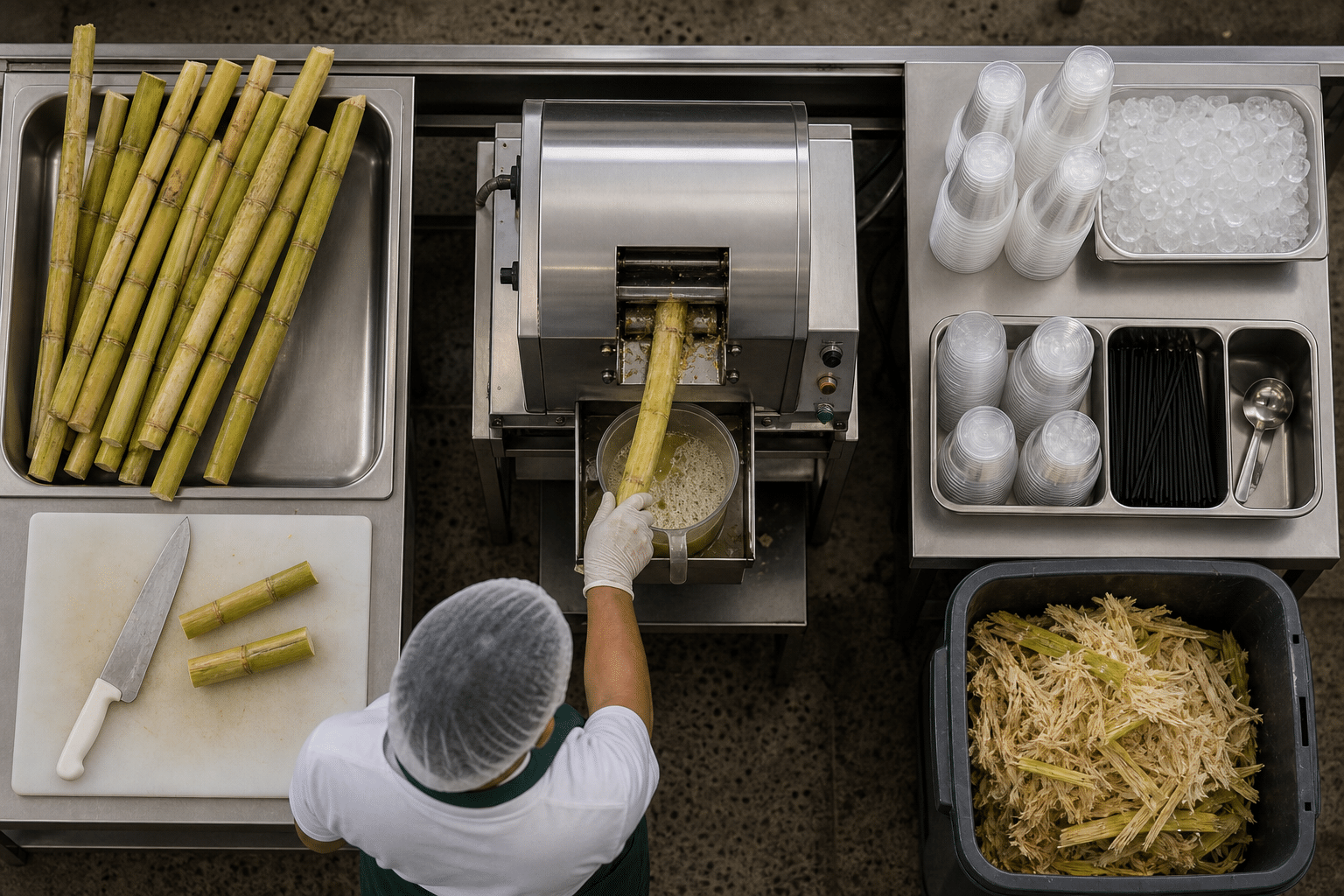
Start with demand patterns rather than estimated total sales. A kiosk with steady daytime orders places different demands on a machine than a market stall that experiences short, intense queues. Record your busiest 15- to 30-minute periods, not only your average day. Then consider whether one operator will prepare cane, crush it, handle payment and serve drinks, or whether those tasks will be shared.
For the TiniForce S3 and EasiDeMax S4, ask the supplier to explain the intended operating sequence for the precise configuration offered. Confirm the recommended cane preparation, feeding approach, pass arrangement where applicable, juice collection method, stopping procedure and daily cleaning process. This reveals whether the equipment fits your staff workflow.
A smaller operation often benefits from a simple, repeatable process: wash and trim cane in a separate prep area, keep only a manageable quantity at the service counter, crush to order and clean the food-contact areas at the required intervals. A high-traffic operation may need a more deliberate division of work, with prepared cane held in a suitable food-safe manner and one team member focused on operating the machine.
Do not plan service around a machine running continuously without breaks for wiping, checking and safe cane handling. Build these steps into the operating standard. The aim is consistent service, not an unrealistic theoretical pace.
Compare the Supplied Configuration, Not Just the Model Name
Request like-for-like quotation details for both models. This is the most important step in a commercial sugarcane juicer comparison because the usable machine is the delivered configuration, not the name used in a brochure or conversation.
Use the following questions when reviewing TiniForce S3 and EasiDeMax S4 proposals:
- Electrical compatibility: What voltage, frequency, plug or hard-wiring arrangement is quoted? Does it match the site supply and local installation rules?
- Physical dimensions: What are the machine width, depth, height and required clearance? Include room for feeding cane, removing residues and cleaning.
- Food-contact and cleaning access: Which components contact juice or cane? Which parts can be removed or accessed for washing under the documented procedure?
- Operating controls and safety guarding: What controls, guards and emergency-stop arrangements are supplied on the quoted version? Operators should understand their intended use before service begins.
- Cane acceptance: What preparation is recommended for the cane you source? Confirm this with samples or representative measurements where possible.
- Included items: Check the scope of supply, such as collection containers, tools, consumable items, manuals and any optional accessories. Do not assume these are identical across quotations.
- Support scope: Ask what installation guidance, remote troubleshooting, spare-parts availability and warranty terms apply in your market.
If one quotation provides more complete documentation, clearer operating guidance and better alignment with your site, that operational certainty can be more valuable than a small initial price difference.
Check Site, Counter and Utility Requirements
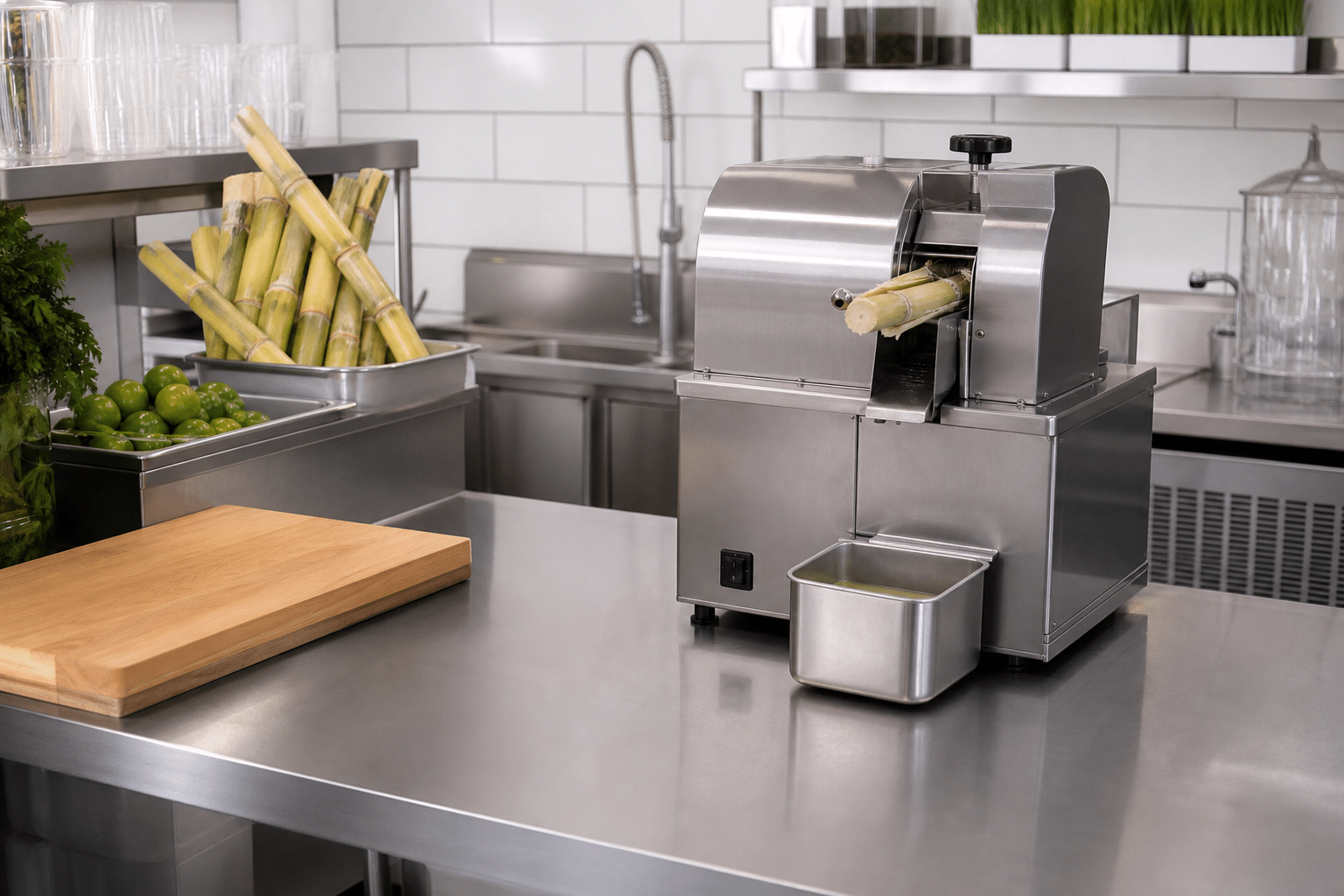
Machine choice should be confirmed against the physical site. Begin with a scaled plan of the work area, including counters, hand-wash facilities, sinks, refrigerators, drains, service windows and staff routes. A sugarcane juicer needs more than a place to stand: it needs practical access for cane loading, juice handling, cleaning and maintenance.
Leave enough clear working space around the unit for the operator to feed cane safely and remove pressed cane material without reaching awkwardly across the machine. Think through where whole cane arrives, where it is washed and cut, where prepared pieces wait, and how residues move to a waste container. These movements should not cross unnecessarily with clean cups, ice or finished drinks.
Confirm the electrical supply with a qualified local professional where required. Do not use an unapproved voltage conversion method or an extension arrangement that is unsuitable for commercial equipment. The machine’s quoted electrical information should be checked before shipping and again before commissioning.
Also assess the counter material and load-bearing capacity, ventilation around the workspace, lighting for cleaning inspection and access to water for the documented sanitation routine. Requirements differ by country and premises type, so local food-service and electrical rules take priority.
Plan Cane Preparation and Juice Service Together
Neither model can compensate for inconsistent raw material preparation. Cane may vary by variety, growing region, storage condition, diameter, fibrousness and straightness. Before selecting a machine, document the cane you expect to use and ask whether the supplier recommends a specific cutting or preparation method for the quoted model.
Use clean, sound cane from a controlled supplier. Establish a receiving check for visible damage, excessive dirt and deterioration. Your preparation team should follow a defined procedure for washing, trimming and cutting according to your local food-safety plan and the machine instructions. Do not force oversized, badly bent or unsuitable pieces into a feed opening.
Extraction approach also affects the workflow. Some operations may use a single pass while others may use more than one pass according to the equipment instructions and their commercial process. The relevant choice is not simply which method sounds more productive; it is whether the method is repeatable, hygienic and realistic during a queue. Review the practical differences in single-pass and multi-pass sugarcane crushing when setting your service standard.
Fresh cane juice is a perishable beverage. If you plan to hold, bottle or transport juice rather than serve it immediately, develop the process with appropriate local food-safety advice. Machine selection is only one part of that wider production system.
Cleaning, Training and After-Sales Support
For daily-use equipment, cleaning access and operator discipline often have as much influence on long-term usability as the purchase specification. Include cleaning in the comparison from the first conversation. Ask each supplier how the quoted TiniForce S3 and EasiDeMax S4 units are shut down, which areas are cleaned during service, which components require end-of-day attention, and which tools or materials are recommended.
Set clear responsibility for the routine. A practical cleaning schedule normally identifies who performs each task, when it is done, how it is verified and where the procedure is recorded. Follow the official machine instructions and your local hygiene requirements. Disconnect or isolate equipment as instructed before cleaning, and never put hands or tools into moving or energized machine areas.
Staff training should cover more than starting the machine. Operators need to know safe feeding practices, what type of cane should not be processed, when to stop work, how to respond to an abnormal sound or obstruction, and how to report a maintenance issue. Supervisors should retain the applicable manual and supplier contact information at the site.
Before ordering, ask about the route for technical support and replacement parts in your sales region. A well-documented parts identification process, responsive communication and a sensible preventive-maintenance routine help reduce avoidable disruption.
A Practical Buying Checklist
Use this checklist to make the TiniForce S3 versus EasiDeMax S4 decision more objective:
- Describe your peak service periods and expected operating days.
- Measure the full work zone, not only the empty counter surface.
- Confirm local voltage, frequency, plug type and installation requirements.
- Provide representative cane dimensions and explain how cane will be washed, trimmed and cut.
- Request the current specification sheet and dimensional drawing for each quoted model.
- Clarify the exact scope of supply, including accessories, tools, documents and optional items.
- Review the feeding, stopping, residue-handling and cleaning steps with the people who will operate the unit.
- Confirm support contacts, spare-parts procedures and warranty terms for your destination market.
- Check that your planned juice handling and storage process meets local food-service requirements.
- Keep a written record of assumptions used to select the machine.
This approach protects against an avoidable mismatch. It also gives purchasing, operations and site teams one shared basis for approving the equipment.
Making the Final Decision
The best outcome from this sugarcane juicer comparison is a machine that fits your operational reality. Select the TiniForce S3 if its confirmed configuration, physical footprint, operating procedure and support arrangement align most closely with your outlet. Select the EasiDeMax S4 if its confirmed configuration is the stronger match for the same criteria. Do not treat a model number as proof of suitability without reviewing the current quotation and documentation.
For buyers planning a fleet, private-label programme or market-specific configuration, discuss the commercial requirements early. Topics such as electrical versions, documentation, branding, packaging and after-sales planning are easier to address before production and shipment arrangements are finalised.
A careful pre-purchase comparison helps create a safer, cleaner and more manageable juice operation from the first day of service.