
The Shift Toward Natural Sweeteners in Commercial Baking
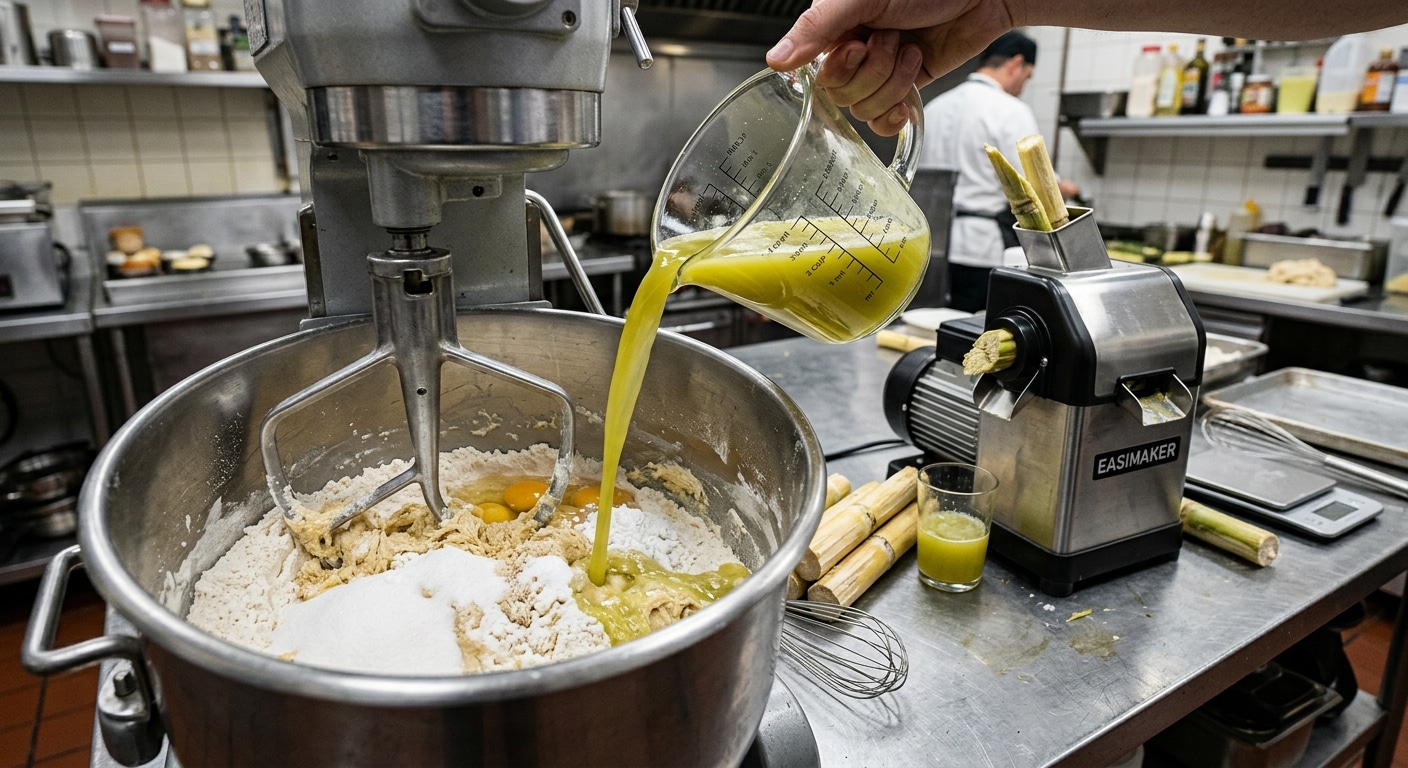
Clean-label initiatives are reshaping the commercial bakery sector. Consumers increasingly scrutinize ingredient lists, driving demand for natural, unrefined alternatives to highly processed white sugar. For commercial bakers and pastry chefs, substituting refined sugar with fresh sugarcane juice offers a dual advantage: it meets consumer demand for natural ingredients while introducing unique, complex flavor profiles to baked goods.
However, transitioning from a dry, crystalline sweetener to a fresh, liquid ingredient requires precise formula adjustments. This guide explores the technical considerations of using fresh sugarcane juice in large-scale baking, focusing on moisture control, flavor pairing, and the electric extraction equipment necessary for on-site processing.
Understanding Fresh Sugarcane Juice in Culinary Applications
Fresh sugarcane juice is the raw, unpasteurized liquid extracted directly from sugarcane stalks. Unlike molasses or refined cane syrup, which undergo extensive boiling and clarification, fresh juice retains its natural grassy notes, vitamins, and a lighter, more delicate sweetness.
Brix and Sugar Concentration
In commercial baking, consistency is critical. Fresh sugarcane juice typically has a Brix level (sugar content) ranging from 15% to 22%, depending on the cane variety, growing region, and harvest time. Because the remaining 78% to 85% is water, bakers must account for this significant liquid volume when reformulating recipes.
Technical Factor 1: Moisture Adjustment and Hydration
Replacing a dry ingredient with a liquid requires recalculating the entire hydration percentage of the dough or batter. Failing to adjust for the water content in sugarcane juice will result in compromised crumb structure, extended bake times, and potential product spoilage.
Recalculating Formulas
- Direct Substitution Challenges: If a recipe calls for 1,000 grams of granulated sugar, replacing it with fresh juice to achieve the exact same sweetness level would introduce an excessive amount of water.
- Hydration Compensation: To balance the formula, bakers must reduce other liquids in the recipe (such as water, milk, or eggs) by the exact volume of water introduced by the sugarcane juice.
- Creating a Fresh Syrup: For recipes with low hydration requirements (like cookies or dense pastries), bakers often gently reduce the fresh sugarcane juice over low heat to create a concentrated fresh syrup. This lowers the water content while preserving the natural flavor profile, making it easier to integrate into standard formulas.
Technical Factor 2: Flavor Profiles and Product Pairing
Refined sugar provides a neutral sweetness. In contrast, fresh sugarcane juice introduces a distinct flavor profile that can elevate artisan baked goods.
Tasting Notes
Fresh juice imparts earthy, slightly grassy, and mild vanilla-like undertones. When baked, it contributes to a richer, more nuanced Maillard reaction, resulting in a deeper, more appealing crust color.
Ideal Bakery Applications
- Artisan Breads and Sourdoughs: The natural sugars provide excellent food for wild yeast, accelerating fermentation while adding a subtle sweetness that balances sourdough tang.
- Whole Grain and Rye Goods: The earthy notes of the juice complement the robust flavors of whole wheat, rye, and spelt flours.
- Gingerbreads and Spiced Cakes: Acts as a lighter, fresher alternative to dark molasses, allowing the spices to remain the focal point.
- Vegan Pastries: Serves as a premium, plant-based sweetener that appeals to health-conscious consumers.
Technical Factor 3: Equipment and On-Site Processing
To utilize fresh sugarcane juice at a commercial scale, bakeries must integrate efficient processing equipment into their operations. Sourcing pre-bottled juice often means dealing with pasteurization, which alters the fresh flavor profile and degrades natural enzymes. On-site extraction is the preferred method for maintaining quality.
Choosing the Right Commercial Sugarcane Juicer
For high-volume bakery environments, manual extraction is entirely impractical. Facilities require robust, electric sugarcane juicers capable of continuous operation.
- Electric Operation: Essential for processing hundreds of kilograms of cane per hour without operator fatigue.
- High Extraction Efficiency: Top-tier electric juicers utilize multi-roller systems to extract maximum liquid in a single pass, ensuring high yield and minimizing waste.
- Food-Grade Materials: All contact parts must be constructed from 304 or 316 stainless steel to comply with commercial food safety regulations and resist the natural acidity of the juice.
- Ease of Cleaning: Bakery environments demand strict sanitation. Look for equipment with removable rollers and accessible internal components to prevent bacterial growth and cross-contamination.
Comparing Sweetener Options
| Feature | Refined Granulated Sugar | Fresh Sugarcane Juice |
|---|---|---|
| Moisture Content | < 0.5% | 78% – 85% |
| Flavor Profile | Neutral, pure sweetness | Earthy, grassy, complex |
| Label Appeal | Standard / Highly processed | Premium / Clean label / Natural |
| Processing Needs | Ready to use | Requires electric extraction equipment |
| Crumb Impact | Standard aeration and structure | Requires hydration adjustment; denser crumb if not reduced |
Buying Guide: Sourcing and Implementation
Implementing fresh sugarcane juice into a commercial bakery involves strategic sourcing and capital investment.
- Sourcing Raw Cane: Establish a reliable supply chain with local or regional agricultural distributors. Cane should be processed shortly after harvest to prevent fermentation within the stalk.
- Equipment Investment: Select an electric juicer sized for your production volume. Consider the footprint, power requirements (e.g., 220V/380V for industrial units), and warranty support.
- R&D and Sampling: Before rolling out a new product line, conduct small-batch testing to monitor fermentation rates, bake times, and shelf-life stability. The natural enzymes in fresh juice can alter yeast activity, requiring adjustments to proofing schedules.
Frequently Asked Questions (FAQs)
1. Does fresh sugarcane juice affect yeast fermentation?
Yes. The unrefined sugars and natural enzymes in fresh sugarcane juice are highly bioavailable to yeast. Bakers often notice a more vigorous and rapid fermentation process, which may require shortening proofing times or slightly reducing the yeast quantity in the formula.
2. How long does fresh sugarcane juice last before baking?
Fresh, unpasteurized sugarcane juice ferments quickly. In a commercial setting, it should be extracted and used within a few hours, or immediately refrigerated at temperatures below 4°C (39°F) for up to 24 hours. For longer storage, it must be reduced into a syrup or frozen.
3. Can I use manual juicers for a commercial bakery?
No. Manual juicers lack the throughput, pressure, and efficiency required for commercial volumes. An electric, multi-roller sugarcane juicer is mandatory for processing the quantities needed in large-scale baking while maintaining labor efficiency.
4. Will sugarcane juice change the color of my baked goods?
Yes. Because it contains natural molasses and complex sugars, products baked with fresh sugarcane juice will undergo a more intense Maillard reaction, resulting in a darker, richer crust color compared to those baked with refined white sugar.
5. How do I measure the sugar content of the fresh juice?
Commercial bakers should use a digital or optical refractometer to measure the Brix level of each batch of extracted juice. This ensures consistency in sweetness and allows for precise formula hydration adjustments from batch to batch.
Take Your Bakery’s Offerings to the Next Level
Transitioning to natural sweeteners like fresh sugarcane juice can set your bakery apart in a crowded, health-conscious market. By mastering moisture adjustments and utilizing the right electric extraction equipment, you can deliver exceptional, clean-label products with unforgettable flavor profiles.
Ready to upgrade your commercial kitchen with reliable, high-yield extraction technology? Request a quote / Get a sample today to learn more about our industrial electric sugarcane processing solutions.